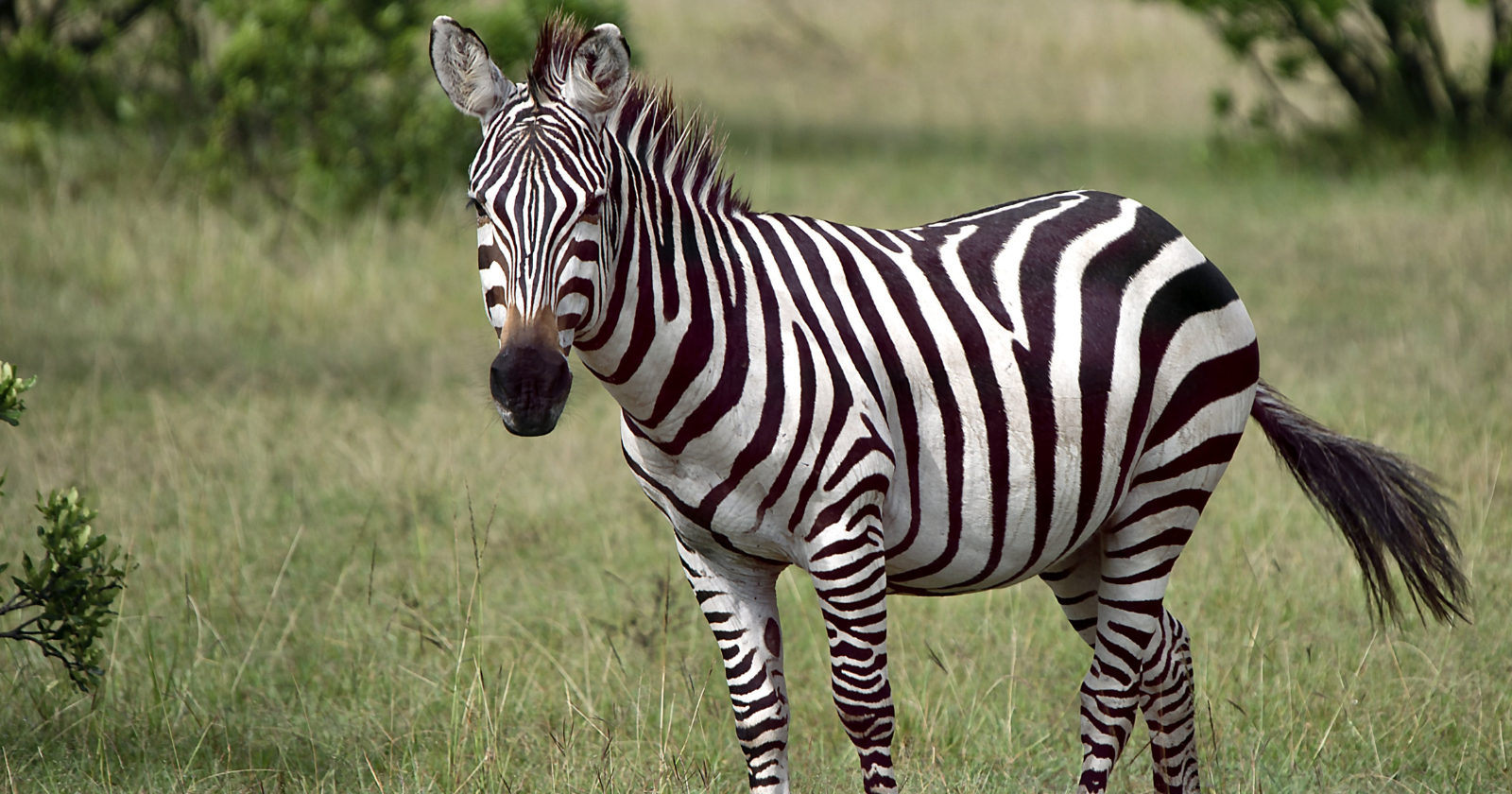
For most of the history of evolutionary biology, nobody has really known why zebras have stripes.
This is not for lack of trying. The specific pattern is one of the most obviously puzzling features of any mammal on Earth — vivid, symmetrical, apparently costly to maintain, and completely useless for the sort of things stripes usually do in nature. Camouflage against savanna vegetation, the most intuitive explanation, does not work: zebras are actually strikingly visible at the distances at which lions and hyenas hunt them. So biologists have proposed alternative after alternative. Thermoregulation. Social recognition. Confusing predators during the chase.
One by one, most of these theories have quietly collapsed. And in 2019, a group of Japanese agricultural researchers painted six black cows with white stripes and pushed the last remaining serious candidate a step closer to being accepted.
The cow experiment
The study was led by Tomoki Kojima at the Aichi Agricultural Research Center in central Japan, and published in PLOS ONE in October 2019.
The design was clean. Six Japanese Black cows — a breed that is naturally uniformly dark — were assigned to three treatments using a Latin-square rotation: painted with black-and-white zebra stripes, painted with black-only stripes (to control for any effect of the paint itself), or left unpainted. The cows spent time in each treatment on natural pasture where biting flies were abundant. Researchers photographed the animals at regular intervals and counted the number of flies visible on their bodies in each image.
The results were direct. Cows in the zebra-stripe condition attracted approximately half as many biting flies as the same animals when unpainted or when painted with black-only stripes. The cows also showed substantially fewer fly-repelling behaviours — the head throws, ear beats, leg stamps, skin twitches, and tail flicks that cattle use to shake off biting insects. They were, measurably, being bothered less.
The specific paint pattern did the work. The stripes were doing something.
What the stripes are actually doing to the flies
The current best explanation for the effect involves the specific visual mechanics of how biting flies land.
Flies do not simply fly straight at a target. In the final approach, they rely on optical flow — the way visual patterns move across their compound eyes as they close in — to judge distance, speed, and the precise moment to slow down for landing. Uniform surfaces produce smooth optical flow. Striped surfaces produce something the fly’s visual system cannot interpret cleanly. The alternating light and dark bands create false movement signals, disrupting the fly’s ability to gauge how close it actually is to the surface.
The result is that flies approach striped surfaces at the wrong speed, often overshooting or bumping off without properly landing. Over the course of an afternoon in a fly-heavy pasture, this small optical mismatch adds up to a substantial reduction in successful landings.
None of this requires the fly to be repelled by the stripes in any active sense. It just requires the stripes to make landing physically harder.
What used to be believed
The insect-deterrent theory has taken decades to reach its current standing, because it has spent most of that time competing with three other serious explanations that biologists once found more plausible.
Camouflage was the obvious first guess — the idea that vertical stripes might break up the zebra’s outline against tall grass, or match the pattern of trees at dawn and dusk. It was tested repeatedly across the twentieth century. It did not survive. Zebra stripes do not reduce visibility to lions or hyenas at their normal hunting distances. At close range, zebras stand out even more against savanna vegetation than uniformly-coloured antelopes.
Thermoregulation was another leading candidate. Some researchers proposed that the alternating light and dark bands might set up small convection currents across the zebra’s skin, cooling the animal in the sun. A 2018 study by Gabor Horvath and colleagues, published in Scientific Reports, tested this directly using metal barrels covered in different patterns. Zebra stripes did not cool the barrels. The thermoregulation theory is now widely considered unsupported.
Predator confusion — the idea that a herd of zebras in motion produces a visually chaotic pattern that makes it hard for a predator to pick out a single target — has held up somewhat better, but has been shown in controlled studies to have only modest effects.
Meanwhile, throughout the same period, evidence was accumulating for the insect-deterrent hypothesis. Tim Caro at the University of California Davis showed in 2014 that stripe patterns across equid species correlate strongly with the geographic distribution of biting flies. Species and subspecies of horses and zebras from fly-rich regions are more heavily striped than those from fly-poor regions. In 2019, Caro and colleagues put striped and plain coats on live horses and directly observed reduced biting-fly attacks on the striped coats.
The Japanese cow experiment was the next step. It tested the hypothesis on an animal that never evolved the pattern at all, and got the same result.
Why one experiment doesn’t settle a theory
None of this means the zebra stripe question is now closed.
Evolution rarely produces features for a single reason. It is entirely possible that the ancestral zebra population had multiple selection pressures — flies, predators, heat management, social signalling — pushing in the same direction, and that the modern stripe pattern reflects the accumulated influence of all of them. Isolating one factor as the explanation is a specific kind of scientific overreach that most working evolutionary biologists are careful to avoid.
What the cow experiment does is make one specific claim more difficult to argue against. If painting stripes on a plain black animal halves the flies that land on it, then stripes have a demonstrable insect-deterrent effect that operates independently of anything else about the animal wearing them. Whatever else zebras evolved their stripes for — if anything else — the flies were probably part of it.
What is happening in a Japanese pasture right now
The Aichi Agricultural Research Center is currently exploring whether the practical technique can be scaled up.
The idea is not academic. Biting flies cause substantial losses in the global cattle industry, reducing weight gain in beef cattle and milk yields in dairy cows. Insecticide use to control them contributes to environmental contamination and drives resistance in fly populations. If painted stripes can reduce fly landings by 50 percent without any chemical involvement, the implications for animal welfare and pesticide reduction are genuine.
The team’s original paint job wore off within a few days and had to be reapplied. Researchers are now working on longer-lasting formulations. Somewhere in central Japan, at any given moment, there is now a small pasture with several confused-looking cattle in poorly-drawn white stripes, quietly participating in an experiment that has, over the past decade, closed off most of the alternative theories about why zebras look the way they do.