

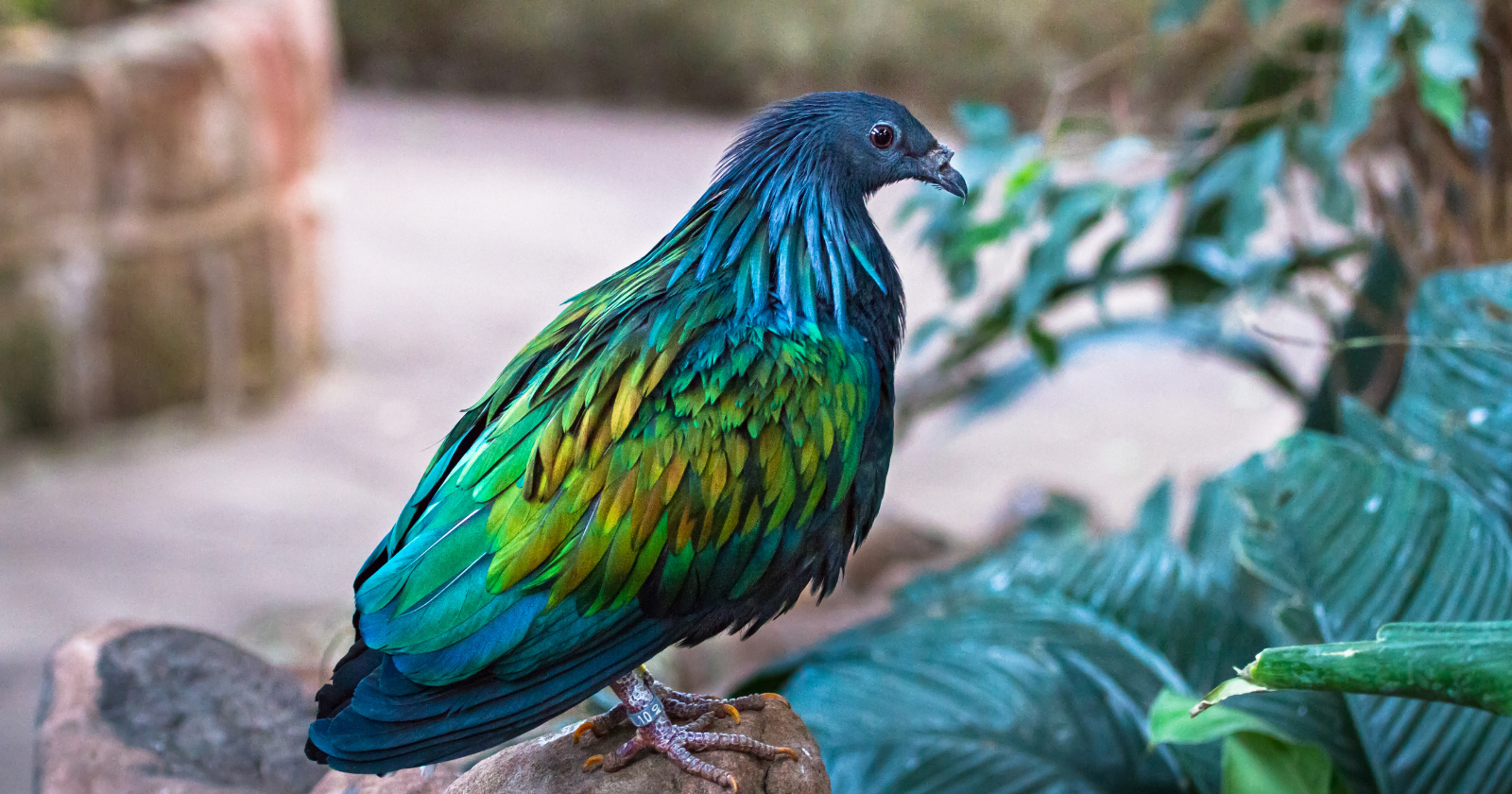
Walk into the tropical bird house at almost any large zoo and you may pass it without a second look. A stocky, dark pigeon about the length of a ruler, with a curtain of iridescent green and copper feathers hanging from its neck and a stubby white tail. It pecks at fallen fruit, keeps to the shadows and generally minds its own business.
That bird is a Nicobar pigeon, and it is the nearest living thing on Earth to a dodo.
A pigeon that hides in plain sight
The Nicobar pigeon (Caloenas nicobarica) is named for the Nicobar Islands in the Bay of Bengal, but its range runs east across the Malay Archipelago and out into the Pacific as far as the Solomon Islands and Palau. It weighs a little under a pound, roughly 16 inches long, and spends most of its day on the forest floor of small offshore islets, turning over leaf litter for seeds and fallen fruit.
What sets it apart from other pigeons is how it lives. It is nomadic, moving between islands in flocks of up to 85 birds and flying over open water to reach places where food is available. That habit of hopping from island to island is the key to the whole story, because it is almost certainly how a distant ancestor of this bird ended up on a volcanic speck 3,000 miles to the west.
The genetic evidence
For most of the 20th century, nobody was quite sure what the dodo was. It had been drawn as a fat, comical, vaguely turkey-like thing, and various naturalists filed it alongside ostriches, rails and even vultures. The pigeon connection was suspected from skull anatomy as early as the 1840s but remained contested.
That changed in 2002, when a team led by Beth Shapiro at Oxford extracted mitochondrial DNA from a dodo specimen held at the Oxford University Museum of Natural History and published the results in Science. The dodo sat firmly inside the pigeon family. Its closest relative of all was the Rodrigues solitaire, another giant flightless bird from a neighboring island that vanished in the 1700s. Both were extinct. The nearest living branch on the tree was the Nicobar pigeon.
A full nuclear genome sequenced from a Copenhagen specimen in 2022 confirmed the result. Of every bird alive today, the Nicobar pigeon shares the most recent common ancestor with the dodo.
An island rises, and a bird finds it
Mauritius did not exist for most of Earth’s history. It was pushed up out of the Indian Ocean by volcanic activity roughly eight million years ago, part of a chain of hotspot islands that also includes Réunion and Rodrigues. When it broke the surface it was bare rock, and everything that lives there today either arrived by air, by sea, or was carried in.
At some point in the millions of years that followed, a pigeon from the Caloenas lineage arrived. Perhaps a flock got blown off course in a storm, perhaps a few birds island-hopped down the chain of now-submerged seamounts. However they got there, they found a place with abundant fruit, no ground-dwelling mammals, no snakes and no predators of any kind capable of taking an adult bird.
What happens when nothing wants to eat you
Flight is expensive. Flight muscles burn energy, feathers need constant maintenance and the light, hollow bones a flying bird needs come at the cost of strength. Birds put up with all of that because the alternative is being eaten. Take the predators away and the math changes.
On island after island, birds that no longer need to escape anything have followed the same path: they get bigger, their wings shrink and their breastbones flatten because there is no longer a need to anchor powerful flight muscles. New Zealand’s kakapo, the Galápagos flightless cormorant and the Inaccessible Island rail all did it independently. So did the dodo.
The bird that arrived weighing about a pound became one that stood around three feet tall and weighed somewhere between 20 and 40 pounds, depending on which estimate you trust and the time of year. Its wings shrank to useless stubs. It nested on the ground, laid a single egg and, by every account of the sailors who met it, showed no fear of humans whatsoever. Why would it? Nothing had threatened it for millions of years.
The other side of the same coin
The dodo’s calm was its undoing. Dutch sailors reached Mauritius in 1598 and found the birds easy to catch and, according to some accounts, not especially good to eat, but that hardly mattered. What finished the species was what the sailors brought with them: rats, pigs, cats and monkeys that raided the ground nests and ate the eggs. The last reliable sighting was in 1662, less than a century after first contact.
The Nicobar pigeon, meanwhile, never gave up flight because it never had the chance to. It lives on small islands close to larger landmasses, and it moves between them constantly. There was always something to fly away from and somewhere to fly to. The genes that would let a bird settle down and grow into a dodo were still there, sitting quietly, but the conditions never arrived.
Why the pigeon matters now
That shared ancestry has made the Nicobar pigeon central to one of the most ambitious biology projects currently underway. Texas-based Colossal Biosciences, whose chief science officer is the same Beth Shapiro who ran the 2002 DNA study, has established a breeding colony of Nicobar pigeons and is using their embryos as the raw material for an attempt to engineer a bird that looks and behaves like a dodo. In March 2026 the company reported it had collected the first primordial germ cells from Nicobar embryos, publishing the work in the Journal of Heredity.
Whether a gene-edited pigeon in a chicken egg counts as a dodo is a fair question, and plenty of biologists have raised it. But the logic behind choosing this particular bird is sound. If you want to know what a dodo was before it landed on Mauritius, the closest you can get is a wary, glossy, entirely airworthy pigeon that still spends its days flying between islands, exactly as its cousin’s ancestors once did.
The Nicobar pigeon is listed as near threatened by the IUCN, squeezed by hunting, habitat loss and a proposed transshipment port on Great Nicobar. It would be a strange irony if the last living link to the dodo went the same way.