Insects have conquered almost everything. They live in deserts, glaciers, caves, hot springs and the fur of other animals. Around a million species crawl and fly across every continent. And yet the largest habitat on Earth, the open ocean, is almost completely empty of them.
The standard explanation, repeated in textbooks for decades, is pressure. Insects breathe through networks of air-filled tubes, and dive an insect deep enough, the argument goes, and the water squeezes those airways until they implode. The deep sea, on this view, is simply closed to any animal built around a bubble.
Nobody told the lake flies of Lake Malawi.
The commute
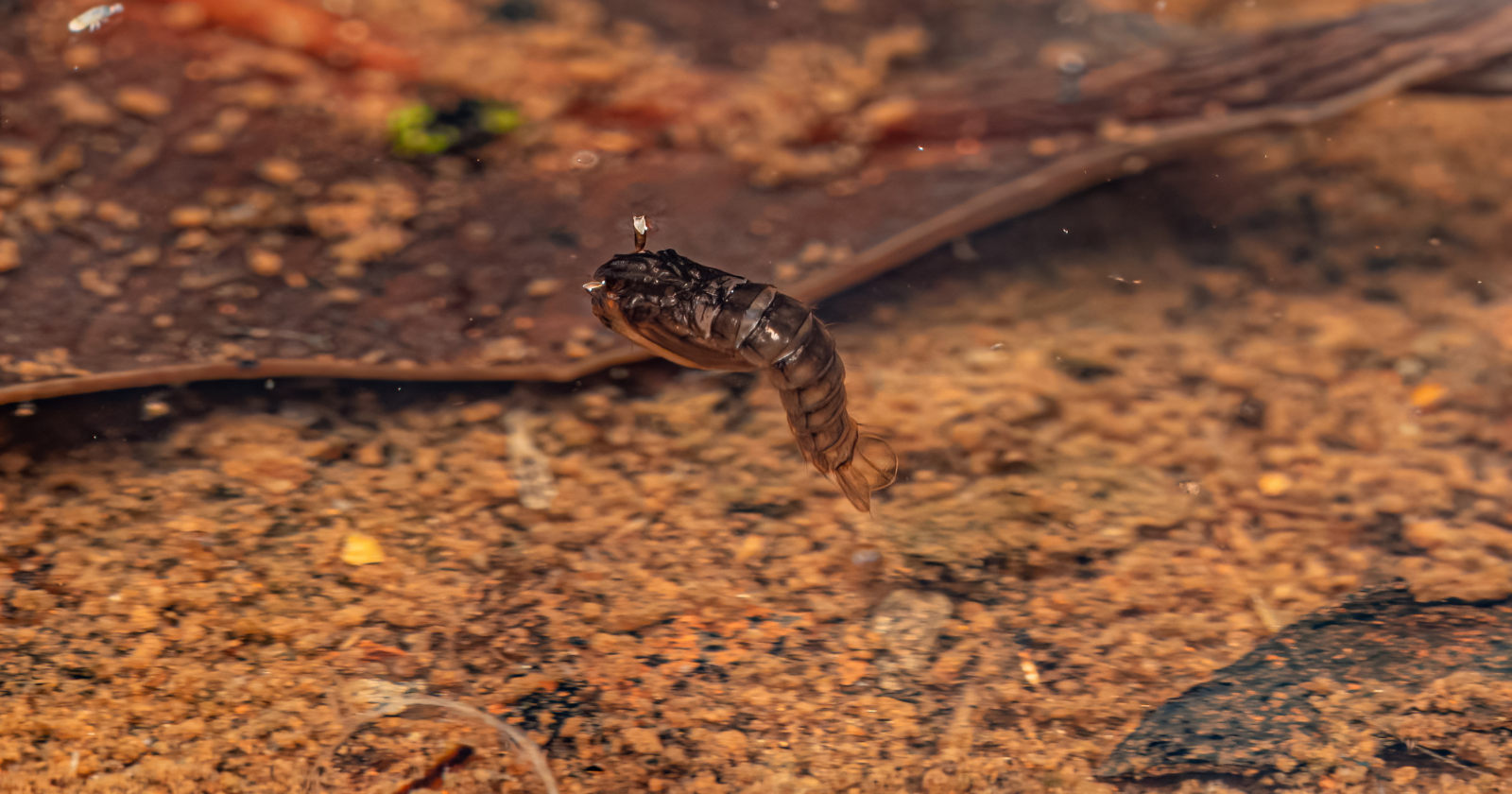
Lake Malawi, in East Africa, is one of the deepest lakes in the world, plunging past 700 metres. It is home to billions upon billions of the larvae of a midge called Chaoborus edulis, tiny transparent creatures that swarm so thickly that clouds of the adult flies rising off the lake look like smoke on the horizon.
Every day, those larvae make a commute that should be impossible. At night they hang in the surface waters, hunting zooplankton. At dawn, with hungry fish waking up around them, they sink, more than 200 metres down into the lake’s permanently oxygen-free depths, a dead zone where no fish can follow. They spend the day hiding in the dark, running their bodies without oxygen, and at dusk they rise again through a gauntlet of waiting mouths to feed.
A team led by researchers at the University of British Columbia sank a sonar unit to the lake floor to watch this migration happen, and published what they found in the journal Science in July. The larvae really do ride down past 200 metres, every day, carrying air with them the whole way.
Ballast tanks, not lungs
The trick is what the larvae did with their breathing system. Somewhere in their evolution, they repurposed it. Instead of using their tracheal system to breathe, C. edulis larvae absorb oxygen directly through their skin, and the air-filled parts have been remodelled into two pairs of small internal sacs that work like a submarine’s ballast tanks, controlling buoyancy rather than supplying air.
The walls of those sacs are the heart of the discovery. They are built with rings of resilin, a rubbery protein found across the insect world, wherever evolution needs a near-perfect elastic. Resilin is what powers a flea’s jump, storing and returning energy with almost no loss, and it is one of the most efficient elastic materials known in nature. In these air sacs, bands of resilin are set in stiffer cuticle like the folds of an accordion, and the larva can make the resilin swell or shrink by changing the pH of the sac wall. Sacs expand, the larva floats; sacs contract, it sinks. Depth control by chemistry.
Squeezed until they implode
That accordion structure turns out to be astonishingly strong. To find its limits, the researchers put larvae in miniature pressure chambers and turned up the pressure until the sacs finally failed. The sacs from Lake Malawi’s larvae held out to pressures equivalent to more than 400 metres of water, roughly double the depth of their daily dives, and in the biggest individuals close to half a kilometre.
For comparison, the team ran the same test on Chaoborus relatives from shallow lakes such as Lake Victoria. Their sacs gave out at far gentler pressures, exactly as habitat would predict. The Malawi species had evolved a genuinely deep-rated hull.
Senior author Philip Matthews, a zoologist at UBC, called the result a big surprise, and drew the conclusion plainly: pressure isn’t the barrier we thought it was to insects colonising the ocean.
So why is the ocean still empty?
Which deepens the original mystery rather than settling it. If an insect can build pressure-proof air sacs in a freshwater lake, physics alone cannot explain why the sea remains insect-free. Only a handful of sea-skater species live on the ocean at all, and they stay on the surface.
The surviving explanations are about competition and history rather than implosion. The ocean was already full of crustaceans, the insects’ relatives, occupying every niche an insect larva might want, from plankton to deep scavenger. Insects, which evolved on land, may simply have never found an open door. Salt balance, the difficulty of completing a life cycle that usually ends with a flying adult, and the sheer distance from shore all stack against them too. The Lake Malawi larvae show the deep end of the pool was never locked, just occupied.
A rubber worth copying
There is a practical thread as well. A material that changes volume on chemical command, reliably, cheaply and for a lifetime of daily cycles, is something engineers actively want. The researchers note that resilin’s pH-driven swelling could inform smart materials and artificial muscles that actuate without motors or electricity.
Which would be a fitting afterlife for the discovery. A midge larva in an African lake, solving deep-sea engineering with a protein borrowed from a flea’s knees, may end up teaching human designers how to build machines that flex, sink and rise on nothing more than a change in acidity.