

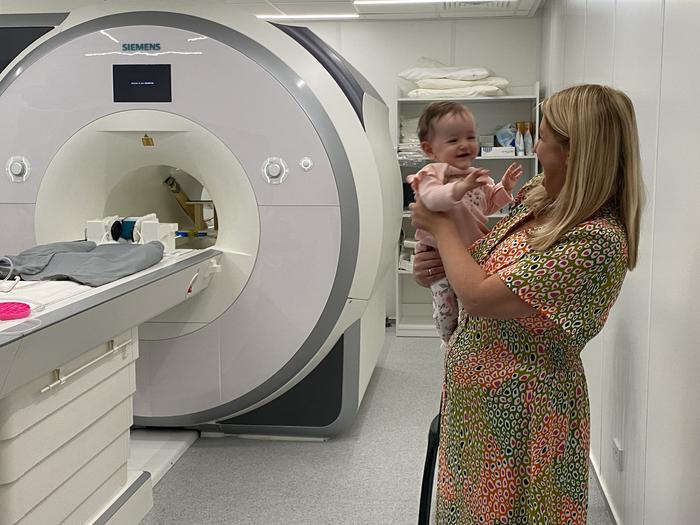
Baby Eli settles into a comfy beanbag, sound-cancelling headphones snug over his ears. On the screen above him, bright colours flash: a rubber duck, a shopping cart, a bird, a tree. He’s two months old and researchers are watching his brain sort these objects into categories, a cognitive feat scientists thought impossible at such a young age.
The experiment, conducted at Trinity College Dublin, challenges everything we assumed about infant cognition. At just eight weeks, babies cannot speak, cannot point, can barely control their own limbs. Yet their minds are already doing something remarkable: categorising the visual world.
“Parents and scientists have long wondered what goes on in a baby’s mind and what they actually see when they view the world around them,” says Dr. Cliona O’Doherty, who led the study while working in Trinity’s Cusack Lab. “This research highlights the richness of brain function in the first year of life.”
The team recruited 130 two-month-olds (with help from Dublin’s Coombe and Rotunda Hospitals) for what would become the largest longitudinal study of awake infant brain imaging. Each baby watched colourful pictures representing 12 common categories for about 15 to 20 minutes whilst functional MRI scanners measured their neural activity. Long enough, it turns out, to capture something extraordinary.
The scans revealed distinct patterns of brain activity for different object categories. But here’s what makes the finding particularly striking: the researchers used artificial intelligence models to decode what those patterns meant. By comparing the babies’ brain activity to computational models of visual recognition, they could see that two-month-old minds weren’t just passively absorbing shapes and colours. They were actively sorting, classifying, organising.
“Although at two months, infants’ communication is limited by a lack of language and fine motor control, their minds were already not only representing to how things look, but figuring out to which category they belonged,” O’Doherty explains. The foundations of visual cognition, she notes, are in place much earlier than expected.
Rhodri Cusack, the Thomas Mitchell Professor of Cognitive Neuroscience who leads the research group, emphasises the methodological breakthrough: “This study represents the largest longitudinal study with functional magnetic resonance imaging of awake infants. The rich dataset capturing brain activity opens up a whole new way to measure what babies are thinking at a very early age.”
The implications extend beyond basic neuroscience. Professor Eleanor Molloy, a neonatologist from Children’s Health Ireland who co-authored the study, points to clinical applications: “There is a pressing need for greater understanding of how neurodevelopmental disorders change early brain development, and awake fMRI has considerable potential to address this.” Being able to peer into infant cognition could help identify atypical development months or even years earlier than current methods allow.
Then there’s the AI angle. Somewhat ironically, artificial intelligence helped reveal that human babies learn in ways that put machines to shame. “Babies learn much more quickly than today’s AI models,” Cusack observes, “and by studying how they do this, we hope to inspire a new generation of AI models that learn more efficiently, so reducing their economic and environmental costs.”
Dr. Anna Truzzi, now at Queen’s University Belfast, frames the achievement in broader terms: “Until recently, we could not reliably measure how specific areas of the infant brain interpreted visual information. By combining AI and neuroimaging, our study offers a very unique insight.” That insight, she suggests, will ripple outward: informing early-years education, clinical support for neurodevelopmental conditions, and perhaps most intriguingly, inspiring more biologically-grounded approaches in artificial intelligence.
Baby Eli, oblivious to the significance of his 20-minute scan, has already moved on. But the data from his developing brain and those of 129 other infants might just reshape how we understand the earliest foundations of human thought.
Study link: https://www.nature.com/articles/s41593-025-02187-8