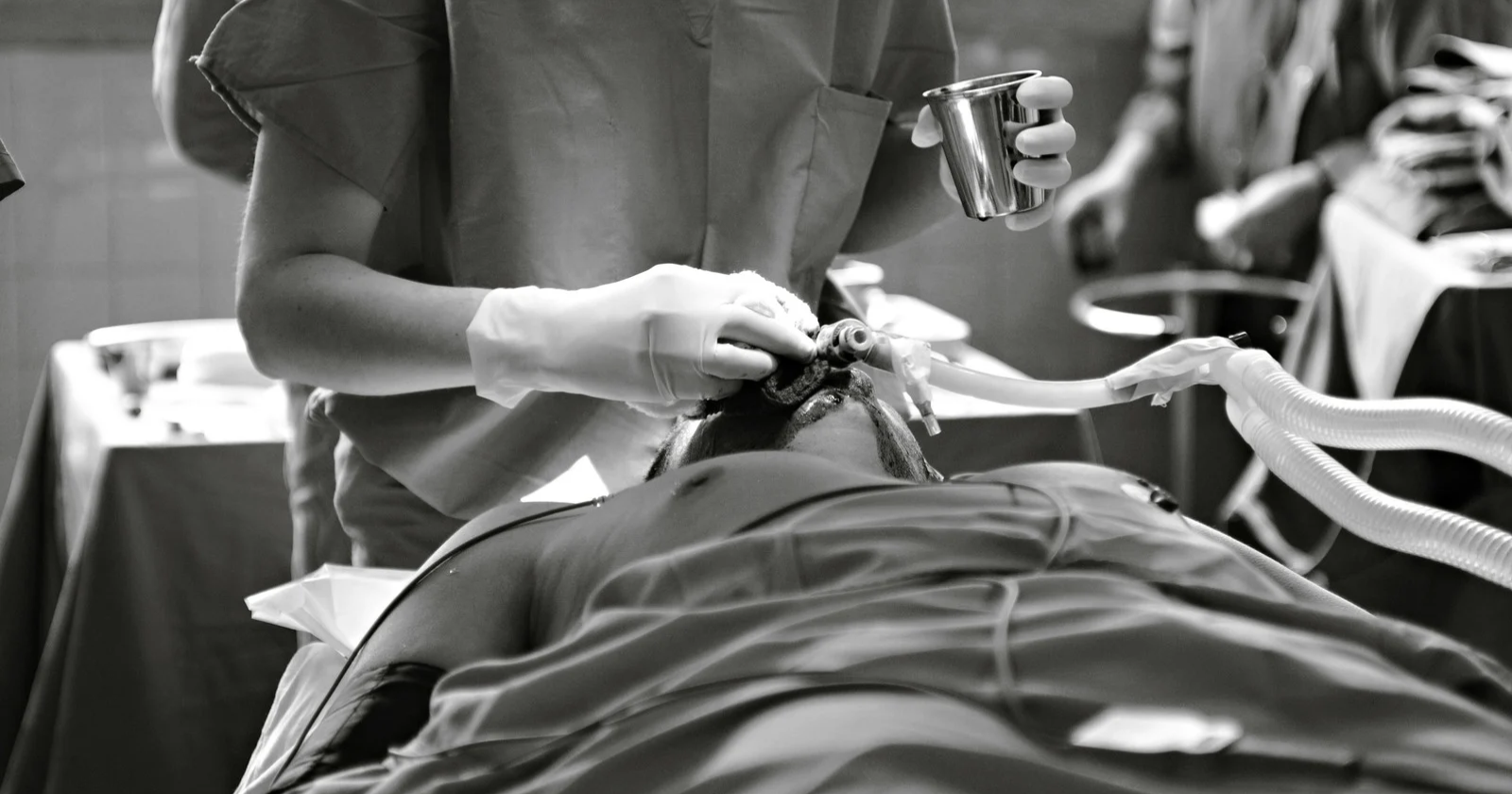
On the morning of 29 November 1944, in an operating theatre at Johns Hopkins Hospital in Baltimore, a 15-month-old girl named Eileen Saxon lay waiting for an operation nobody had tried on a patient before. Her lips and nail beds were purple. Alfred Blalock, the hospital’s chief of surgery, held the instruments. Behind him, on a small step stool at his right shoulder, stood a Black lab technician who never earned a college degree. Vivien Thomas wasn’t scrubbed in and never touched the patient. He was there because, as Katie McCabe reported in her 1989 Washingtonian profile of Thomas, he had done the operation dozens of times in the lab, and Blalock had done it once, as Thomas’s assistant.
The paper that announced the operation was published in JAMA in 1945 by Blalock and the paediatric cardiologist Helen Taussig. I read all 14 pages, and Thomas isn’t mentioned once. Years earlier, he had been classified on the payroll as a janitor. Johns Hopkins finally gave him an honorary doctorate in 1976, more than 31 years after he climbed onto that stool.
Why the babies turned blue
The children Taussig was seeing had tetralogy of Fallot, a cluster of four heart defects. The two that matter here are a narrowed exit from the heart to the lungs and a hole between the heart’s two pumping chambers, which lets oxygen-poor blood cross over and head straight out to the body. Their blood never carried enough oxygen, and their skin showed it.
Blalock and Taussig’s paper makes a point I didn’t expect: “it is not the cyanosis, per se, which does harm.” Cyanosis is the blue tinge, the visible sign of a body short of oxygen. The authors’ target was volume: too little blood was reaching the lungs, so the job was to send more.
The method was plumbing. In the first case, the paper records, the surgeons divided the left subclavian artery, which normally carries freshly pumped blood out towards the arm, and joined its end to the side of the left pulmonary artery, which supplies the lung. Some blood that had already left the heart for the body was diverted back for another pass through the lungs, like running half-clean dishes through the dishwasher again.
The shunt left the defect itself in place, so it was no permanent cure, as the Johns Hopkins library exhibit on the operation makes clear. It bought time. Surgeons today usually perform a modified version: instead of rerouting the arm artery, they bridge it to the lung artery with a small synthetic tube, the approach a Great Ormond Street team in London described in 1981.
From a Nashville payroll to the Hopkins dog lab
Thomas reached medicine sideways. The Depression halted carpentry work in Nashville and wiped out his savings for college and medical school. In 1930 he got a job at Vanderbilt University as laboratory assistant to Blalock for $12 a week and no overtime on 16-hour days, McCabe writes.
Then, in a conversation about pay with a Black co-worker, he discovered that Vanderbilt had him classified as a janitor. He took it to Blalock. McCabe quotes Thomas’s account: “I told Dr. Blalock . . . that for the type of work I was doing, I felt I should be . . . put on the pay scale of a technician, which I was pretty sure was higher than janitor pay.” That “pretty sure” may be the most polite accusation in the history of payroll.
A 2021 tribute from the American College of Cardiology puts that classification at Johns Hopkins, and the 2024 announcement renaming the operation in his honour says Blalock first hired him there. McCabe’s account, drawn from Thomas’s memoir, places both at Vanderbilt. Thomas didn’t reach Hopkins until 1941, when Blalock brought him to run the surgical lab. At the time, McCabe writes, the hospital’s only other Black employees were janitors. That may be how the label followed him north.
The idea of sending more blood to the lungs was probably Taussig’s, Tom Treasure judges in an essay for the James Lind Library. Turning it into an operation fell to Thomas, in the dog lab. “It was Thomas who successfully made the systemic to pulmonary shunt in the laboratory,” Treasure writes. There were no needles small enough to join an infant’s arteries, so, McCabe writes, Thomas cut lab needles down and held them steady with a clothes peg. Denton Cooley, the intern in the theatre that November morning, told McCabe: “it was Vivien who had worked it all out in the lab, in the canine heart, long before Dr. Blalock did Eileen, the first Blue Baby.”
At Hopkins the problem was money. The library exhibit’s profile of Thomas says he was paid far less than white workers in the same position. When he finally announced he would leave, Blalock negotiated an offer that doubled Thomas’s salary, two days before Christmas 1946.
What the 1945 paper leaves out
The paper’s opening lines have some swagger: “A ‘blue’ baby with a malformed heart was considered beyond the reach of surgical aid.” On the lab work, it says: “Before undertaking the operations on patients, many experiments were performed in an effort to produce pulmonic stenosis in dogs. This work met with little success.” Performed by whom, the paper doesn’t say. Presumably not the dogs.
The paper does find room for names elsewhere. It notes a grant from the Robert Garrett Memorial Fund for the Surgical Treatment of Children. In the second case report, it says the encouragement of the first assistant, Dr William Longmire, “played no small part” during the operation. I can believe a 1945 surgical paper wouldn’t make a technician without a degree a co-author. Crediting a fund and the first assistant’s encouragement while the man who worked out the operation goes unmentioned is harder to explain away. Nothing I’ve found records whose decision that was.
Blalock doesn’t come out of the record as a cartoon villain. In 1937, by McCabe’s account, Henry Ford Hospital in Detroit offered him a prestigious chairmanship, but its policy against hiring Black staff ruled out Thomas, so Blalock turned it down. Later he kept Thomas at his elbow in the theatre, which Treasure notes was against all convention in a Baltimore where Black workers used the hospital’s back door. Yet Thomas worked behind the bar at Blalock’s parties for extra money, and when Blalock went to London in 1947, he took Hank Bahnson, not Thomas. Where the partnership was at stake, Blalock held firm. When it came to credit and social standing, he let the rules of the day stand, and that seems to me the honest verdict.
The paper is also candid about Eileen. It reports that she went home on 25 January 1945, gaining weight and “only occasionally cyanotic”, and warns that if her cyanosis got worse, “it may be necessary to perform a similar operation on the opposite side.” It did get worse, and the Hopkins exhibit records that she did not survive the second operation. In 1950, McCabe records, Blalock operated on his 1,000th blue baby.
Thirty-one and a half years
Recognition came slowly, and first from the people Thomas had trained. On 27 February 1971 his “Old Hands” packed a Hopkins auditorium to present a portrait they had commissioned, which was hung opposite Blalock’s. On 21 May 1976, Johns Hopkins awarded him an honorary doctorate and a place on the medical school faculty. From the first operation, I make it 31 years, five months and 22 days.
Strictly speaking the degree was a Doctor of Laws, so the man who taught a generation of surgeons to operate became Dr Thomas in a subject he had never studied. “The applause was so great that I felt very small,” he wrote.
He spent his last years on his memoir, indexing it from a hospital bed. It appeared two days after his death in 1985 as Pioneering Research in Surgical Shock and Cardiovascular Surgery. His own title, McCabe reports, was Presentation of a Portrait: The Story of a Life. He seems to have named his life story after the day his former students honoured him, and I find that the most revealing detail in the record.
A name in the middle
The operation’s name took longer still. SickKids in Toronto, which says the operation is still used today, renamed it the Blalock-Thomas-Taussig shunt in 2023. In February 2024 all five of Ontario’s children’s hospitals adopted the name, pointing to the 1945 paper as the reason the old one stuck. I’d have liked them to get his first job right, but I find it hard to be cynical about a renaming, even a late one.
Thomas sits in the middle of the name, between the surgeon who held the instruments and the cardiologist who most likely had the idea. Given where he stood in 1944, that seems about right. Getting him there took 79 years and two hyphens.