

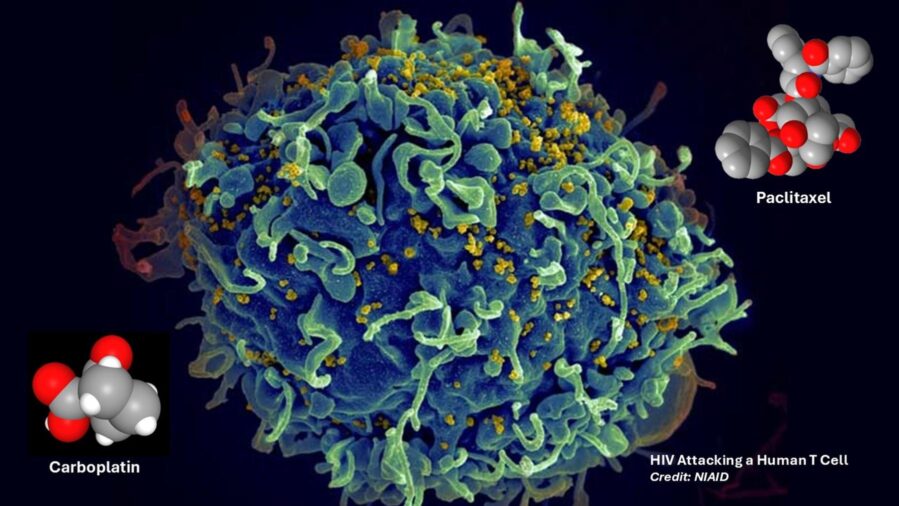
When a lung cancer patient living with HIV started chemotherapy, researchers noticed something unexpected: the number of immune cells harboring dormant virus dropped sharply. The observation, detailed in The Journal of Clinical Investigation, offers a new angle on one of medicine’s most stubborn problems—how to eliminate the infected cells that allow HIV to hide for decades, even when antiviral drugs keep the virus itself undetectable.
The patient, identified in the study as ES24, received paclitaxel and carboplatin for metastatic cancer. After treatment, Johns Hopkins Medicine researchers found a marked reduction in the most clonally expanded HIV-infected CD4+ T cells, the very population thought to sustain the viral reservoir over time. These cells carry strands of HIV DNA permanently stitched into their genomes, and when they divide, they pass that genetic cargo to their descendants.
In practical terms, HIV keeps itself alive by photocopying infected immune cells rather than constantly making new virus. Many of these integrated proviruses stay completely dormant, producing no viral proteins at all, which allows them to evade both immune surveillance and standard antiretroviral drugs. The Johns Hopkins team’s finding suggests that the cells maintaining this reservoir may be vulnerable precisely when they try to proliferate.
Cells Caught in the Act of Dividing
To test whether the chemotherapy effect could be reproduced, the researchers isolated a specific clone of HIV-infected CD4+ T cells from the patient. These cells carried an intact, replication-competent provirus. When the team stimulated them with a cognate peptide—a protein fragment the T cell was programmed to recognize—the cells began dividing rapidly.
Adding paclitaxel, carboplatin, or the antiproliferative drug mycophenolate mofetil halted that expansion. Uninfected T cell clones, by contrast, were largely spared. The drugs work by disrupting the cell cycle itself: paclitaxel prevents the spindle formation needed to pull chromosomes apart during division, while carboplatin creates cross-links in DNA. In lab experiments, treatment resulted in a 32-fold to 60-fold reduction in the targeted HIV-infected cells after a single round.
“It’s vitally important for us to learn why there were significantly fewer clonally expanded, infected CD4+ T cells in the patient who received chemotherapy. If we can understand the mechanism by which that happened, perhaps it can be translated into a means of curing HIV,” Joel Blankson explains.
Blankson, a professor of medicine at Johns Hopkins School of Medicine, notes that the approach differs fundamentally from earlier “shock and kill” strategies, which tried to force dormant virus to reveal itself by producing viral proteins. Instead, this method targets the cells’ dependence on repeated division, cutting off the process that allows the reservoir to quietly expand over time.
What Happens When Infected Cells Need to Grow
The findings come with important caveats. This was a single patient, and chemotherapy itself is far too toxic for routine use in people living with HIV. The strategy also requires knowing which peptides will trigger a person’s specific infected clones, making it a form of personalized medicine most applicable to patients on long-term therapy whose reservoirs are dominated by a few large clones.
Still, the study changes how researchers think about HIV persistence. Rather than an untouchable archive of sleeping virus, parts of the reservoir appear to rely on constant cellular motion. Francesco Simonetti, an assistant professor of medicine at Johns Hopkins, suggests that infected T cell clones studied in the research were so susceptible to chemotherapy and antiproliferative drugs because they depend on frequent proliferation to persist in the body.
The team now plans to see if this selective elimination occurs in other people living with HIV. If the mechanism holds across a larger population, it could lead to therapies combining vaccines—to trigger the right cells—with short courses of antiproliferative drugs to prune the viral reservoir. By tilting the balance between cell division and death, scientists hope to shrink the reservoir to a point where the body might finish the job on its own.