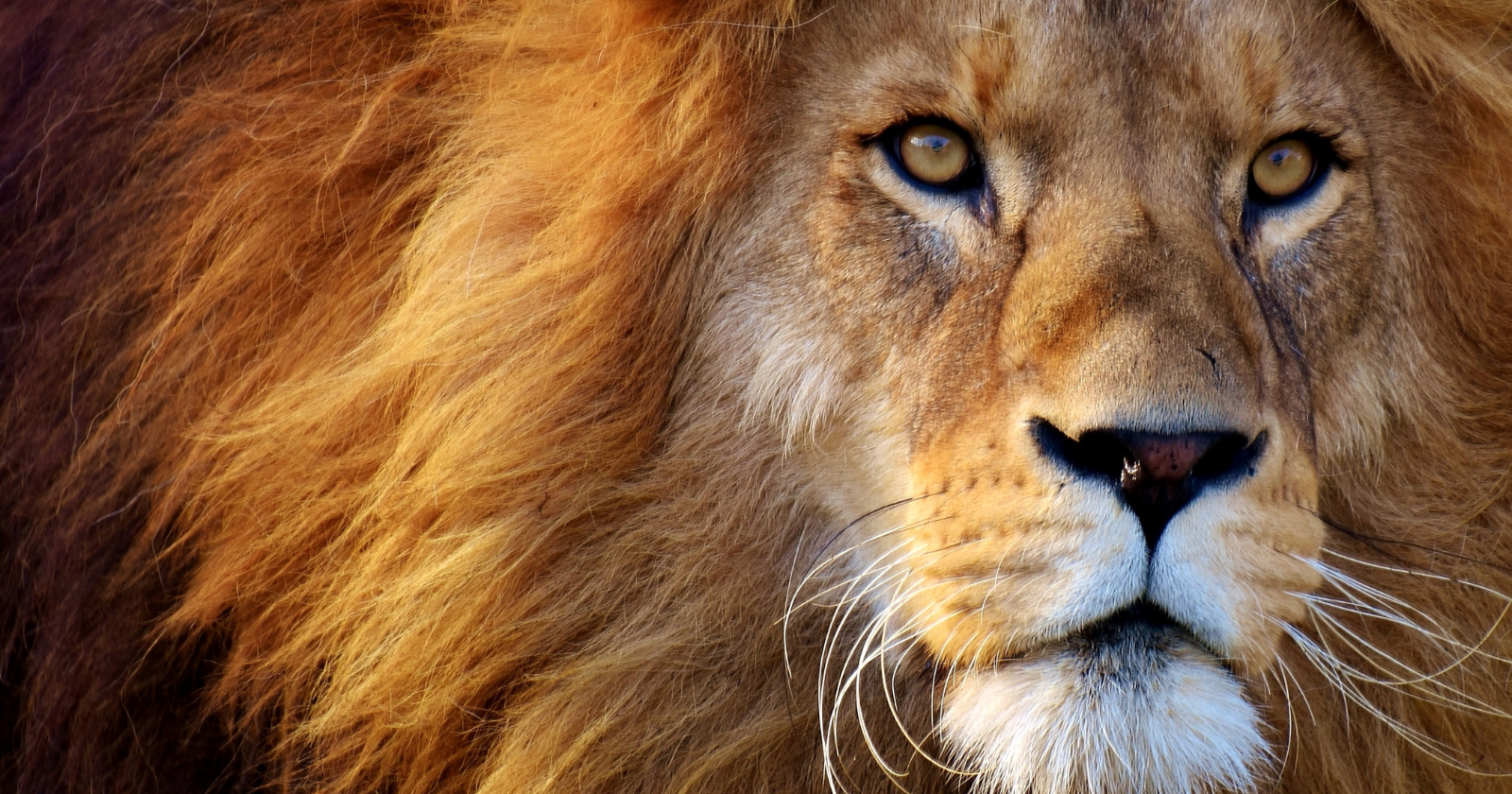
Somewhere out in the dark, a sound arrives with no obvious source. It seems to come up through the ground as much as through the air, and it does not fade so much as roll away. Eight kilometres off, an animal has opened its mouth.
A lion’s roar is one of the loudest noises any land mammal produces, and it is doing several jobs at once. It stakes a claim on ground. It keeps a scattered pride in contact across kilometres of grass. It also tells whoever is listening a great deal about the individual making it, and that signal is what has occupied researchers for three decades.
Where the volume comes from
Most of it starts in the throat. A team led by Sarah Klemuk at the University of Iowa examined lion and tiger larynges and found something odd about the vocal folds. Where most mammals have a triangular profile jutting into the airway, big cats have folds that are flat and squared off, with fat packed into the tissue behind them. In a paper published in PLOS ONE, they found that this geometry lets the tissue respond to passing air with much less lung pressure than the noise would otherwise cost.
Co-author Ingo Titze, a voice scientist at the University of Utah, put it more bluntly in the announcement of the findings: the roar works on roughly the same physical principle as a human baby’s cry, just several octaves lower and considerably harder to ignore.
The other half of the distance belongs to the weather. Low-frequency sound bends when temperature and wind change with height, and savanna air does that dramatically over a day. Modelling by David Larom and a team of atmospheric scientists in the Journal of Experimental Biology found that the area covered by a savanna elephant’s low-frequency call expands and contracts across 24 hours by as much as a factor of ten. The same paper noted that lion calls are shaped by similar atmospheric swings, though that tenfold figure was calculated for elephants, not lions. Cool, still nights with a temperature inversion sitting near the ground are excellent. Hot, gusty afternoons are close to useless.
Lions appear to know this
Matthew Wijers and colleagues at Oxford’s Wildlife Conservation Research Unit fitted microphones and motion sensors to lions in Zimbabwe’s Bubye Valley Conservancy. They then trained a machine learning model to recognise a roar’s acceleration signature, letting them detect calls from movement data alone across more than 500 nights and seven animals, well beyond what the short-lived audio recorders could sustain. Their analysis, published in Animal Behaviour, found roaring clustered at night with a peak just before dawn, and that lions favoured exactly the conditions the physics rewards: low wind, low temperature, high humidity.
They were also choosy about where. The same study reported that lions roared more often near rivers and water points inside their range, and went noticeably quiet once they crossed the boundary of it.
Announcing yourself in someone else’s living room is a poor idea.
Counting the opposition
The listening side is stranger than the shouting side. In the early 1990s, Karen McComb, Craig Packer and Anne Pusey ran a set of playback experiments across 21 prides in Serengeti National Park, broadcasting either one unfamiliar female roaring or three roaring in overlapping chorus. Their results, reported in Animal Behaviour, showed defending lionesses were far less willing to approach three intruders than one, and when they did approach three they moved slowly, pausing to scan ahead and check on stragglers.
The tally worked both ways. Defenders weighed how many of their own were present, and when the numbers looked thin they roared themselves, apparently to call in absent pridemates before committing to anything. One playback experiment does not settle a question, though this finding has held up well and has since been extended to males and to juveniles.
A roar is closer to a name
Roars are not interchangeable. Karen McComb turns up again here, this time with a different set of co-authors. Writing in Proceedings of the Royal Society B, they showed that lionesses with cubs stay relaxed when they hear the resident males who fathered those cubs, and retreat quickly with the cubs when the roar belongs to an unfamiliar male. Unfamiliar females get approached instead. The distinction is made instantly, on sound alone.
Machines can now do a passable version of the same trick. Using the biologger recordings, the Oxford group modelled the shape of each roar’s fundamental frequency over time and could match roars to individual lions with 91.5 per cent accuracy, up from about 71 per cent using cruder summary measures. The contour, meaning the way the pitch moved through the call, carried the signature.
That number matters more than it sounds. Lion populations are hard and expensive to count, usually requiring collars, darts and vehicles. A microphone on a post is cheaper than all of it, and more recent work on classifying roar types with machine learning is trying to make that practical at scale. Leopards have already been given the same treatment.
Which sets up a mildly absurd future. The signal a lion evolved to carry eight kilometres through cold night air, meant for rivals and relatives, turns out to be legible to a laptop as well. The pride is not the only thing listening any more.