

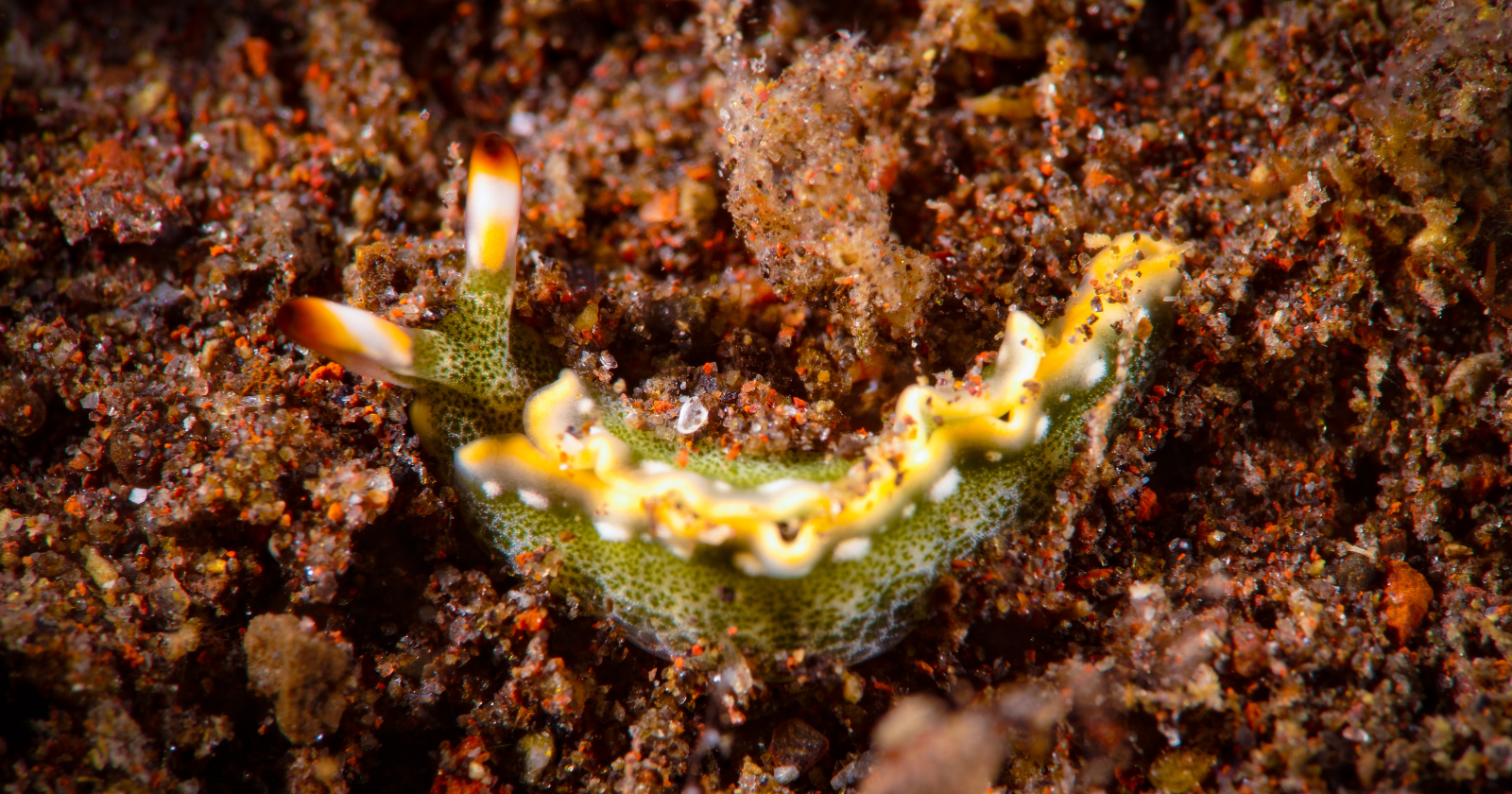
One morning in a lab at Nara Women’s University, a sea slug’s head crawled away and left the rest of the animal sitting there.
The abandoned body did not die. It shifted when touched. Inside it, a heart carried on beating. Nothing had attacked it and nobody had cut it. The slug had unzipped itself at the neck, on purpose.
Sayaka Mitoh, then a doctoral student in Yoichi Yusa’s lab, was raising Elysia slugs from eggs to study how they live and breed. She expected the head to be dead within a day. Instead it started grazing on algae within hours, had a new heart under way within a week, and by the third week had rebuilt an entire body. The account the pair published in Current Biology describes one individual that managed the trick twice.
The neck comes with a dotted line
Look closely at a healthy Elysia marginata and you will find a faint groove running around its neck. Mitoh and Yusa call it a breakage plane, and every separation they saw happened along it.
They tested the idea by tying fine nylon thread around the groove on six slugs. Tissue at the site began visibly breaking down after 16 to 18 hours, and all but one had shed its head between 18 and 22 hours.
That is a leisurely way to lose a body. A lizard drops its tail in the time it takes a bird to close its beak. A separation that grinds on for hours makes a poor emergency exit from a predator’s mouth.
What gets left behind
By weight, the shed body is more than 80 per cent of the slug. It takes the heart, the kidney, the intestine and most of the reproductive organs with it. What crawls off is a head with a sliver of neck attached, carrying a pair of eyes, a mouth and very little else.
Cast-off bodies never grew new heads. They kept moving for days, flinching at contact, slowly going pale as their stolen chloroplasts faded out, and then they stopped.
The smaller piece is the one that lives.
Staying alive without a heart
Sacoglossan sea slugs eat algae and keep the chloroplasts intact inside their own tissue, running them like borrowed solar panels. Biologists call the habit kleptoplasty. Mitoh and Yusa propose that this trickle of sunlight income is what keeps a bodiless head going long enough to rebuild. Nobody has tested that directly.
How the rebuild works is even less settled. In a release from Cell Press, Mitoh said she suspects there must be stem-like cells sitting at the cut end of the neck, capable of growing everything that was thrown away.
Age decides who gets through it. Heads from younger slugs, between seven and eleven months past hatching, fed within hours. Heads from animals hatched more than 480 days earlier never ate at all and were dead in ten days, a figure set out in coverage by CNN. Mitoh told Scientific American that very old individuals gain little from the manoeuvre, since they probably cannot reproduce anyway.
The parasite theory
The second species came from the wild, and those slugs had company. Elysia atroviridis collected off the Japanese coast were carrying a parasitic copepod, Arthurius sp., living inside their tissue. Of 82 infested slugs, three shed their bodies, and two of those grew replacements within a week.
Every slug that performed the separation was carrying the parasite. Every regenerated body came back clean.
So the working explanation is pest control by amputation. Jettison the infested bulk, keep the head, start again. Earthworms are known to do something comparable when a protozoan parasite gets into them, as the pair note in their paper. They floated two duller alternatives as well: cutting loose when tangled in algae, or ditching a build-up of toxic chemicals absorbed from food.
How much this actually proves
Three slugs out of 82. Five out of 15. Science laid out the same counts in its coverage, and the source is a two-page correspondence rather than a body of replicated work.
There is an awkward detail, too. The lab-bred Elysia marginata showed no sign of parasites, and a third of them threw away their bodies anyway. Mitoh and Yusa claim the parasite function for E. atroviridis alone, which is the careful way to put it. What these animals do is on the record. Why they do it rests on three individuals and a decent hunch.
Regeneration gets the headlines, and fair enough, since a heart that starts growing back within a week is worth staring at. The stranger part is the decision. Something running on a nervous system you could lose in a teaspoon weighed itself up, concluded the heart was the expendable bit, and then took the better part of a day to work itself in half.