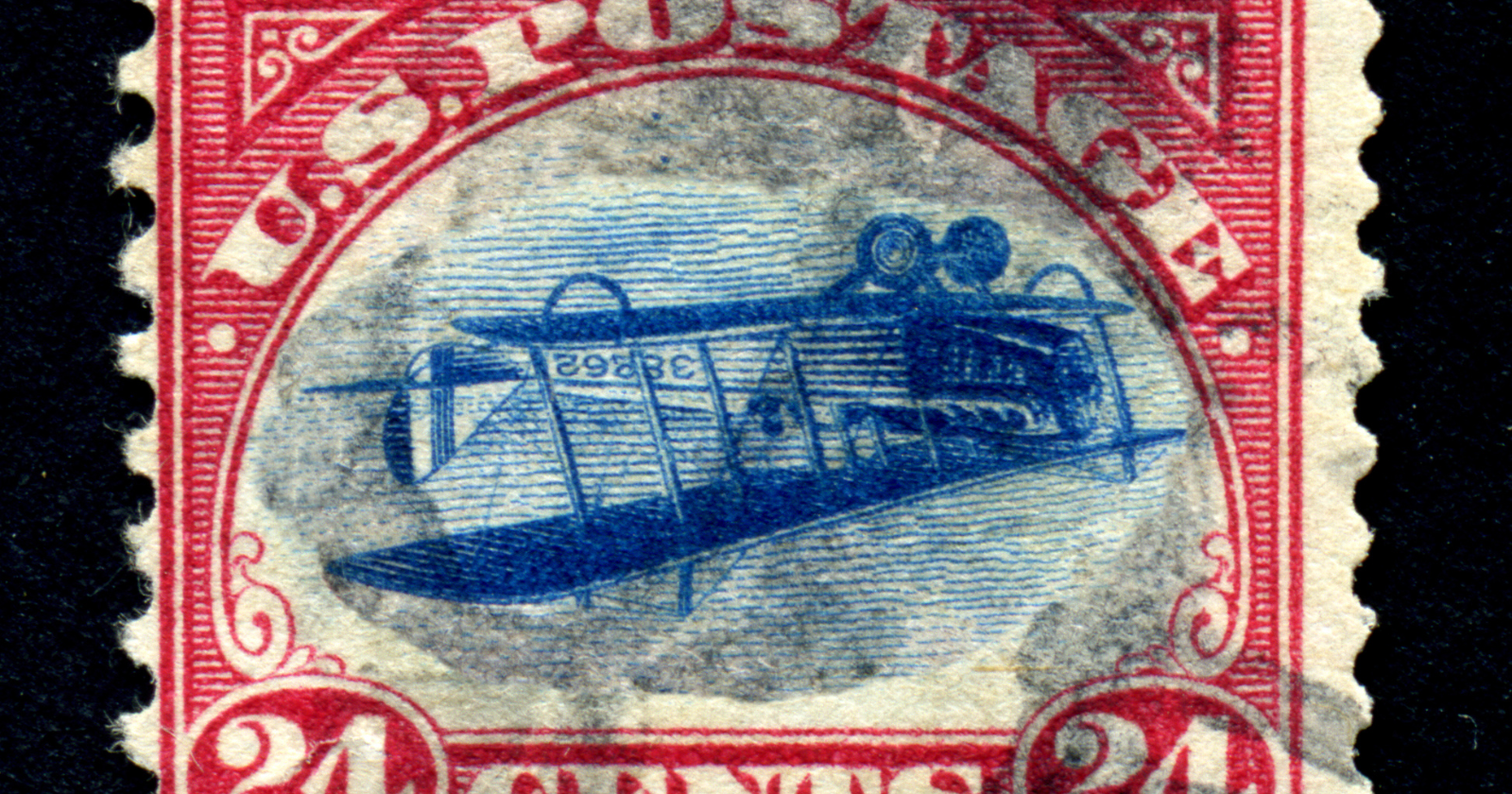
The clerk at the New York Avenue post office had never seen an aeroplane, which turned out to be a two million dollar blind spot.
Lunchtime, 14 May 1918. William Robey, a 29-year-old Washington clerk with a stamp habit, had walked over from his office hoping for exactly this. The new airmail issue had gone on sale the day before, timed to the first scheduled flights. Its design needed two colours, carmine rose for the frame and deep blue for the biplane, which meant every sheet went through the press twice. Collectors in Washington, Philadelphia and New York had done the arithmetic on that and were loitering at counters, waiting for someone to feed a sheet in the wrong way up.
Robey asked for a hundred of the 24-cent stamps. Every Curtiss JN-4 on the sheet slid across to him was flying belly up. He paid the face value of $24, worth roughly $510 now, as Smithsonian magazine has documented, and only mentioned the error once the money had changed hands.
How a plane ends up upside down
The Jenny was an intaglio stamp. Ink sits in lines cut into a metal plate and is pressed onto damp paper under heavy pressure. With the war on, the Bureau of Engraving and Printing had every press it owned running, so the new airmail stamp went onto an old hand-fed “spider press”, according to the Smithsonian’s National Postal Museum. Crews on presses like it averaged about 350 sheets of 100 stamps a day.
Two colours meant two engraved plates, one for the carmine frame and one for the blue aeroplane, and two trips through the press. The frame went on first and the plane second. The sheets carried guidelines and arrows in the margins to help the printer centre the plane inside the frame on that second pass.
If a sheet that already had its red frames was turned round before the second pass, or the blue plate went back into the press the wrong way after inking and wiping, every plane on the sheet came out flying upside down. The museum says either could explain the Jenny, and that several sheets with the error were caught and destroyed before one reached a Washington counter. To stop it happening again, the word TOP was later added to each plate, in both colours.
The week Robey spent not blinking
Postal inspectors reached his workplace within hours. They leaned on him, came back, questioned his wife at home. What they lacked was any legal basis for taking the sheet, and Robey, who was nobody’s novice, declined to oblige.
He spent that evening riding streetcars around the capital with a briefcase full of upside-down planes.
The couple slept badly, sheet stashed under the bed. A week later he carried it to Philadelphia and walked out with a certified cheque for $15,000 from the dealer Eugene Klein, a profit of $14,976 on a lunchtime purchase. That money bought a house and a car. Klein passed the sheet to Colonel Edward Green for $20,000, and Green did the thing that made the legend: he cut it up, pencilling a position number on the back of each stamp before dispersing them among friends.
Which is why nobody discusses the Inverted Jenny sheet. They discuss Position 49, or Position 76.
Four stamps, one display case, one still gone
Ethel McCoy owned positions 65, 66, 75 and 76 as an intact block, bought in 1936 for $16,000, as the Christian Science Monitor recounted. In 1955 she lent it to the American Philatelic Society for a convention in Norfolk, Virginia, and someone cut through the exhibition case and walked off with it.
Two were recovered in the decades that followed. Position 76 surfaced in 2016 when a young man in Britain took it to a New York auction house to sell, having inherited it from his grandfather and knowing nothing about its history, after which the FBI and the Manhattan US Attorney’s office returned it to the American Philatelic Research Library, which holds McCoy’s claim. Position 66 has never reappeared. No suspect was ever named.
What a well-behaved rectangle of paper is worth
“There’s no 98. There’s no 100.”
Scott Trepel of Robert A. Siegel Auction Galleries was talking about Position 49, which grades 95 for centring and, he explained on NPR, cannot be improved on by any surviving example. It had sat in one family’s bank vault for a century, never hinged into an album, never exposed to light.
In November 2023, four bidders pushed it to a hammer price of $1.7 million. With commission, the total came to $2,006,000, the most a single American stamp has ever fetched at auction. The buyer, a real estate developer named Charles Hack, already owned one.
The rarity nobody wanted
In 2013 the Postal Service reprinted the Jenny as a $2 souvenir sheet, dedicating it alongside the opening of the Smithsonian’s stamp gallery, then quietly printed 100 panes with the plane the right way up and scattered them through the mail order system. Every sheet went out in a sealed envelope so buyers could not peek.
Manufactured scarcity, shrink-wrapped.
Its own inspector general later concluded the stunt breached internal rules against creating rarities for revenue, and that only 20 of the 100 corrected panes had been registered as sold.
Scarcity can be printed to order. What cannot is a rushed press operator with a war on, a clerk who had no mental picture of a plane, and a man on his lunch break who did.