

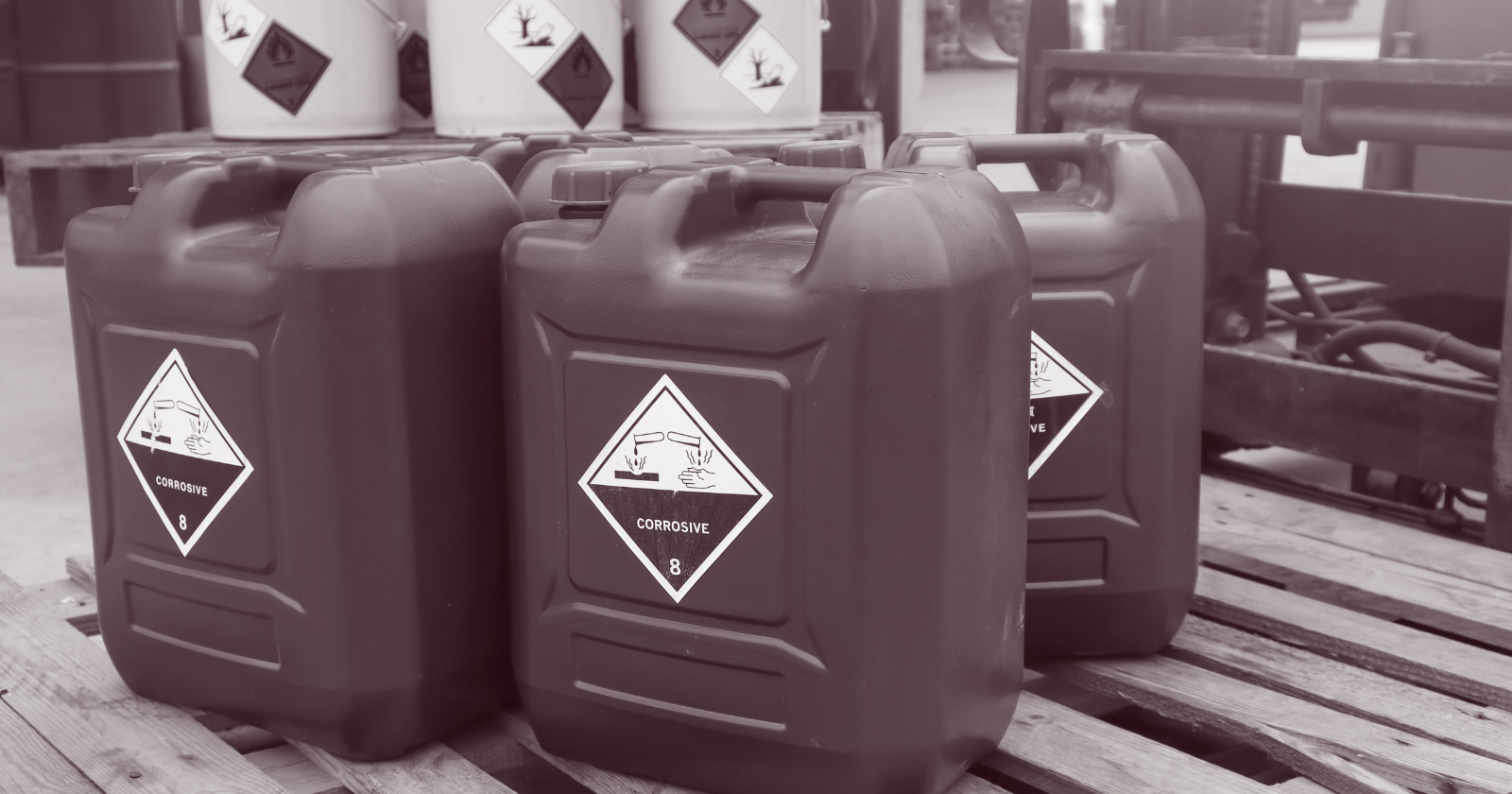
Somewhere east of Bornholm, a trawler hauls up a net that smells faintly of garlic, and the correct response is to cut the gear loose and get on the radio.
That instruction is written down and numbered, in the guidance for fishermen published by HELCOM, the intergovernmental commission responsible for the Baltic marine environment. Cut the tackle. Mark the position. Call the national contact point by coastal radio. Leave the fish on deck, and bring nothing ashore, roe and livers included, until an authority has cleared the catch.
Eighty years of cold seawater has not dissolved the problem.
How 40,000 tonnes got down there
When the war ended, the occupying powers inherited German chemical weapon stockpiles and almost no appetite for handling them. Dumping was quick and cheap. HELCOM’s figures put roughly 40,000 tonnes of chemical munitions on the Baltic floor, holding an estimated 15,000 tonnes of actual warfare agent. The official sites were deep basins east of Bornholm and south-east of Gotland, plus a shallower dump at the southern entrance to the Little Belt, only about 30 metres down.
Ships did not always make it to the marked squares. Records kept by the commission show material going over the side while vessels were still en route from the loading harbours at Wolgast and Flensburg, and some of it travelled in wooden crates, which then drifted. Partners in the CHEMSEA and DAIMON projects, funded through Interreg, put the consequence plainly: because dumping began before the ships arrived, the munitions effectively litter the entire seabed.
What comes up in the net
Mustard gas dominates the inventory, and the sea has made a poor job of disposing of it. The agent barely dissolves in water. German wartime batches were thickened with arsenic oil so they stayed usable in winter, and over decades the contents polymerise into a solid mass that chemists call mustard heel. A review of the exposure status of sea-dumped agents in Marine Environmental Research puts around 7,000 tonnes of sulphur mustard in the Bornholm Deep alone. Most of it went down inside 250 kg aircraft bombs and artillery shells, alongside arsenic-bearing compounds such as Clark I and Adamsite.
So it sits there, solid, in near-freezing water, waiting for a trawl door.
A separate paper in the same journal, on microbial responses to dumped mustard, records as much as 1,010 kg of chemical munitions netted east of Bornholm in a single year between 2000 and 2005, all of it corroded into clay-like lumps. The worst year on that record was 1991, with 103 separate catches totalling more than five tonnes. The leaflet itself sorts what surfaces into three grades of decay, ending with yellow-brown lumps of up to 100 kilograms and roughly the consistency of plasticine.
The gas box
Boats working bottom gear in the risk areas must carry protective and first-aid equipment, including one “gas box” for every three crew. Inside are bottles of decontamination fluid, sprays of chlorinated anti-gas powder, cotton wool and tongue spatulas. In the zone where nerve agents went down, the list adds ten atropine injectors per three crew.
The medical advice is the part that lingers. Mustard does not announce itself, and symptoms may take hours to appear, so decontamination begins on suspicion alone. Do not rub your eyes, even when they sting. Do not puncture blisters. Scrape any grease off the skin with a knife instead of wiping, which only works it in.
That is battlefield medicine, handed to people catching cod.
What the science can and cannot say
Proving the harm is harder than picturing it. HELCOM’s position is that arsenic-bearing agents have spread through sediments around the dumpsites, while in every case investigated so far, no parent compounds or breakdown products have appeared in the water column in measurable quantities.
Jacek Bełdowski of the Institute of Oceanology at the Polish Academy of Sciences, who led CHEMSEA and its successors, reported a less comfortable result. In 2014 his team found munitions residues in fish tissue, and calculated that each corroding object contaminates up to 250 metres of seabed, occasionally as much as a kilometre. Cod spawn in the Bornholm Basin. Those two facts share a map.
A 2025 study in Chemosphere from the GEOMAR Helmholtz Centre for Ocean Research Kiel found dissolved explosive compounds in almost every water sample taken across the south-western Baltic in 2017 and 2018. The total came to about 3,000 kilograms, heaviest in the bights of Kiel and Lübeck, with concentrations below health thresholds. One study, one stretch of coast, two survey years, and it measures residue from conventional explosives, so it works as a warning light more than a verdict.
Someone is finally hauling it up
In autumn 2024, German contractors began lifting munitions from the Bay of Lübeck under a federal pilot worth 100 million euros, the first time since 1945 that dumped ordnance had been raised as a precaution instead of an emergency. Hakai Magazine followed the crews and their yellow seabed robots through work closer to archaeology than demolition.
Momentum has held. GEOMAR gathered industry, researchers and regulators in Kiel in April 2026 to draft a roadmap for clearance and unpick the legal obstacles. By mid-2026, as Fraunhofer IGD reported, Germany had opened a federal competence centre in Rostock to coordinate recovery and prepare a floating disposal platform. Federal environment minister Carsten Schneider called the effort a task for generations, a diplomatic way of describing 1.6 million tonnes of ordnance, most of it conventional, across the German North Sea and Baltic.
All of that happens in about 20 metres of water, close to German beaches, where divers can operate and voters can watch. The chemical dumps east of Bornholm sit past 70 metres, in a basin nobody swims in, and the German programme does not reach them.
So the survey work out there runs as it always has, one net at a time, done by people who were only trying to catch fish.