

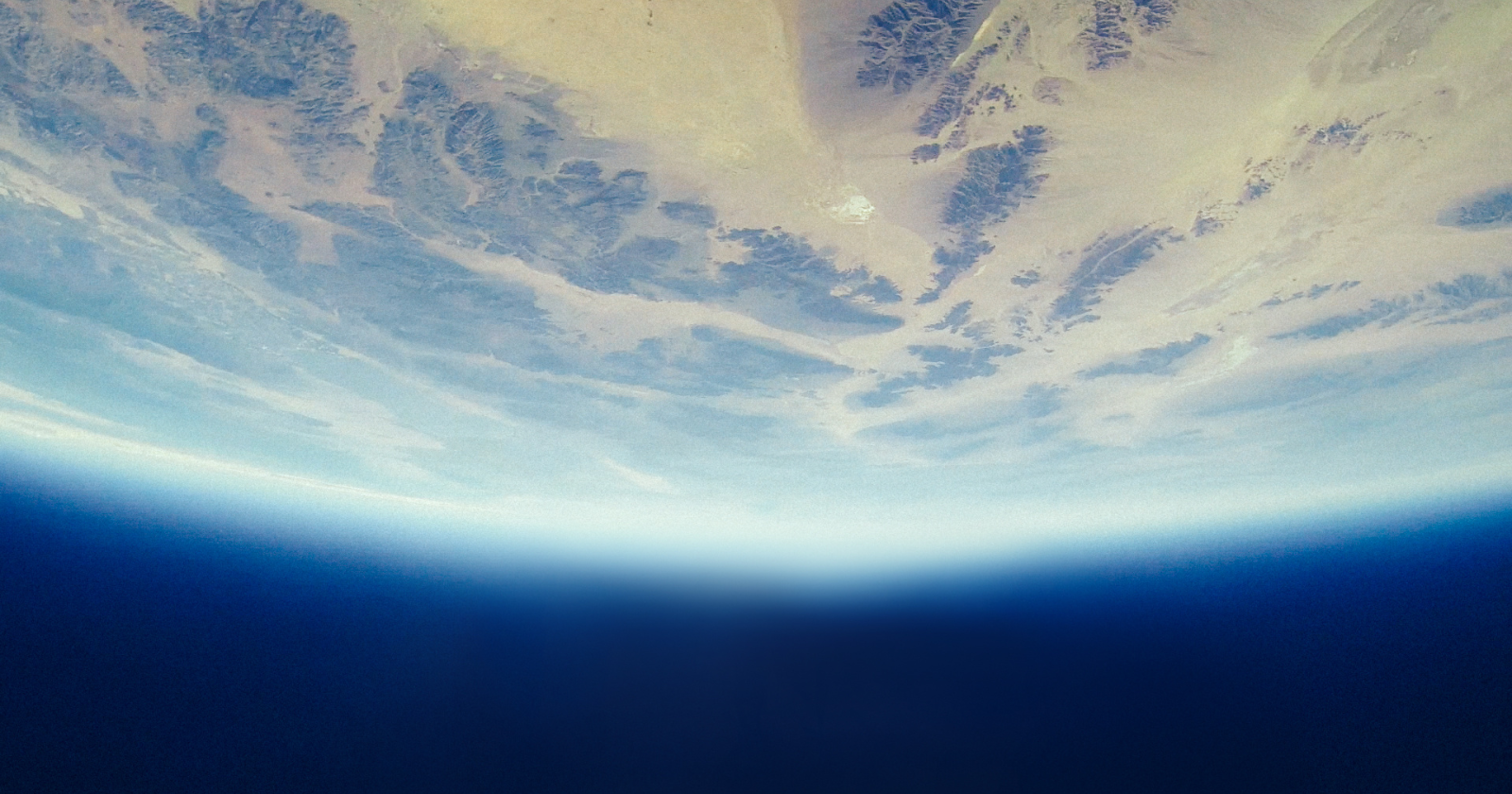
Hairspray nearly wrecked the sky.
It had help, obviously. Fridges, foam packaging, car air conditioners, industrial solvents and countless aerosol cans that hissed their way through the 1970s ran on chlorofluorocarbons, a family of chemicals so stable they looked like a gift from industrial chemistry. Cheap, non-flammable, non-toxic, perfectly happy sitting in a canister under the sink for a decade.
That stability was the whole problem.
What two chemists worked out in 1974
Mario Molina and Sherwood Rowland, both at the University of California, Irvine, followed a dull-sounding question somewhere alarming: where do CFCs actually end up? Nothing at ground level breaks them down, so they drift upwards for decades until they reach the stratosphere, where ultraviolet light is finally strong enough to smash them apart and set chlorine loose.
Their 1974 paper in Nature laid it out bluntly. These compounds could linger in the atmosphere for 40 to 150 years, and the chlorine released from them destroys ozone. One chlorine atom does not take out a single ozone molecule and retire. It works as a catalyst, cycling through thousands of them before anything finally mops it up.
That matters because ozone, sitting about 20 to 30 kilometres up, absorbs most of the Sun’s damaging UV-B radiation before it reaches the ground. Thin it out and you get more skin cancer, more cataracts, and measurable damage to crops and plankton.
Chemical manufacturers were unimpressed and pointed out that no alternatives existed for a class of genuinely useful products. Molina and Rowland took the argument straight to journalists and politicians, and American regulators banned CFCs as aerosol propellants in 1978, leaving a short list of essential medical exemptions. The rest of the world kept spraying.
A hole nobody’s model had predicted
Then came Halley Bay. Joe Farman, Brian Gardiner and Jonathan Shanklin of the British Antarctic Survey had been pointing an ageing instrument at the polar sky since the 1950s, and their springtime ozone readings kept collapsing in ways the textbooks could not explain. Writing in Nature in 1985, the three reported that spring ozone totals over Antarctica had fallen considerably. The brutal cold of the polar stratosphere, they argued, was what made the region uniquely sensitive to rising chlorine.
Leading models had promised that any thinning would stay small for at least another decade. Those models were built around conditions at 30 degrees north, roughly the latitude of Cairo, and their output was being read as a global estimate by default.
A treaty that everybody actually signed
Governments moved with a speed that now looks faintly unbelievable. The Montreal Protocol was signed in September 1987, two years after Farman’s paper, and went on to achieve universal ratification. The UN Environment Programme recorded the last outstanding amendment as ratified in 2014. Production was throttled on a schedule rather than switched off overnight, developing countries got extra time, and the rules tightened as the chemistry got clearer.
Enforcement had one ugly moment. In 2018, NOAA’s Stephen Montzka and colleagues reported an unexpected rise in global CFC-11 emissions, later traced to rogue production in eastern Asia. The alarm prompted action. Parties to the treaty pressed for enforcement, China stepped up inspections, and a 2021 study in Nature found that emissions from eastern China had returned to pre-2013 levels by 2019.
Where the sky stands now
Ozone depletion still happens every southern spring. In 2025 it was unusually mild. NOAA and NASA ranked it the fifth smallest hole since 1992, averaging 18.71 million square kilometres during the peak depletion season, and breaking up nearly three weeks earlier than the recent norm. Montzka puts the decline in ozone-depleting substances above Antarctica at about a third of the way back towards pre-ozone-hole levels since the peak around 2000.
Weather muddies any single season, and a weak polar vortex in August 2025 helped. Stronger evidence comes from the statistics. A team led by Peidong Wang and Susan Solomon at MIT applied a climate fingerprinting technique to fifteen years of satellite data. In a paper published in Nature last year, they put 95 per cent confidence on the finding that recovery is being driven by falling chlorine, not by natural variability or greenhouse warming. One study is one study, though this one matches what the monitoring agencies have been reporting year after year. Solomon told MIT News the conclusion was that the hole is recovering, “which is awesome”.
Full repair is still decades away. Old CFCs keep seeping out of demolished buildings, discarded fridges and landfill foam, one reason the Antarctic hole is not expected to close permanently until the late 2060s.
Solomon reckons a stray year with no Antarctic depletion at all could arrive by about 2035. Somebody starting school around then will grow up with no idea that the sky was ever broken, which is roughly what winning looks like.