

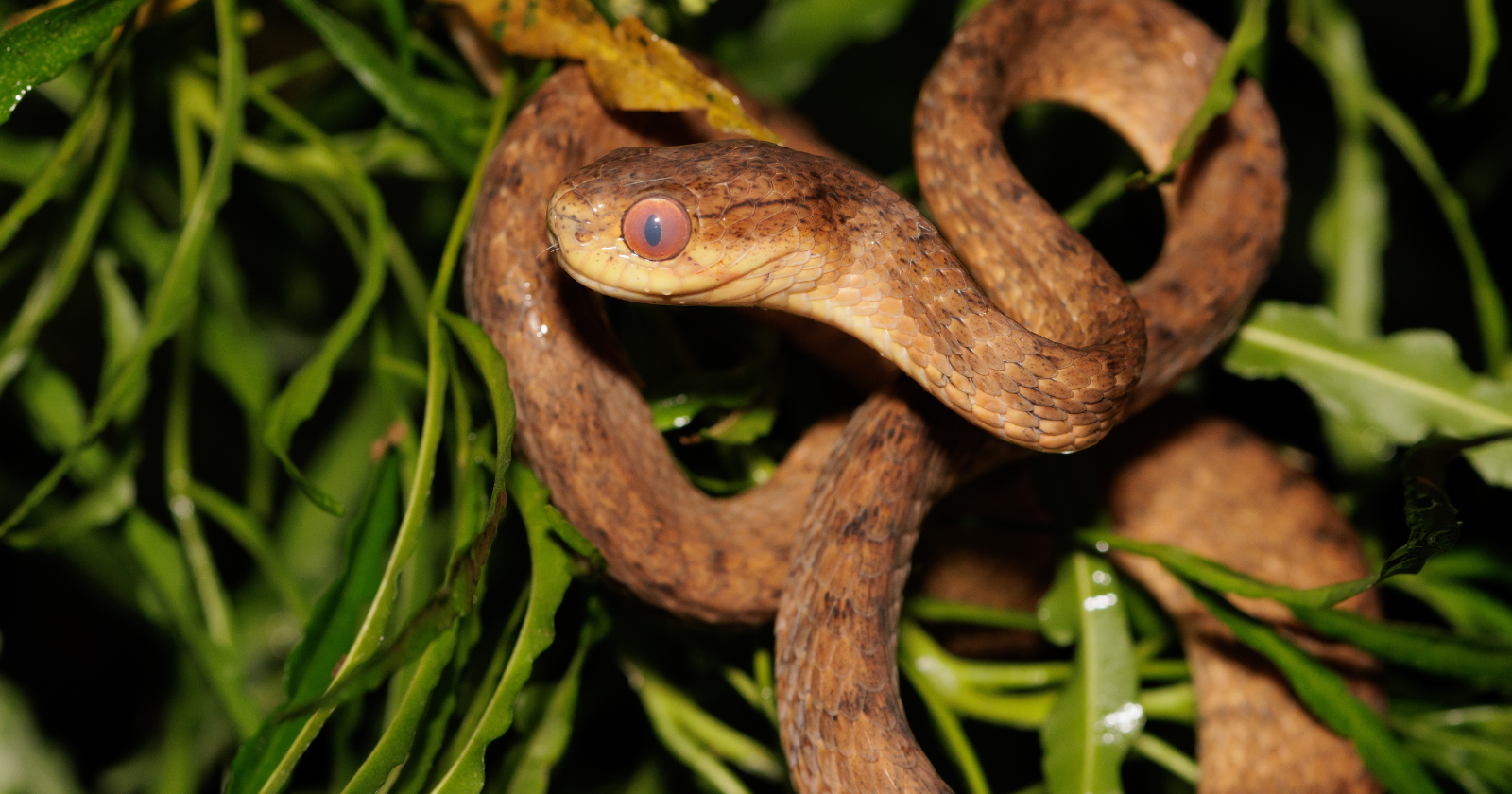
Four times a second, a helicopter flying over Guam spits out a dead mouse.
Each one is a newborn, already deceased, with an 80-milligram tablet of paracetamol tucked inside (Americans know the drug as acetaminophen, the active ingredient in Tylenol). It rides down in a biodegradable cartridge that opens in mid-air and unspools a ribbon designed to tangle in the branches, leaving the bait dangling in the canopy like a very grim Christmas ornament. Whatever eventually swallows it is almost certainly a brown tree snake, which is the whole idea.
How a stowaway snake emptied Guam’s forests
Shortly after the Second World War, and before 1952, brown tree snakes reached Guam from elsewhere in the South Pacific, most likely hidden in ship cargo. A US Geological Survey synopsis of the invasion describes what followed with admirable bluntness. Prey was abundant, predators were absent, and the snakes multiplied to numbers never seen before. The fallout included thousands of power outages, the loss of pets and domestic birds, and considerable distress for residents who kept finding snakes inside their homes.
Native wildlife fared far worse. A 2007 review published in Pacific Science found the snake eliminated 13 of Guam’s 22 native breeding bird species, including 10 of its 12 forest birds, and contributed to the loss of several native bats and lizards. The two forest species that hung on were left severely reduced.
Places far from Guam have reason to worry too. The island is a large port and home to several military bases, which gives the snakes plenty of chances to hitch a ride elsewhere. A US Department of the Interior release cites estimates that an established population in Hawaii alone could cost between US$593 million and US$2.14 billion a year.
Why paracetamol is lethal to a snake
“They go into a coma, and then death.” That was how Peter Savarie, a researcher with the US Department of Agriculture’s Wildlife Services, described the effect to National Geographic. In people, paracetamol takes the edge off headaches and fevers. In brown tree snakes, it disrupts haemoglobin, the blood protein that carries oxygen around the body. Savarie also offered a darkly practical point about safety: few other species on Guam are likely to be tempted by the mice, largely because the snakes have already eaten most of them.
The dose is small by human standards, a fraction of a standard 500-milligram adult tablet. Before any island-wide baiting began, a 2002 risk assessment examined what else might eat the baits or scavenge poisoned snakes. Rodents, cats, pigs and birds all raised flags on paper, yet field and laboratory tests found they took in very little of the drug. The authors concluded that the benefits outweighed what they judged to be minimal risks to other animals.
Getting a dead mouse to stay up a tree
Why hang bait in the canopy at all? The target is a nocturnal climber that does much of its hunting in the branches, so that is where the food has to be, and holding it off the ground puts it out of reach of most animals it isn’t meant for. A USDA blog post describes each bait as fitted to a biodegradable, streamer-like device that snags on branches where the snakes feed. Because the baits hang in trees, are spread thinly and get eaten quickly, anything else rarely gets a look in.
Covering big, remote stretches of forest called for a machine. Wildlife Services and its partners built a system that manufactures the cartridges automatically and fires them from a helicopter-mounted dispenser, as detailed in a paper for the 2020 Vertebrate Pest Conference. It launches four cartridges a second, and a single load of 3,600 can treat 30 hectares at 120 baits per hectare in 15 to 30 minutes, depending on how efficiently the helicopter flies its route.
The hardware has its hiccups. A 2020 study in the Wildlife Society Bulletin examined an operation in which 12,686 cartridges went out over a 55-hectare site and estimated that the ribbon came loose on roughly 22 to 33 per cent of them. Surveyors walking the site afterwards found six unopened cartridges, a single dead snake and no dead bystanders.
What 30 radio-tagged snakes showed
Ahead of a June 2019 baiting run on Andersen Air Force Base in northern Guam, biologists fitted 30 adult snakes with radio transmitters. Each unit carried an accelerometer, so any snake that stayed still for more than 24 hours would register as dead. Findings published in the Journal of Wildlife Management were unambiguous on one point: 11 of the 30 died during the baiting period, about 37 per cent, while none died in a comparison period without bait.
A strong size effect ran through the data. Smaller adults died at an estimated rate of 59 per cent and larger adults at 14 per cent. Sex made no measurable difference. This is one study at one site, and its authors kept their conclusion measured: aerial baiting can cut snake numbers, and reaching eradication will probably take further refinement or other removal tools working alongside it.
Big snakes are a known weak spot. Most reptiles keep growing throughout their lives, and a 2021 dose study in Management of Biological Invasions found the standard 80-milligram bait kills the vast majority of Guam’s snakes but starts losing its effect at around 200 grams of body weight. A doubled 160-milligram bait should work on nearly all females.
Males grow much larger, and for the very biggest of them, the researchers concluded, other methods will be needed, which for now makes Guam’s heftiest snakes its likeliest survivors.