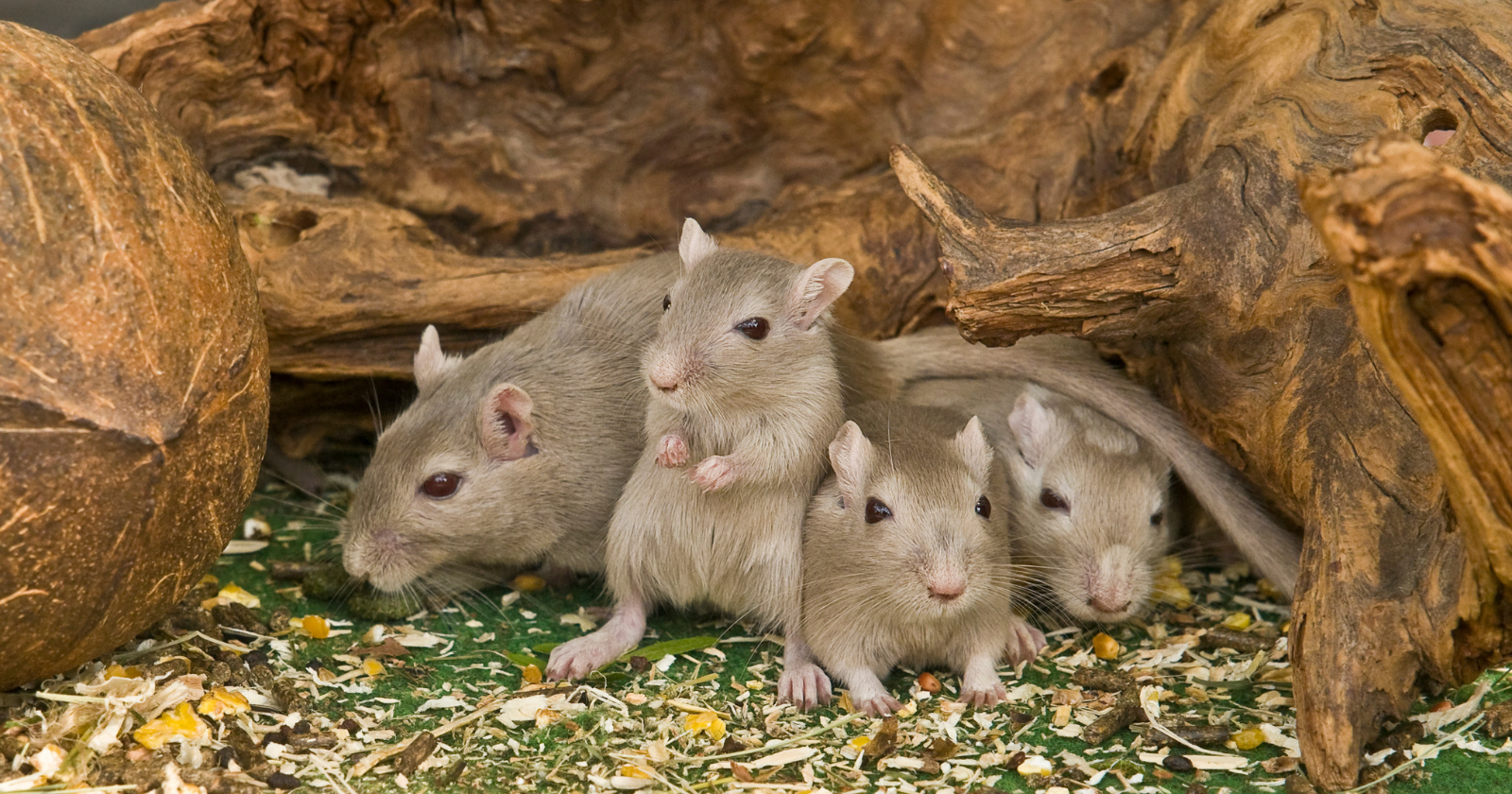
Eight mice moved into paradise in July 1968. Four years later the place was a ghost town, and not one resident had ever missed a meal.
Paradise had a name: Universe 25, so called because the ethologist John B. Calhoun had already built twenty-four of them. His latest sat in a laboratory at the National Institute of Mental Health in Maryland, a metal pen roughly 2.6 metres to a side. Food hoppers, water bottles, shredded paper for nesting and 256 nest boxes reached by mesh stairwells filled the inside. No cats, no parasites, no weather to worry about. Calhoun reckoned the nest boxes alone could house something like 3,840 mice in comfort, a figure he set out in his 1973 report Death Squared for the Proceedings of the Royal Society of Medicine.
Numbers never came close.
Growth stopped while there was still room
Four breeding pairs went in. After a slow settling-in stretch the colony began doubling roughly every 55 days, which is what mice do when nothing is trying to eat them. By day 315 there were around 620 animals. Then the doubling slowed, and by day 560 the count topped out near 2,200 and sat there, a bit over half the notional capacity, with hundreds of empty nest boxes going spare.
What had run out was not floor space but jobs. Young males coming of age found every desirable territory already claimed and defended, so they pooled in the middle of the pen in listless mobs that occasionally erupted into fights that went nowhere. Females rearing litters without a male guarding the nest began abandoning pups or attacking them. Weaning turned into a lottery. Writing in Cabinet magazine, Will Wiles records that a handful of mice made it past weaning until about day 600, after which there were pregnancies but no young that survived.
The beautiful ones
What do you call a mouse that never fights, never mates and never leaves its room?
Among that last generation were males with immaculate coats and no scars, having never fought anything worth scarring for. Courtship did not interest them, nor territory, nor the rearing of young. Eating, drinking, grooming and sleeping in the upper boxes filled their days. Calhoun’s answer to his own question was the beautiful ones, a name with no warmth in it. He described two deaths in the colony: a first death of the social self, where the behaviours that keep a mouse functioning quietly drop away, and a second, physical death arriving much later.
Calhoun labelled the long plateau before all this the stagnation phase, and the last recorded conception in Universe 25 landed around day 920. By the time he wrote the colony up, he was projecting a date for the death of the final male. Everything after that was bookkeeping.
Where the idea came from
Ten years before the mice came the rats: eighty of them, crowded into a room ten feet by fourteen and split into four pens. Calhoun ran that setup through the late 1950s, and in a February 1962 article for Scientific American he coined the phrase behavioural sink, describing how his rats would voluntarily pile into whichever pen was busiest and so pump up the very pressure that was wrecking them. That article became one of the most cited in the history of psychology, and it arrived in a decade already braced for demographic catastrophe, six years ahead of Paul Ehrlich’s The Population Bomb.
Calhoun was hardly coy about the parable. He opened his 1973 talk by saying he would speak mostly of mice while his thoughts were on people, a line preserved by the US National Library of Medicine alongside his films and papers.
What one pen can and cannot settle
One experiment, one pen, one population of laboratory mice.
Human crowding research that followed Calhoun refused to fall into line. Psychologist Jonathan Freedman set people to work under varying densities and turned up very little pathology, and the field then split density, a measurable number, from crowding, a subjective feeling shaped by privacy and control. Historian Edmund Ramsden traces that shift in the Bulletin of the World Health Organization, noting that even Calhoun’s rats had not all gone berserk, and the ones who managed to hold a patch of space lived fairly ordinary lives. Rodents can suffer badly under crowding. People, by and large, cope.
Calhoun’s own reading was less fatalistic than his reputation suggests. Speaking to The Scientist, Ramsden pointed out that other Calhoun enclosures with extra rooms let animals live at high density without constant forced contact, and the ugliest behaviour largely faded. Calhoun wanted the people designing prisons, hospitals and housing blocks to take notes. Ramsden and Jon Adams argued in the Journal of Social History that a stripped-down doom version of his work drowned out that message entirely, and knocked his professional standing about in the process.
The part that keeps getting skipped
Calhoun himself called it “not normal science,” his own term for a study built on observation, not controlled hypothesis. Universe 25 now does a job its designer never asked for. It gets wheeled out whenever birth rates dip or a generation of young men seems to be withdrawing, as though a pen in Maryland closed the question in 1973 and everyone since has been filling in details.
Calhoun spent his later career on a duller argument that nobody wanted to hear. His mice had not been undone by abundance, but by a badly designed room, and rooms can be rebuilt.