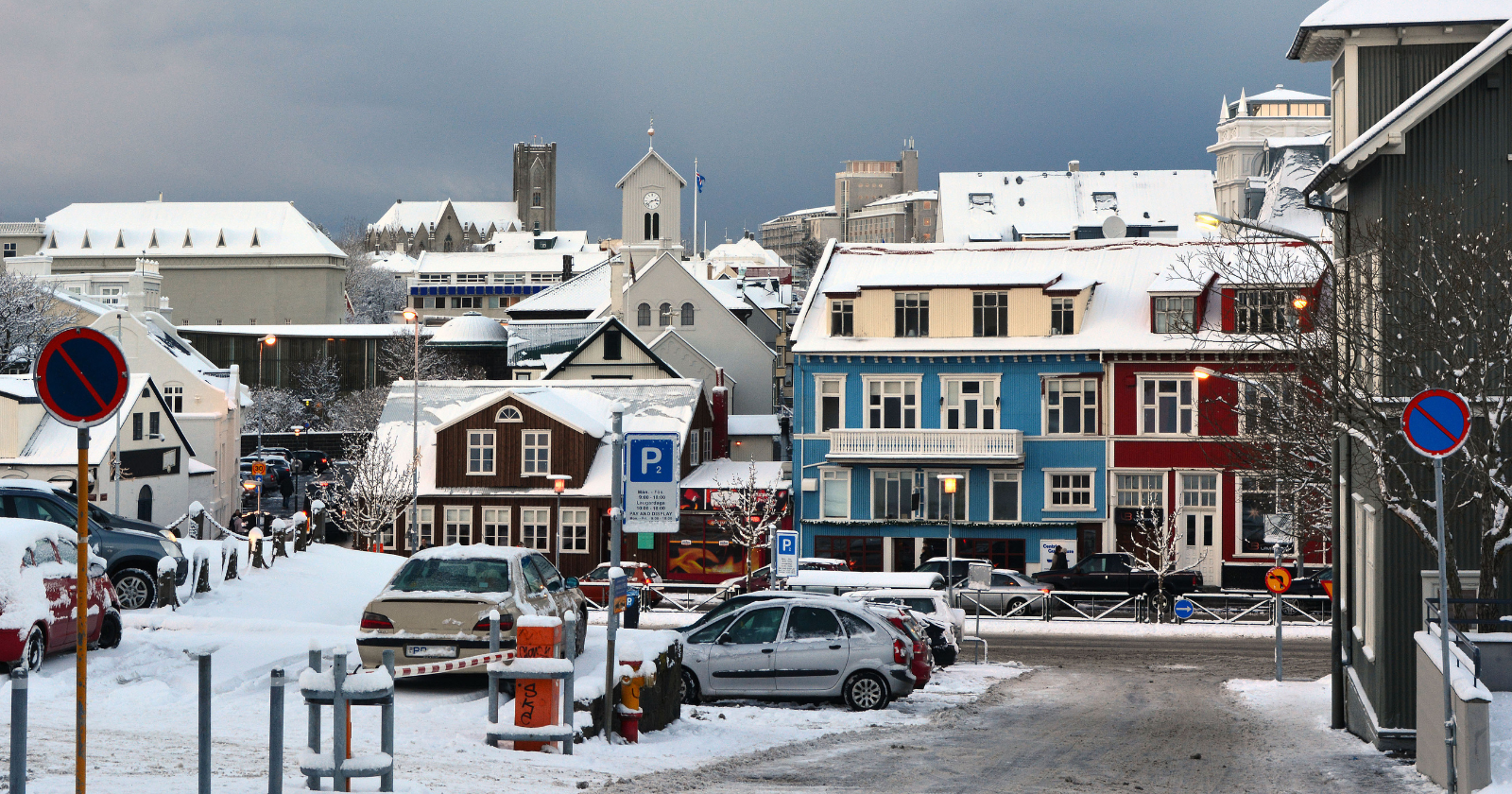
Rain that fell on an Icelandic mountainside is keeping a footpath in central Reykjavík dry this winter.
That is the whole trick, and it takes a moment to sink in. Precipitation lands on high ground, works its way into fractured basalt, sits for a while where the rock is hot, then comes back up and ends its career in somebody’s radiator. Iceland runs nearly all of its domestic heating on that loop. Orkustofnun, the country’s National Energy Authority, puts geothermal at roughly 90 per cent of all energy Icelanders use to heat their homes, with district heating utilities reaching 95 per cent of the population.
Where the heat comes from
No magma is involved. That surprises people. In a review published in Jökull, the journal of the Icelandic geoscience societies, Stefán Arnórsson, Guðni Axelsson and Kristján Sæmundsson describe Icelandic geothermal fluid as meteoric in origin: rain and snowmelt, with a seawater component in some coastal fields.
Their account of the low-temperature systems that supply Reykjavík follows a model first proposed by Gunnar Bödvarsson. Groundwater moves from the highlands towards the lowlands, plunges through an open fracture or along a dyke to a depth of a few kilometres, warms against hot rock, and rises again because hot water weighs less than cold.
Then the fracture does something odd. Circulating water pulls heat out of the rock at the base of the loop. That rock cools, contracts and cracks a little further, and the fracture creeps downward, year after year. The system deepens its own mine shaft as it works.
Evidence for this shows up in the temperature logs. Under Laugarnes, a field sitting directly beneath the city, readings at 3,000 metres come in close to 160°C, well below what the regional gradient of about 120°C per kilometre would predict. Cold water has been chilling the basement for a very long time.
Some of that water is old enough to be a curiosity in its own right. The same paper notes that certain low-temperature fluids hold unusually little deuterium, the heavy isotope of hydrogen, a signature that points to glacial meltwater laid down before the current interglacial. Parts of the supply are rain from an ice age, arriving a few thousand years late.
Laundry springs and the first pipeline
Generations of Reykjavík women hauled washing to the hot springs of Laugardalur, the valley just east of the centre whose name means hot spring valley. In its history of the neighbourhood, the Reykjavík Grapevine notes that some trace the city’s own name, smoky bay, to steam rising off those pools, and that piping the water away between 1928 and 1930 caused the springs to shrink dramatically. Reykjavík gained central heating and lost its laundry.
Orkustofnun dates the first public scheme to 1930, when a three-kilometre pipe carried water from those washing basins to Austurbæjarskóli, a primary school on the eastern edge of town.
What happens after the radiator
“It’s quite simple, when you’ve already installed it,” Eirikur Hjalmarsson of Reykjavík Energy told CBC, fielding yet another round of Canadian questions about Icelandic footpaths. Water that has finished heating a building leaves at around 30°C, still warm enough to be useful, and gets pushed through plastic tubing buried under streets and paths. Hjalmarsson listed the payoff as less ploughing, fewer road repairs (ploughs are hard on asphalt) and fewer people falling over on ice.
The scale is easy to underrate. In the same Jökull review, the breakdown of Iceland’s direct geothermal use puts snow melting at 215 MW of installed capacity and 378 GWh a year, marginally ahead of the 361 GWh going to bathing and swimming.
Iceland spends slightly more heat de-icing its streets and pavements than filling every pool and hot tub it owns.
Why the water goes straight into radiators
What is in this water that lets it skip a treatment plant altogether? Not much, and that is the point. Water from the low-temperature system holds very few dissolved solids, largely because the basalt it has passed through is poor in chloride. That keeps the pipes clean, with no corrosion and no scale, and no reason the water cannot run from well to radiator untreated. Fluid from the volcanic high-temperature fields carries too much hydrogen sulphide and too much silica waiting to precipitate for that to work. Plants such as Nesjavellir put it through heat exchangers to warm clean water instead.
Which is why the hot tap in Reykjavík smells faintly of sulphur and the cold one does not.
Visit Reykjavík counts 18 geothermal swimming pools inside the city, most of them outdoors and open all year. At 64 degrees north, that is a decent flex.
Whether the supply holds
By the late 1950s, Reykjavík was pumping harder than the ground could easily replace. Engineers at Reykjavík Energy, writing up 85 years of the utility’s history for the World Geothermal Congress, record that a large drill rig went into service, deep wells multiplied, and water levels across the low-temperature fields dropped until every spring that had survived the 1930s pipeline was gone. A new balance eventually settled in: stop pumping a field today, and the water rises back to the surface within a year or two.
In a paper presented at Stanford’s geothermal reservoir engineering workshop in 2025, Adolph Bravo Jr and colleagues at the University of Iceland report that Laugarnes has yielded around 160 litres per second for five decades, with water levels and production temperatures staying flat. They put that stability down to cold recharge picking up heat from shallow formations as it seeps deeper. That is one study of one field, offered as a refinement to the conceptual model rather than a verdict on it.
Nobody in Reykjavík gives any of this a second thought. That is the mark of infrastructure that works. Under the swimming pools, the rock is quietly getting colder, one fracture at a time.