

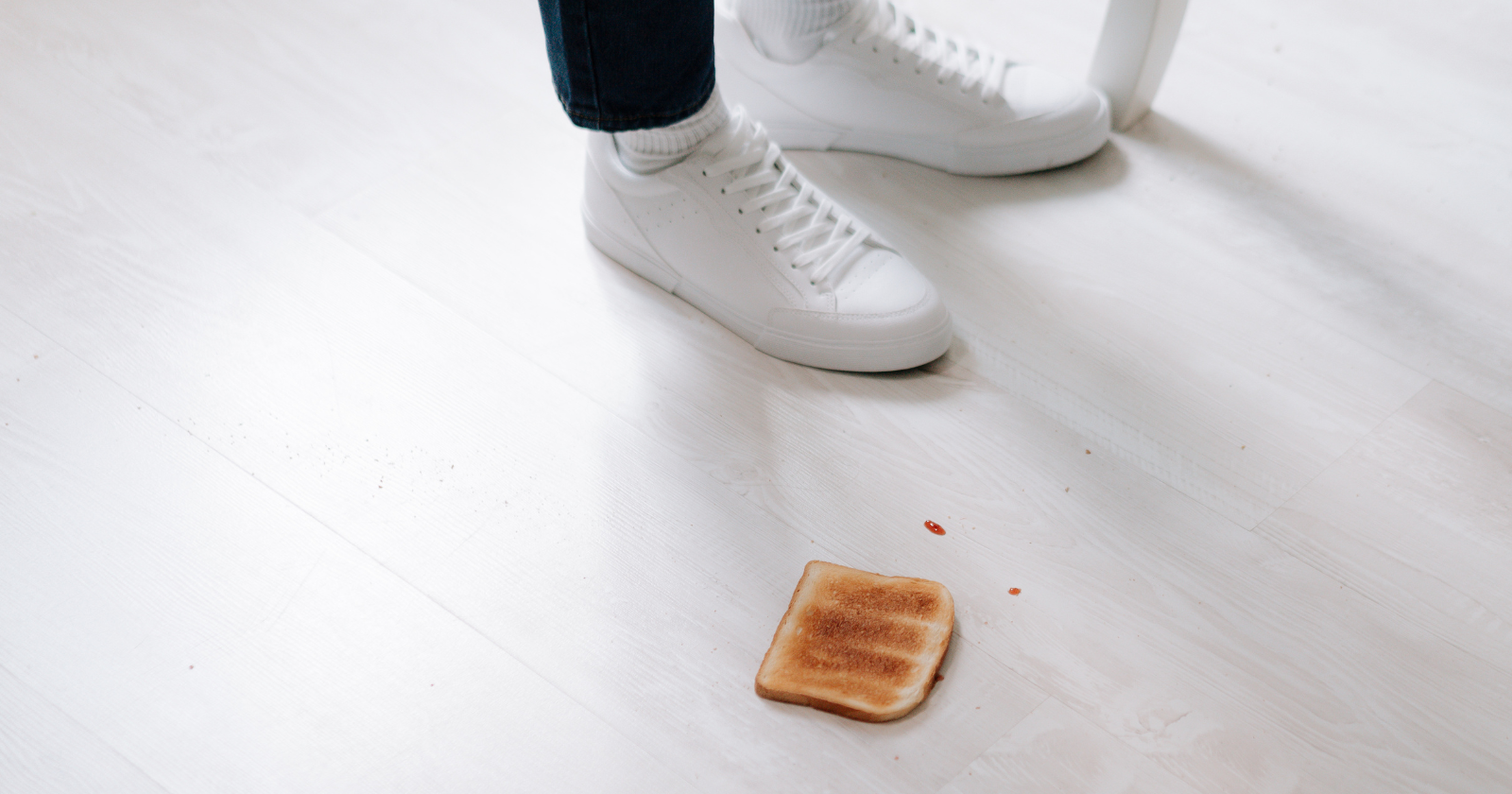
Food was dropped onto deliberately filthy surfaces 2,560 times, from a height of exactly 12.5 centimetres, by gloved hands with a timer running. None of it was eaten. Every piece went into a sterile bag, got pulverised, and ended up smeared across a culture plate.
That is the scale of the 2016 experiment run by Robyn Miranda and Donald Schaffner at Rutgers University, published in the journal Applied and Environmental Microbiology. Their conclusion was blunt. Bacteria do not politely wait out a count of five, and some of it moved across in under a second.
How you test a playground rule properly
Four surfaces went under the food: stainless steel, glazed ceramic tile, maple laminate and indoor-outdoor carpet. Four foods went on top: cut watermelon, plain white bread, bread with butter, and strawberry gummy lollies. Contact times were under one second, five seconds, 30 seconds and a luxurious five minutes. Two different growing broths were used for the bacteria, because the goo the microbes arrive in turns out to matter as well.
That produces 128 possible combinations, and each one was repeated 20 times.
The bug in question was Enterobacter aerogenes, a harmless relative of Salmonella that sticks to things in much the same way. Each surface got about ten million cells and was left to dry for five hours before anything landed on it. Then a piece of food was released from 12.5 centimetres up, which was the highest drop that still guaranteed the food would hit the target square flat.
Moisture does the heavy lifting
Watermelon was a catastrophe. As much as 97 per cent of the available bacteria came across, and in the runs using the richer broth, holding it there longer made no significant difference. The fruit was already soaked through the instant it touched down. Gummy lollies took up the smallest load, topping out near 62 per cent and usually sitting far below that. Bread and buttered bread landed in between and behaved far less predictably from one drop to the next.
Schaffner put the mechanism in one line in the announcement from Rutgers: bacteria have no legs, so they travel with the moisture. Watermelon flesh measures a water activity of 0.99, which is roughly as close to being a puddle as a solid food can get. It also presents a smooth, flat face to the floor, with no crumb structure to keep the contact points apart.
Carpet, of all things, comes out best
Here is the finding that upsets people. Carpet gave up almost nothing, in some conditions around 0.2 per cent, while tile and stainless steel could hand over far more. Fibres appear to grab bacteria and keep them, and the raised pile means only a fraction of the food ever touches anything.
Wood sat in the middle and was the most erratic performer of the four.
None of which makes a carpet a hygienic place to keep your biscuits. Carpet is simply reluctant to share, a useful thing to know and a terrible thing to build a snack habit on.
A teenager got there first
Before any of this, in 2003, a high school intern named Jillian Clarke spread E. coli on laboratory tiles at the University of Illinois and dropped cookies and gummy bears on them. Bacteria moved across within five seconds. She also swabbed campus floors and found them startlingly clean. A survey she ran alongside the lab work put familiarity with the rule at about 70 per cent of women and just over half of men, most of whom said they acted on it. That work earned her the 2004 Ig Nobel Prize for public health, awarded for research that makes people laugh and then makes them think.
Peer-reviewed work followed in 2007, when Paul Dawson and colleagues at Clemson University tracked Salmonella moving from tile, wood and carpet onto bologna and bread. Longer contact meant more bacteria, but mainly on surfaces contaminated at least eight hours earlier. Their carpet figures came in low as well.
Then in 2014 a team at Aston University in Birmingham, led by microbiologist Anthony Hilton, announced findings that were read as a win for the rule. Time mattered, carpet came off best again, and the headlines wrote themselves. That work went out as a university media release rather than a peer-reviewed paper, which is a distinction most of the coverage skipped.
What a single study can carry
One experiment, however many replicates it runs, tests the conditions it was given. Miranda and Schaffner used one organism, four surfaces and a deliberately enormous starting dose. Nobody’s kitchen floor carries ten million cells in a 25 square centimetre patch, and if it does, the watermelon is the least of the problems in that house.
Clarke’s swabs are the useful counterweight. She reported that the campus floors she sampled, walked on all day by hundreds of people, carried too little to count, and that part of her work never made the headlines. A dry floor in a house with no sick people and no raw chicken juice is a low-risk surface. A wet patch by the bin is another matter, and so is the tile where a pack of mince leaked an hour ago.
Which puts the odds in the hands of the floor rather than the reflexes. The stopwatch was always the wrong instrument, and the swab, the one nobody owns, was the right one.