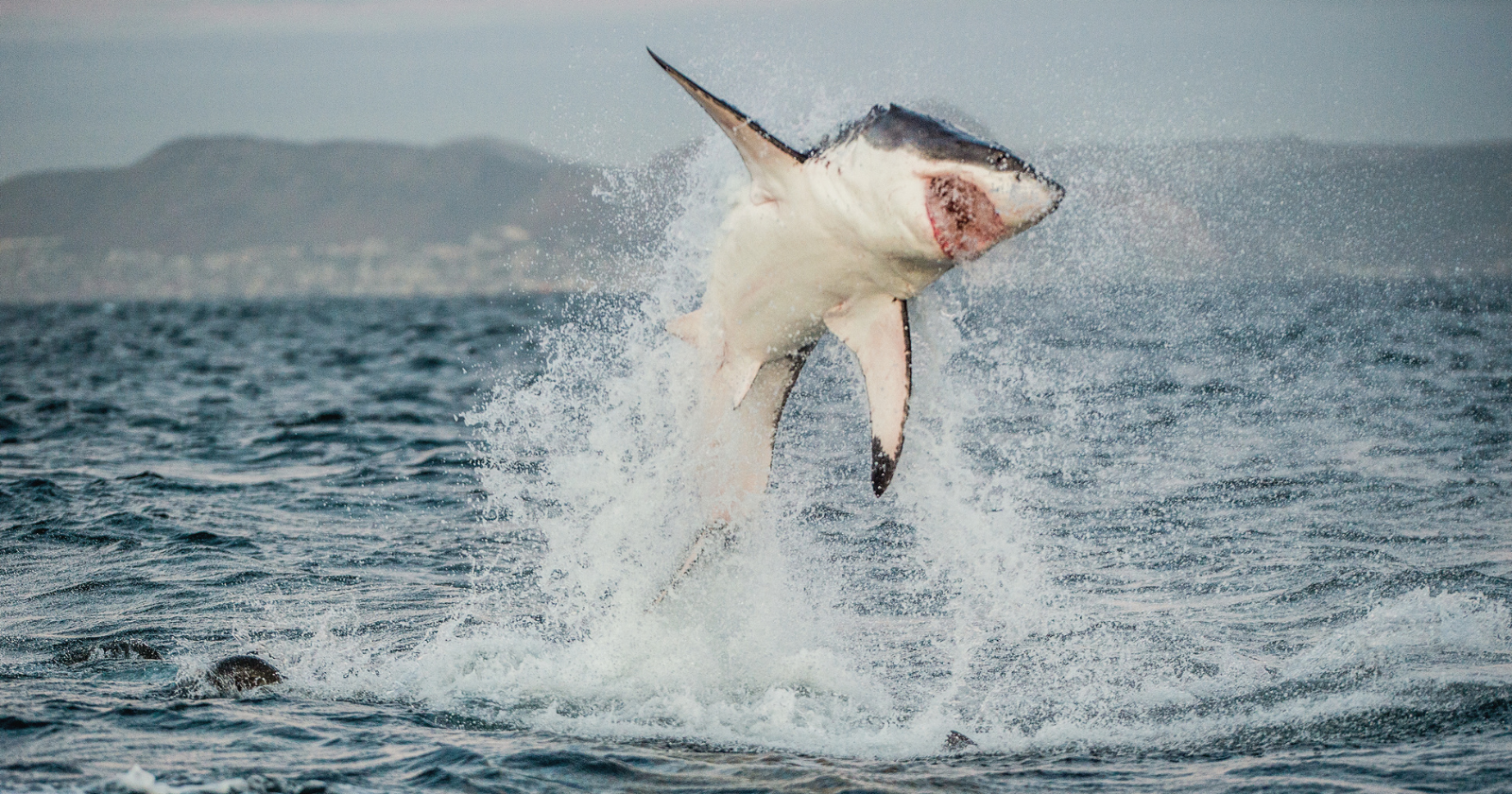
Sharks were already ancient by the time the first tree worked out how to stand up.
The evidence for their head start is spectacularly unglamorous. A scattering of tiny scales, pulled from Late Ordovician rock roughly 450 million years old, with no jaws or skeletons attached to them. They are dermal denticles, the tooth-like studs that still give shark skin its sandpaper feel. Emma Bernard, curator of fossil fish at the Natural History Museum, has pointed out that no teeth have turned up alongside them, which leaves open the odd possibility that the earliest forms had none at all. Researchers are also still arguing over whether those scales came from true sharks or from something standing very close by in the family tree.
Call it 450 million years, then, with an asterisk.
Now go looking for a tree in that world.
What was actually growing on land
Plants had made it ashore by then, although the word “plant” is doing heavy lifting. Tightly fused clusters of spores called cryptospores show up in rocks about 469 million years old. Jennifer Morris of Bristol and her co-authors, in a paper published in Proceedings of the National Academy of Sciences, treat those as the oldest fossils that can confidently be called land plants. Their genetic dating pushes the origin of the group back further still, into the middle Cambrian.
Nobody has the parent plants themselves. What the spores imply, backed up by later fossils, is something liverwort-ish and moss-ish: flat, soft, damp-dependent, pressed against wet ground, with no roots worth the name and nothing that could hold weight above the surface.
Height arrived slowly and it arrived small. Cooksonia, the earliest confirmed plant with internal plumbing, turns up in Silurian rocks and stood, per Britannica, about six centimetres tall. Picture a leafless green fork with spore capsules on the tips, roughly the height of a golf tee. That was the cutting edge of terrestrial life while sharks had already been cruising the shallows for tens of millions of years.
The first thing worth calling a tree
Trees turn up in the Middle Devonian, and the proof of them arrived in two instalments separated by 137 years. Quarry workers near Gilboa in upstate New York uncovered hundreds of fossilised stumps in the 1870s, and for well over a century nobody could say what had grown out of them. Then William Stein of Binghamton University, Christopher Berry of Cardiff and colleagues reported in Nature that they had found an intact crown of a plant called Wattieza, still attached to one of those trunks. That handed palaeobotanists a proper reconstruction of the world’s oldest known forest, at around 385 million years.
It stood about eight metres, resembled a tree fern, carried fronds instead of leaves, and kept its roots shallow. Not much of a tree by modern standards. An enormous one by the standards of everything that had come before.
An older forest on the Somerset coast
That record shifted in 2024. Writing in the Journal of the Geological Society, Neil Davies of Cambridge, William McMahon and Christopher Berry described fossilised trunks, root traces and preserved forest floor in the Hangman Sandstone cliffs near Minehead, on the Devon and Somerset coast, dating to roughly 390 million years ago. The trees, a hollow-trunked type called Calamophyton, grew two to three metres high and shed twigs constantly.
Speaking to the University of Cambridge, Berry sketched a landscape with no undergrowth and no grass, just densely packed trees dropping debris everywhere. Davies added that all that litter piling into the sediment changed how rivers moved across the land, marking the point where water began carving the world the way it does today.
The fossils sit in cliffs a short drive from a Butlin’s holiday camp, which is a fair summary of how geology distributes its treasures.
Measured against Gilboa’s 385 million years, sharks come out roughly 65 million years older than trees, which is the figure that tends to get repeated. Measured against Somerset’s 390, the gap trims to about 60. Geology keeps revising its own arithmetic.
What the newcomers did next
The real innovation was underground. Later Devonian trees, particularly the genus Archaeopteris, sank deep root systems into rock and soil, and deep roots break stone. That accelerates chemical weathering, which pulls carbon dioxide out of the atmosphere, and it flushes nutrients downhill into rivers and eventually into the sea.
A study led by Gabriel Filippelli and Matthew Smart, detailed in a release from the Geological Society of America, traced phosphorus signatures through ancient lake beds in Greenland, northern Scotland and Orkney. Across five separate sites, elevated phosphorus lined up with the arrival of rooted trees, and at two of those sites it coincided with a marine extinction event, including the Late Devonian mass extinction. Their argument is that root-driven runoff fed algal blooms; the blooms then stripped oxygen from the water, and the oceans paid the price. This is one line of chemical evidence for a contested idea rather than a settled verdict, and plenty of researchers put more weight on cooling and other drivers.
Either way, the trees showed up and the planet’s chemistry changed.
That quietly inverts the usual moral of the story. Sharks tend to get cast as the unchanging survivors, patiently outlasting everything, and they have certainly outlasted a lot. They also changed enormously along the way, with most of the families swimming around today tracing back only about 100 million years. The lineage is old. The animals are not.
The trees were the disruptive arrivals, and the sharks simply kept swimming through the consequences.