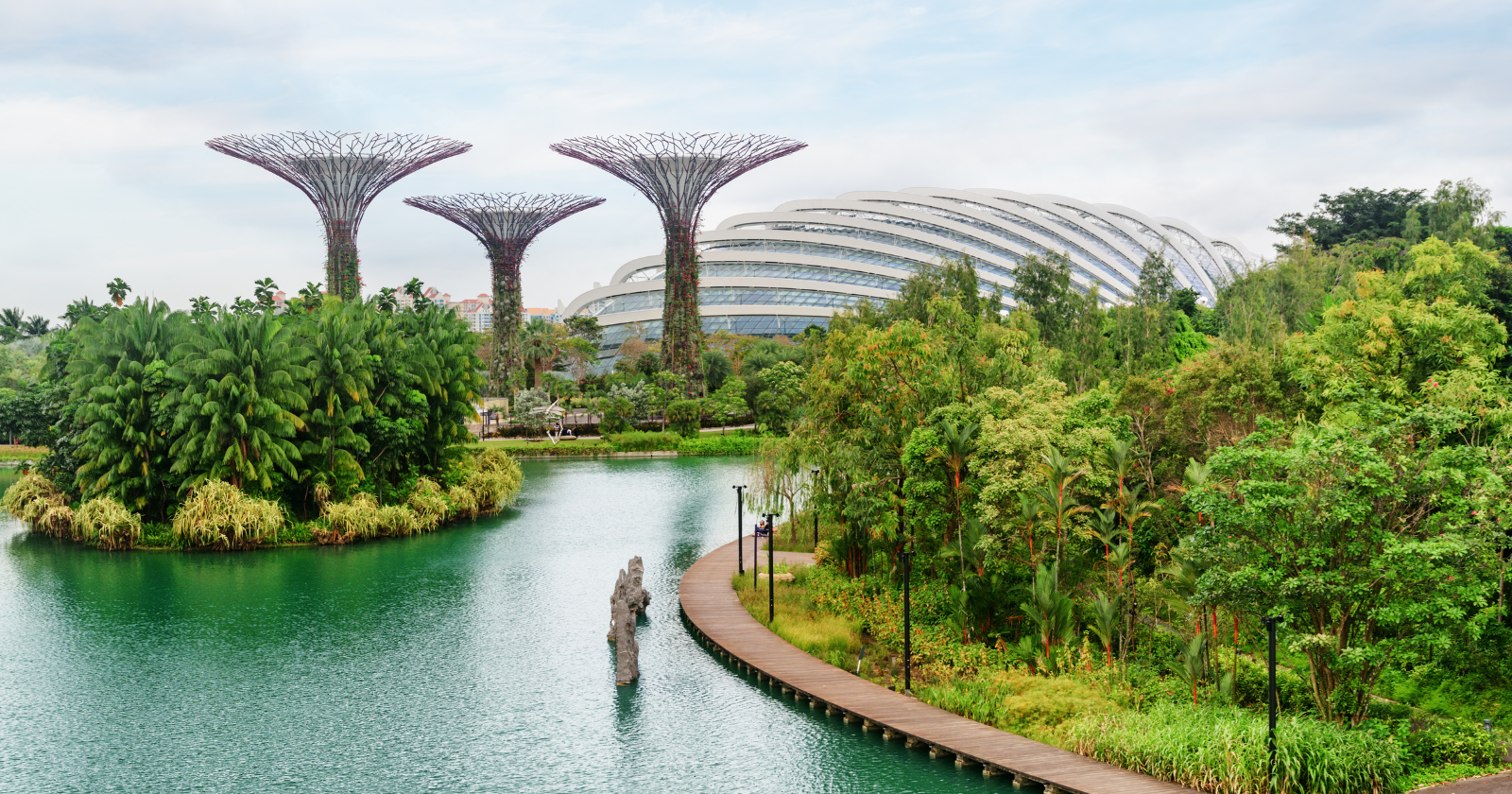
There is a moment on a Singapore footpath, somewhere around two in the afternoon, when a person would happily hand over their wallet for six metres of canopy.
That instinct turns out to be well calibrated. Singapore has spent six decades planting trees with the enthusiasm most countries reserve for motorways, and the science catching up to that habit points to two separate payoffs: cooler air above the road, and a lighter load on the electricity meter inside the building beside it.
What shade actually does to a thermometer
On a punishing August afternoon in 2023, researchers walked routes through Singapore’s one-north district hauling panoramic cameras, thermal imagers and heat stress trackers. Writing in Science of the Total Environment, Lei Xu, Ronita Bardhan and colleagues reported that street shade trimmed roughly 0.8 degrees Celsius off air temperature across twenty paired sunlit and shaded sites.
Modest. The bigger number tracks something a thermometer misses entirely: how a body actually registers heat. Measured on the Universal Thermal Climate Index, which folds in radiant heat, humidity and air movement, shade took off an average of 3.1 degrees, and headed off 92 per cent of the extreme heat stress the team would otherwise have logged.
Bardhan, who supervised the study through the Cambridge Centre for Advanced Research and Education in Singapore, has argued that street shading deserves to be treated as essential infrastructure, especially for people whose work keeps them outdoors.
One paper, one afternoon, twenty sites. Worth holding lightly, though the direction matches a large body of urban climate work elsewhere.
Where the famous 2.6 degrees comes from
Singapore’s planning literature has long quoted a ceiling of 2.6 degrees of street-level cooling from trees. Trace that figure back and it lands in Strategies for Cooling Singapore, a catalogue of 86 heat mitigation measures assembled by researchers at the Singapore-ETH Centre, SMART, TUMCREATE and the National University of Singapore. The catalogue credits the 0.9-to-2.6-degree range to Sten Gillner and colleagues, who monitored street trees at heavily paved sites in Dresden, Germany.
The same document puts Singapore’s urban heat island at about 4 degrees on average, occasionally past 7. So even the optimistic end of the tree range is a dent rather than a cure, which is roughly what the researchers themselves say.
The argument about air-conditioning
Singapore runs more air-conditioning units per capita than anywhere else in Southeast Asia, and NUS professor Wong Nyuk Hien has described the machines as pervasive and energy-hungry in equal measure. Anything that lightens the load on them matters more than a couple of degrees on a footpath.
This is where canopy near a facade starts earning its keep. Trees intercept solar radiation before it reaches a wall, which keeps the wall from turning into a slow-release radiator. The Cooling Singapore catalogue cites experimental fieldwork on a Nigerian university campus by Morakinyo and colleagues, in which an unshaded building’s indoor temperature ran up to 5.4 degrees above outdoor conditions, while its tree-shaded neighbour never exceeded 2.4. Simulations of vertical greenery on Singapore buildings, cited in the same volume, showed cooling-load reductions ranging from roughly 10 to 31 per cent, depending on how much of the facade was covered and how dense the foliage was.
Scaled up, the accounting gets eye-catching. A team assessing the open-source InVEST urban cooling model against Singapore data estimated that vegetation-driven cooling cuts 228 gigawatt hours a year from public housing energy use, worth about 47 million Singapore dollars a year across roughly 11 million square metres of block footprint. That figure comes out of a model calibrated against observed temperatures, and the authors publish a confidence interval wide enough to drive a bus through, running from roughly 28 million to 66 million dollars.
What trees cannot do
Evapotranspiration, the process by which plants release moisture and cool the surrounding air, achieves far less in the humid tropics than in a dry city, because the air is already close to saturated. The Cooling Singapore authors say so plainly. Pack trees too densely and the canopy also blocks wind, trapping humidity and pollutants in exactly the streets planners were trying to improve.
Shade, then, is doing most of the heavy lifting. It is why the one-north team found that layering canopy with bus shelters and overhangs beat either approach on its own. Trees keep air moving while they block the sun; a solid overhang kills the radiation but also the breeze. Combine the two and the researchers put the ceiling for well-shaded stretches at 3 to 5 degrees, though they note that reaching that level through planting alone would take decades.
Eight million trees and a basketball court
Since April 2020, the National Parks Board has been running the OneMillionTrees movement, a decade-long push to plant a million additional trees and lift the national total past eight million. The agency’s baseline rate was around 50,000 a year, so hitting the target means sustaining roughly double that pace for ten straight years.
Scale is not the only lever, though. In March 2026, NUS researchers presented findings from a dense microforest planted outside City Square Mall, roughly the footprint of a basketball court, which cooled its immediate surroundings by up to 5 degrees and turned up around 70 per cent more species than a nearby grass patch. Developers doubled the plot’s size in January 2026.
Which suggests the useful unit of climate policy in a land-scarce city may not be the forest or the park at all, but the awkward leftover corner that nobody had costed as infrastructure until somebody put a sensor in it.