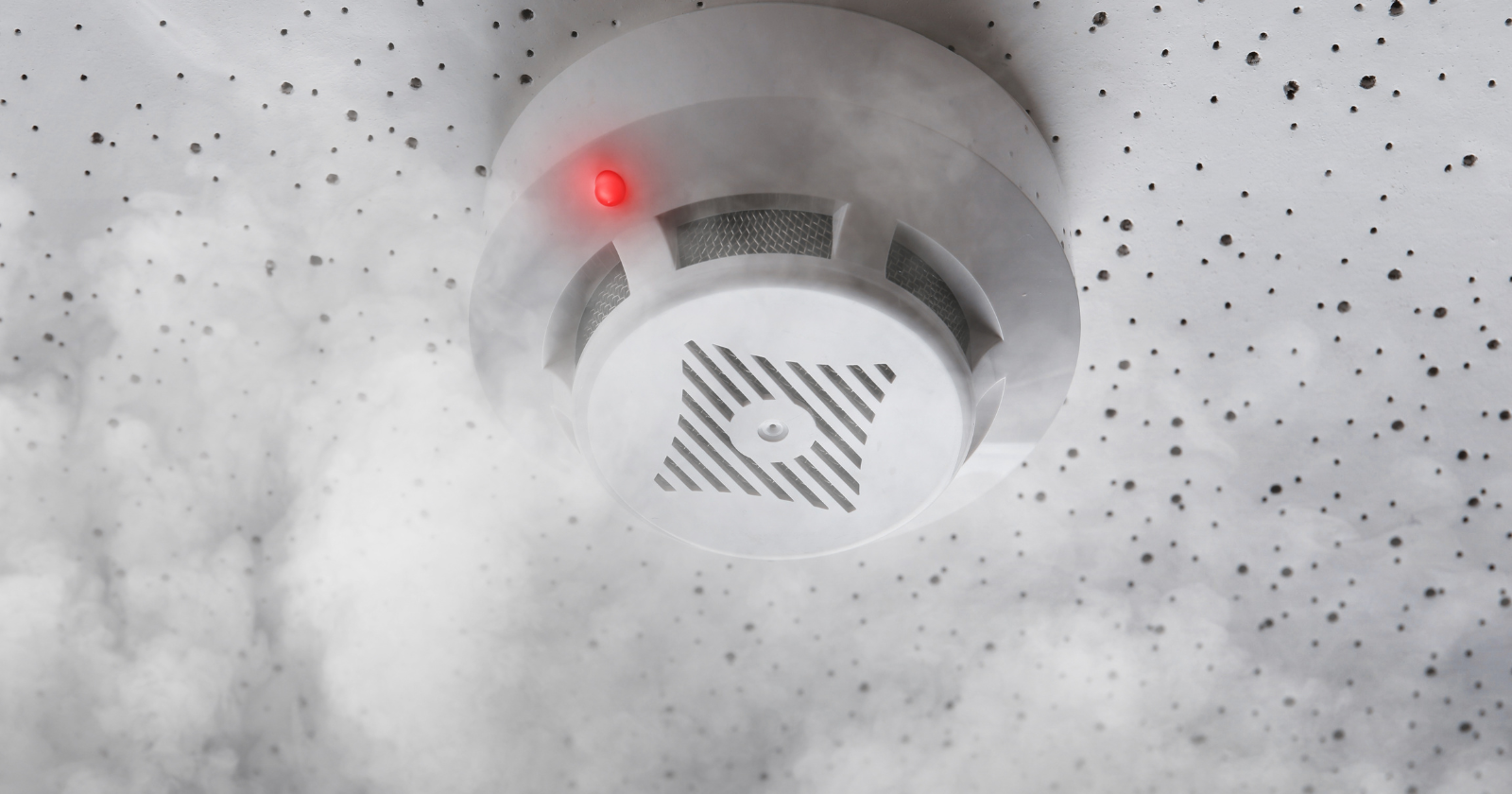
Screwed to the hallway ceiling, chirping once a year and otherwise ignored, sits one of the strangest descendants of the Manhattan Project most households will ever own.
An ionisation smoke alarm carries roughly 0.3 micrograms of americium-241, an element that did not exist on Earth in any usable quantity until people built reactors capable of making it. The finished device sells for about ten dollars.
An element announced on a children’s radio show
Americium was first isolated in late 1944 by Glenn Seaborg, Leon Morgan, Ralph James and Albert Ghiorso, who bombarded plutonium-239 with neutrons and let the decay chain do the rest. As documented by Los Alamos National Laboratory, the wartime work stayed secret until it was cleared for a chemistry symposium in November 1945.
Seaborg beat his own announcement by five days. He turned up as a guest on the NBC panel show Quiz Kids, where a child asked whether anything new had been found beyond plutonium and neptunium. Seaborg said yes, named elements 95 and 96, and told the nation’s schoolchildren their textbooks were now four elements out of date. The Royal Society of Chemistry dates the slip to 11 November 1945 and notes that he put the name americium forward the following year.
A failed gas detector and a cigarette
The alarm itself has an equally offhand origin. In the late 1930s the Swiss physicist Walter Jaeger was building a sensor for poison gas, and it stubbornly refused to register any. He lit a cigarette in frustration and the meter moved. Per the US Nuclear Regulatory Commission, that accident led towards the device now bolted above the stairs.
Commercial approval took another quarter of a century. The Atomic Energy Commission licensed the first radioactive detectors for distribution in 1963, mostly into factories and warehouses, and cleared householders to use them without a licence in 1969.
What the speck actually does
Alpha particles stream off the americium and knock electrons loose from the air inside a small chamber. Two charged plates collect the resulting ions, setting up a steady trickle of current, and the US Environmental Protection Agency describes the alarm as triggering the moment smoke breaks that flow.
Alpha particles are energetic enough to ionise air and so short-ranged that thin foil can stop them, which is the whole reason a radioactive source can be hung above a bed.
How much radiation is in the hallway
Almost none. Most units hold one microcurie or less. The regulator puts a two-alarm household under 0.002 millirems a year, a dose an East Coast resident picks up from natural background in about twelve hours and a Denver resident in three. The source is rolled thin between two layers of metal and sealed into the chamber, openable only by deliberate force, which it politely discourages.
Its 1979 analysis found that ten million unwanted alarms a year could go safely into the rubbish, which remains the official advice.
Australia is showing it the door
Several governments have decided the ionisation design is the wrong default, for reasons that have nothing to do with the radiation. Those alarms are being phased out in Australia, Belgium, France and Germany, per the World Nuclear Association, in favour of photoelectric units that watch for light scattering off smoke particles.
Queensland has pushed hardest. Every private home, townhouse and unit in the state needs interconnected photoelectric alarms by 1 January 2027, and the rules published by the Queensland Fire Department state plainly that a compliant alarm must not contain an ionisation sensor. Photoelectric units catch smouldering furniture fires sooner, and older ionisation designs have also been more prone to nuisance alarms from cooking, at least in the field data summarised by the National Institute of Standards and Technology. That second point matters, because the department warns against the householder’s favourite remedy for a screaming alarm, which is removing the battery.
Moon missions are next in line
Supply has always been the awkward part. Rocky Flats in Colorado turned out americium-241 for commercial sale from 1962 to 1984, the leftover inventory ran dry by 2004, and American buyers leaned on Russian material for years afterwards. Los Alamos restarted domestic production in 2017 and delivered its first shipment in 2020, pulling the isotope out of plutonium residues where it had been sitting as a contaminant nobody wanted.
Europe came to americium from the other direction. Facing a global shortage of plutonium-238, the European Space Agency chose americium-241 for the nuclear batteries meant to keep landers alive through the lunar night. In 2019, researchers at the UK’s National Nuclear Laboratory used heat from americium extracted at Sellafield to light a small bulb.
So the element is being quietly evicted from Queensland hallways for being slow off the mark on a sofa fire, and simultaneously fitted to batteries powered by an isotope with a half-life of more than four centuries. Much of the americium now being eyed for space power began as an unwanted by-product of nuclear material. Few contaminants get a second act that good.