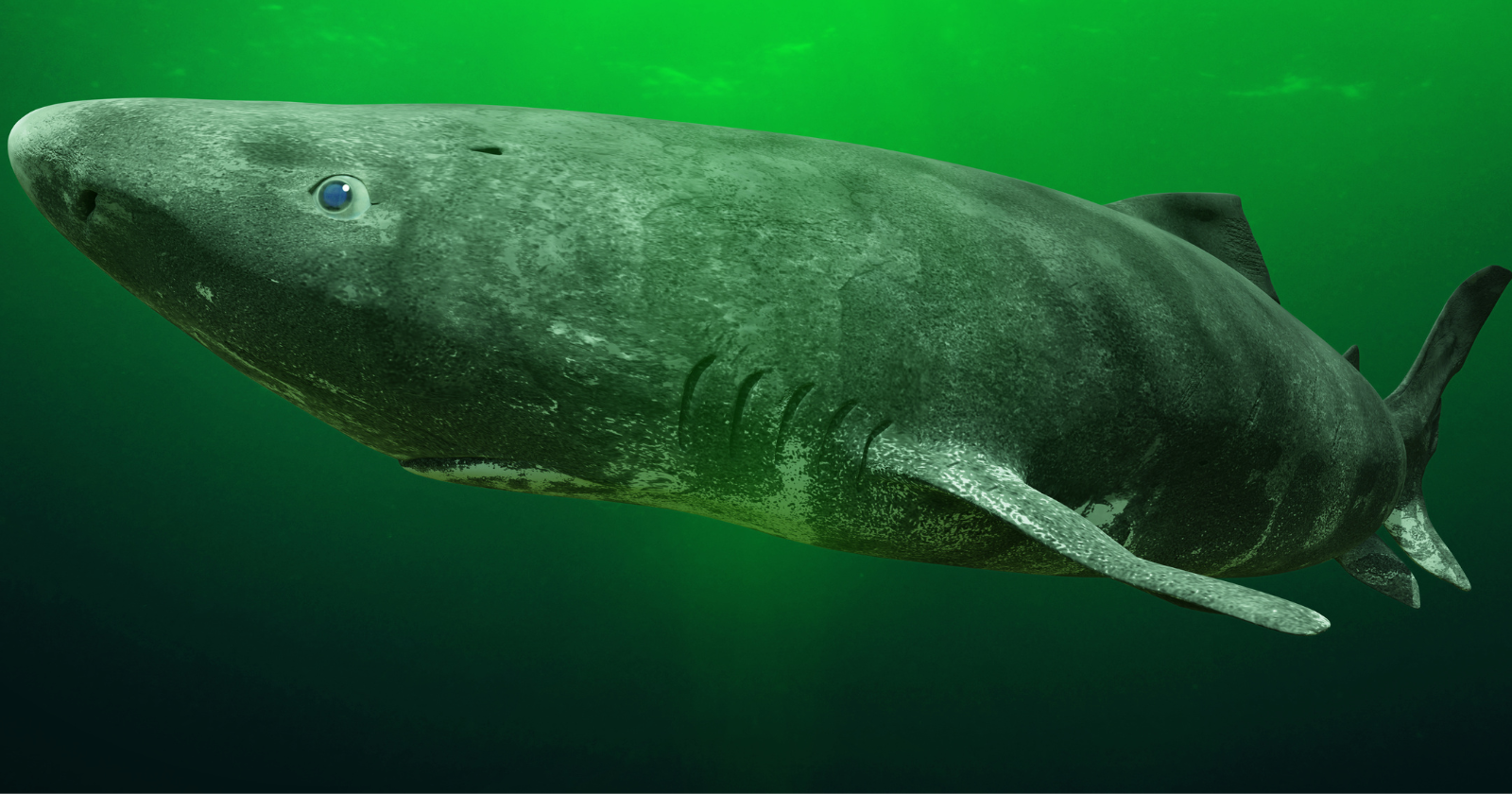
Someone out for a slow walk moves at roughly the same pace as a Greenland shark cruising through Arctic water. That shark may have been keeping up the pace since before Mozart was born.
That pace has been measured, and not from a boat deck either. Yuuki Watanabe and colleagues attached data loggers to six free-swimming Greenland sharks and clocked them moving at 0.34 metres per second, a shade over one kilometre an hour, with a single sweep of the tail taking about seven seconds. The team, writing in the Journal of Experimental Marine Biology and Ecology, found these to be the lowest figures recorded for any fish of comparable size. Water temperature during the study sat near 2 degrees Celsius.
Burst speed maxed out at 0.74 metres per second, barely double that pace, and still slower than a seal can swim. Seal remains keep turning up in Greenland shark stomachs anyway, so Watanabe’s group floated the explanation that the sharks pick them off while they nap in the water. Unglamorous, but it works.
Dating a shark through its eye
Greenland shark eye lenses grow in layers, and the proteins at the dead centre are laid down early in life and never replaced. That makes the lens core a small biological time capsule, immune to the chemical churn of the rest of the body.
A team led by Julius Nielsen took advantage of this, measuring radiocarbon in the lens nuclei of 28 female sharks and publishing the results in Science in 2016. The smallest animals carried traces of the nuclear bomb pulse from the early 1960s, which gave the team a dated reference point. Working back from there, the largest shark in the sample, five metres of it, came out at 392 years old, plus or minus 120.
Wide error bars, one study, one method. It remains the best number anyone has, and it comfortably clears the previous vertebrate record holder, the bowhead whale, which manages a little over two centuries.
A body that spends almost nothing
Slow swimming is cheap. Cold water makes it cheaper still. A shark’s muscles run at whatever temperature the ocean hands them, and at 2 degrees, most of its chemistry slows to a crawl.
Eric Ste-Marie and colleagues put actual numbers on this by running field respirometry on sharks up to 126 kilograms, the largest individual shark ever measured that way. They reported in Scientific Reports that resting metabolic rates were remarkably low in absolute terms, though close to what scaling relationships predict once body mass and temperature are factored in. A follow-up study using archival biologgers, published in the Journal of Experimental Biology, translated that into groceries: an average 224-kilogram shark needs somewhere between 164 and 193 grams of prey a day to keep the lights on.
A single Greenland halibut of about a kilogram covers most of a week. Going by the same team’s numbers, fifteen kilos of ringed seal could carry an animal for eight months.
The chemistry inside a Greenland shark is strange too. Its tissues are saturated with urea and trimethylamine N-oxide, compounds it uses to keep its body fluids balanced against seawater. The side effect is flesh that’s toxic to eat raw. It has to be fermented and dried first, which is exactly what Icelandic curing does.
Adolescence that lasts 150 years
Slowness stops being charming at the point of reproduction. That same radiocarbon work put female sexual maturity at roughly 156 years, give or take 22. A review of 312 specimens gathered over six decades, published in PLOS ONE, found females reach maturity at about 4.2 metres in length.
Getting to 4.2 metres takes a while when growth runs at under a centimetre a year.
Run the arithmetic and it gets odd. A female becoming reproductive this year was born around the 1870s, before the electric light bulb was a commercial product, and she has spent every decade since then getting by on very little food and waiting.
What the genome hints at
Two teams have now sequenced the thing, and they landed on slightly different totals. Researchers at the Leibniz Institute on Aging and Ruhr University Bochum posted a preprint describing an assembly of roughly 6.45 gigabases in 2024, among the largest genomes sequenced outside the four-limbed branch of the tree, with most of the bulk supplied by transposable elements, the so-called jumping genes. They also flagged a cluster of duplicated genes involved in DNA repair, plus an unusual insertion in the tail end of p53, the tumour suppressor that keeps damaged cells from multiplying.
A second group, writing in PNAS this year, produced a 5.9-gigabase assembly and pointed to expanded immune gene families, signals of cancer resistance and, again, DNA repair.
None of this demonstrates a mechanism. Gene duplications are a hypothesis about longevity, and the scientists involved say so themselves. Nobody has found a switch labelled four hundred years.
Slow biology meets fast fisheries
Roughly 3,500 Greenland sharks are pulled up as bycatch every year across the Northwest Atlantic, the Arctic Ocean and the Barents Sea, according to IUCN estimates. In 2020, the Red List shifted the species from near threatened to vulnerable, as reported by Mongabay. Trawl gear does not care how old an animal is.
An animal that takes 150 years to produce its first pup cannot restock a population on any timetable a fisheries manager would recognise. Four centuries of patience, and the bill arrives inside one human career.