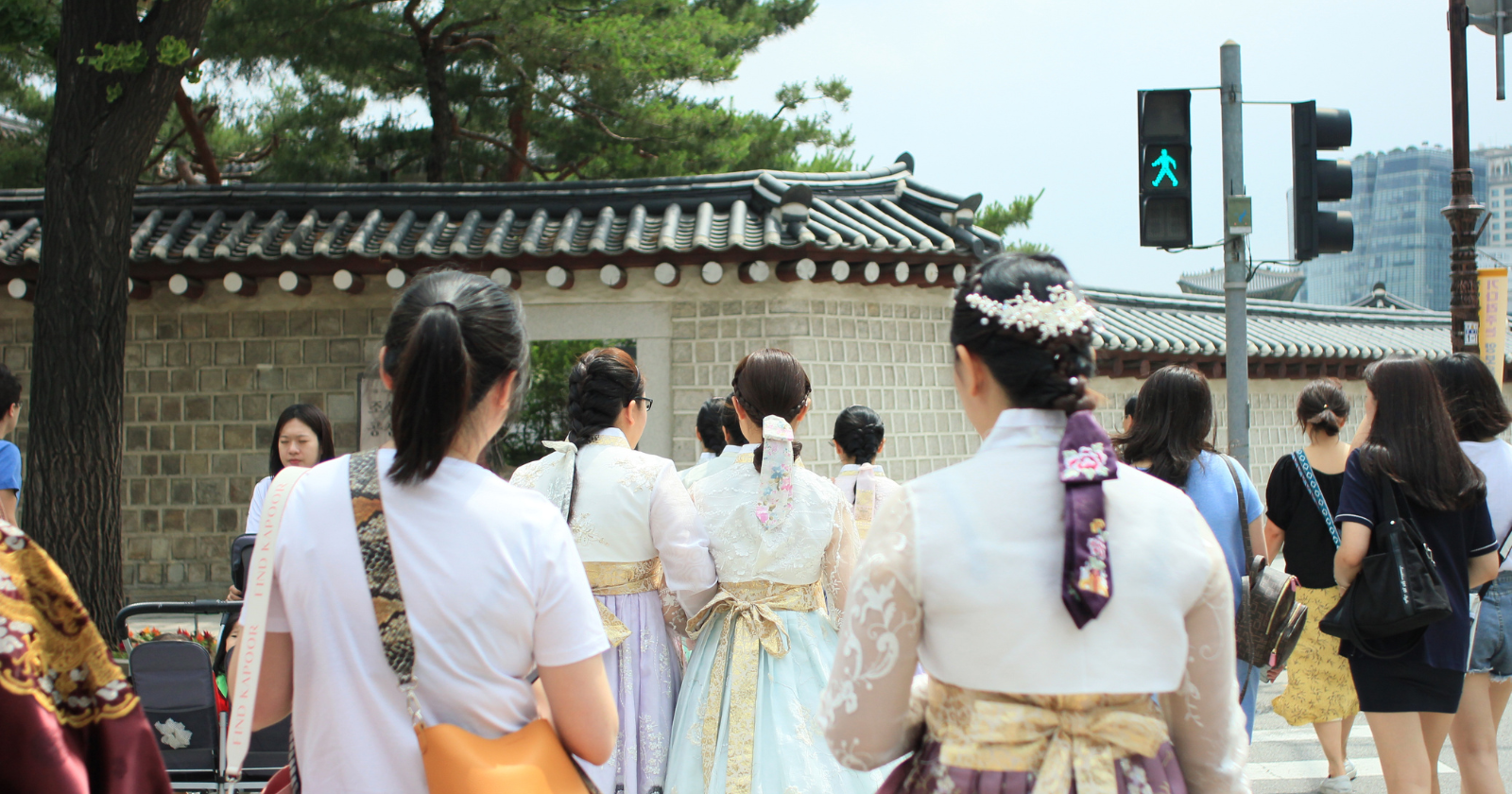
Somewhere right now a woman is standing in a doorway running calculations: who in there is tense, who has been talking too long, whether the joke she rehearsed on the way over will land or thud. By the time she says hello, she has already worked out which version of herself is safest to bring inside.
Koreans have a word for that scan. Nunchi, literally eye-measure, is the fast read of a room’s temperature and the adjustment that follows. In an interview with NBC News, the journalist Euny Hong, whose book carried the concept to Western readers, described nunchi as “a secret weapon of the disadvantaged.” That framing has more teeth than the self-help shelf gives it credit for.
Who gets taught to look first
The task of watching runs downhill in a hierarchy. In an essay that won the Berkeley Language Center‘s 2025 contest on untranslatable words, Lucy Eunhyul Kim described growing up between Korea and the United States and finding nunchi both her sharpest asset and her deepest confusion. In Korea, she wrote, a well-timed glance can carry more than a paragraph. Children absorb this before they have words for it.
Gender layers onto that hierarchy too, and not always where popular wisdom assumes.
When the scan never switches off
In the 1980s, twelve depressed women in the US Pacific Northwest sat down with a psychologist named Dana Crowley Jack and talked about their relationships. What she heard from them became Silencing the Self, published by Harvard University Press in 1991. Women learn to judge themselves through other people’s eyes, to treat caring as putting themselves last, to bury feelings that might cause trouble, and eventually to live split between an agreeable outside and a furious inside. Jack framed these as relational templates rather than fixed traits. That distinction matters, because templates are built by circumstance and can be dismantled by it.
Set that list beside a description of excellent nunchi and the overlap is uncomfortable. Same vigilance, same speed, different destination.
What three decades of data show
Does that pattern hold up three decades on? Jack, with Leslie Brody and Jennifer Sikov, went back through the evidence in a review published in Sex Roles in February 2026, covering 126 studies that used her Silencing the Self Scale. The pattern was consistent. Self-silencing clustered in unfair and hurtful environments, in settings shaped by traditional ideas about gender roles, and in relationships marked by conflict and lopsided power. Circumstance, in other words, more than temperament.
One finding in the same review complicates the popular story, and it deserves saying plainly. Twenty-nine studies compared men and women on the scale. None found women scoring higher, and nineteen found scores significantly higher among boys and men.
The habit itself turns out to be gender-neutral. What splits along gender lines is the social deal attached to it: a quiet man is often read as steady. A quiet woman gets handed the monitoring as an unpaid duty, then assessed on how gracefully she performs it. This is one review of one literature, and its authors flag the gaps themselves, particularly around culture and gender identity.
The room really does punish the alternative
Picture two identical résumés: same experience, same confident answers in the interview, different names at the top. Laurie Rudman and Peter Glick, in a 1999 paper in the Journal of Personality and Social Psychology, found that assertive female applicants were judged less socially skilled than identical male applicants. That judgement cost them hiring recommendations for jobs where being pleasant was part of the brief. Their conclusion had a nasty symmetry. Women needed to look assertive to seem employable, and got marked down as interpersonally deficient the moment they did.
Shrinking, then, is rarely a failure of nerve. Quite often it is an accurate reading of a rigged room, which is exactly what nunchi is for.
The bill arrives forty years later
Tiny accommodations compound. The OECD’s 2025 pensions country note for Korea puts the gender gap in hourly wages at 28 per cent, the widest of any member country, compared with an average near 11 per cent. Combine that with differences in hours worked and years spent in employment and the expected gap in lifetime earnings reaches 50 per cent, compared with an OECD average of 35. Fewer than 40 per cent of Koreans over 65 drawing a contributory pension are women, though women make up 56 per cent of that age group.
Those figures are driven by career breaks and pay structures, not good manners. Politeness supplies the texture of the thing from the inside: one small yielding at a time, none of them worth a row on its own.
Forty years of not making a fuss adds up to a number somebody else gets to keep.
None of which makes nunchi a defect. Reading a room is how people avoid causing damage they never intended, and a world without it would be exhausting in a different way. Anyone who has sat through a meeting with a man who has none of it knows the cost of the alternative.
Nunchi will tell you precisely what a room wants from you. It was never built to tell you whether the room deserves what you give it.