

Key Takeaways
- MIT’s team discovered a synthetic fourth dimension in electrons within moiré crystals, revealing unexpected behavior in magnetic fields.
- They used naturally occurring ternary compounds for crystal growth, creating consistent moiré superlattices without manual assembly.
- This discovery allows for better exploration of higher-dimensional physics and potential applications in superconductivity and electronics.
- The findings suggest that electrons can experience effective forces in synthetic dimensions, leading to measurable physical signals.
- Researchers note that while promising, practical applications in four-dimensional electronics still require further exploration.
The numbers didn’t add up. When Kevin Nuckolls and his colleagues at MIT pressed a tiny crystal against a magnetic field at the National High Magnetic Field Laboratory in Tallahassee and watched the electrons oscillate, the measurement came back with more than forty distinct frequencies, arrayed in a comb so regularly spaced that the spacing itself didn’t correspond to anything in the three-dimensional structure of the material. The obvious explanations were exhausted, one by one. Magnetic breakdown, quasiparticle interference, various non-standard mechanisms for generating phantom frequencies: none of them fit. What the data seemed to require, when the team finally looked at the problem from a different angle, was a fourth dimension.
The crystal belongs to a family of materials called moiré crystals, named, something like the moiré fabrics of 18th-century France, for the shimmering interference patterns that emerge when two slightly mismatched layers are stacked together. Physicists have been building moiré materials by hand since roughly 2014, stacking graphene sheets with Scotch tape and tweezers and considerable patience. What the MIT team found is different in kind.
Checkelsky’s lab at MIT found a way to let chemistry do the stacking. Rather than assembling moiré devices one layer at a time, they identified a class of naturally occurring crystals, a ternary compound of strontium, tantalum, and sulfur, in which alternating layers of two slightly different lattice types grow together during synthesis. The result is a material whose moiré superlattice is built into every layer simultaneously. Thousands of stacks, all essentially identical, produced in a single crystal-growth run rather than fabricated individually in a lab. “It feels incredible for our team to have made this materials discovery,” Nuckolls said. The moiré superlattice wavelength in the simplest variant is roughly 4 nanometres, comparable with the handmade versions that have consumed a generation of condensed matter physics.
The synthetic dimension isn’t a place the electrons go; it’s a mathematical structure that emerges from the interference pattern between two mismatched atomic lattices. Because that interference generates a new periodicity in the crystal, electrons experience effective forces and orbital constraints that can only be fully described using four-dimensional equations. The measurable consequence is a cascade of oscillation frequencies in a magnetic field that match the predictions for a 4D Fermi surface, not a 3D one. The electrons stay in the lab; their behaviour doesn’t.
Hand-assembled moiré devices are made one layer at a time, and tiny variations in twist angle or strain produce crystals with subtly different properties. That makes systematic experiments difficult and scaling to practical devices essentially impossible. The new bulk crystals grow with the moiré superlattice already built in, consistently, across thousands of stacks in a single batch. That’s a plausible route toward moiré-based electronics, and it also means experiments can be conducted on samples large enough for techniques, like the torque magnetometry used here, that simply don’t work on single flakes.
Loosely. The 2025 Nobel recognized work on superconducting quantum circuits, which depend on quantum tunneling between circuit elements. The MIT work involves a different kind of quantum tunneling, in which electrons appear to hop through a synthetic dimension rather than across a Josephson junction. What connects them is the broader theme of engineering quantum behavior by designing the environment the particles move through, rather than by changing the particles themselves.
Theorists have predicted for decades that higher-dimensional systems should support superconducting states with properties inaccessible in three dimensions, including forms that break symmetries requiring at least four spatial dimensions to express. Whether those predictions can be tested in the new moiré crystals is the most immediate experimental question the team has flagged. The material platform is now available; what it produces under the right conditions is genuinely unknown.
The synthesis alone would be significant. But the 4D finding is the stranger thing.
To understand what the team found, it helps to know how physicists read electrons in metals. When a metal is placed in a strong magnetic field, its electrons orbit in tight loops, sweeping out areas of momentum space that depend on the shape of the Fermi surface, a mathematical object encoding which quantum states the electrons can occupy. Measure the quantum oscillations of those orbits and you get, in principle, a direct map of the Fermi surface’s geometry. For an ordinary metal, the map is clean: a handful of frequencies, each corresponding to a distinct orbital cross-section. What Nuckolls and colleagues found was more than forty frequencies, linearly spaced, with nearly equal amplitudes across the whole cascade.
“Mathematically, the equations describing the electron dynamics in these crystals are four-dimensional,” said Nisarga Paul, a recent MIT PhD and co-lead author on the paper. The framework that finally made sense of the data came not from quantum materials physics but from crystallography, specifically from work done in the 1970s to describe quasicrystals. Without a repeating unit cell, quasicrystals defy standard lattice description; mathematicians found that the most natural account was to embed the incommensurate three-dimensional structure into a higher-dimensional periodic lattice from which it could be read as a projection. The MIT team applied the same logic to the electrons.
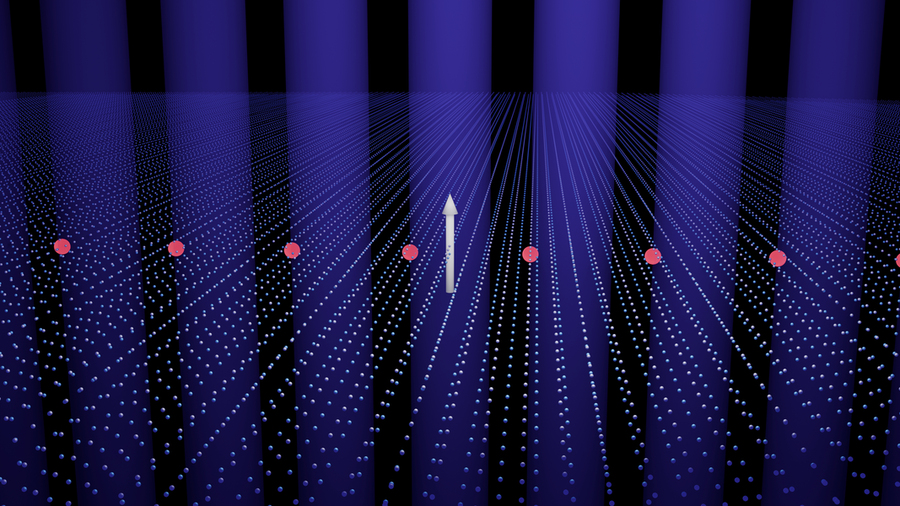
The idea, in brief, is this. The moiré superlattice, that long-wavelength interference pattern between the two mismatched atomic layers, generates a new effective dimension of momentum space, perpendicular to the three that physically exist. An electron sweeping its cyclotron orbit through the crystal can, in a sense, hop along this synthetic dimension, its orbit incrementing by a fixed quantum of area with each hop. Each successive orbit corresponds to one more step along the fourth dimension. Line them all up in frequency space and they produce the comb. “Our measurements uncover ‘shadows’ of emergent 4D landscape upon which the electrons live,” Nuckolls said. The electrons haven’t gone anywhere. They’re still confined to the three-dimensional crystal sitting in the lab in Tallahassee. They just behave as though they aren’t.
The physicists are at pains to be clear that the fourth dimension is synthetic, a mathematical structure encoded by the incommensurate lattice rather than a genuine additional direction in space. Whether that distinction matters much in practice is perhaps an open question. Quantum tunneling through a fictitious dimension produces real, measurable electronic properties. The frequency comb in the data is not a mathematical artefact; it’s a physical signal. And the theoretical predictions that become accessible in four dimensions have been worked out on paper for decades: higher-dimensional topological phases, superconducting states that break symmetries only expressible in four or more spatial dimensions, forms of conductance with no conventional analogue.
The synthesis route opens that possibility in a way that hand-assembled two-dimensional devices couldn’t. Moiré devices built by stacking exfoliated flakes are finicky: twist angle varies from sample to sample, strain gradients accumulate, reproducibility is a persistent headache. The new bulk crystals don’t have those problems. The moiré superlattice is set during growth, coherent throughout millimetre-sized crystals, and nearly identical diffraction patterns emerge from any crystal in a given batch. Checkelsky and colleagues showed that varying growth conditions, temperature sequences, precursor stoichiometries, the choice of salt catalyst, produces at least five distinct structural families with different superlattice wavelengths and orientations, without altering the chemical composition of the layers. That tunability is what makes it a platform rather than a single interesting specimen.
There is, as usual, a gap between interesting physics and usable technology. The path from four-dimensional Fermi surfaces to an electronic device exploiting four-dimensional topological protection is not obvious and probably not short. What Checkelsky’s group has demonstrated is a proof of concept: scalable moiré materials are possible, and the exotic physics they generate can be read from bulk crystals using established techniques.
Checkelsky pointed to what he called “long-standing theoretical predictions for higher-dimensional conductors and superconductors” as the most immediate territory to explore. The theoretical machinery exists; the experimental constraint has been the absence of a material clean and reproducible enough to test it. The new crystals may be that material. The higher-dimensional landscape the electrons navigate is, at the moment, mostly uncharted.
Nuckolls noted that moiré materials research has been driven out of MIT for more than a decade, from the Hofstadter’s butterfly discovery in 2014 through magic-angle superconductivity in 2018 to last year’s fractional quantum anomalous Hall effect without a magnetic field. This paper is continuous with that lineage. The tool has changed, the scale has changed, and the dimensionality, at least for the electrons, has changed too.