
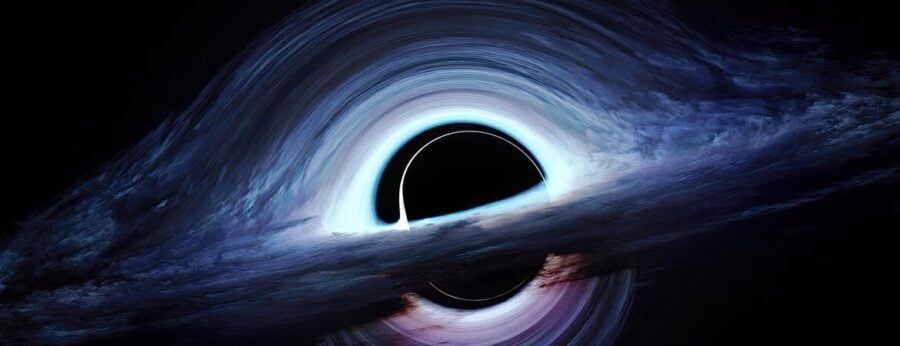
Before the first star had ignited, before any galaxy had taken shape, the universe was full of gas: cold, pristine, mostly hydrogen, floating in the dark. In certain pockets of that gas, something was happening at a scale almost too small to calculate. Particles of dark matter, drifting invisibly through the fog, were quietly decaying. Each one released a pair of photons carrying energies of roughly 12 or 13 electronvolts: not much. About a billionth of a trillionth the energy stored in a single AA battery. And yet, according to new research from UC Riverside, that whisper of energy may have been enough to reshape the destiny of an entire gas cloud, routing it away from starhood and toward something far more monstrous.
Key Takeaways
- The universe began with cold gas, primarily hydrogen, where dark matter particles decayed, potentially influencing gas cloud evolution.
- Research from UC Riverside proposes that decaying axions may disrupt molecular hydrogen, enabling direct collapse black holes to form.
- Direct collapse black holes form from gas clouds that skip regular star formation, potentially solving observational discrepancies from the James Webb Space Telescope (JWST).
- The study suggests that the photon spectrum from decaying axions can enhance molecular hydrogen dissociation, affecting black hole formation.
- Future observations could test this mechanism by detecting delays in stellar formation or measuring axion properties in intergalactic hydrogen.
The puzzle the team is trying to solve has been sharpening since the James Webb Space Telescope started returning its first data. Astronomers have found supermassive black holes, some weighing a billion solar masses, lurking in the universe when it was less than a billion years old. Standard theory can’t easily account for them. The ordinary route to a supermassive black hole involves starting with a stellar remnant of perhaps 10 to 100 solar masses and accreting gas for billions of years at close to the physical maximum rate. Do the arithmetic and the timing doesn’t work.
The favoured shortcut goes by the name of direct collapse. In this scenario, a pre-stellar gas cloud skips the fragmentation step entirely. Normally, molecular hydrogen allows such a cloud to cool rapidly, breaking it apart into small knots that each collapse into a modest Pop III star. But if that molecular hydrogen can somehow be destroyed before it acts, the gas stays warm. It heats to around 10,000 kelvin, the point at which atomic hydrogen itself can radiate, and then falls inward as a single mass rather than splintering into dozens of smaller ones. What emerges is a supermassive star, short-lived and unstable, which collapses directly into a black hole seed of perhaps a thousand to a hundred thousand solar masses. That’s a much more useful starting point.
The catch is what does the destroying. The conventional picture requires a nearby galaxy already blazing with young stars, whose ultraviolet light floods the target cloud and photodissociates the molecular hydrogen. That setup demands a particular coincidence of neighbourhood: the irradiating galaxy must be close enough to provide sufficient flux but not so close that it pollutes the pristine cloud with metals. Estimates of how often that coincidence arises have generally fallen short of explaining how many large black holes JWST keeps finding.
Yash Aggarwal, a graduate student in Flip Tanedo’s group at UC Riverside, and colleagues at Sam Houston State University and the University of Oklahoma, looked for a way to make the coincidence less coincidental. Their route ran through dark matter. Specifically, through axions (hypothetical lightweight particles, originally proposed to solve a subtle problem in particle physics) that would decay by emitting a pair of photons. If an axion’s mass sits in a fairly precise window, roughly 24.5 to 26.5 electronvolts, those photons land squarely in the energy range that can disrupt molecular hydrogen. The question was whether enough of them could reach the target.
“The first galaxies are essentially balls of pristine hydrogen gas whose chemistry is incredibly sensitive to atomic-scale energy injection,” said Tanedo, an associate professor of physics and astronomy at UC Riverside. The signature of that sensitivity, he added, might be the supermassive black holes visible today: early gas clouds effectively acted as dark matter detectors, and what they recorded is written in the mass of the black holes they became.
The key insight in the paper, published in the Journal of Cosmology and Astroparticle Physics, is about where the photons come from. Earlier work had focused on axions decaying within the gas halo itself. But Aggarwal’s team calculated that decaying axions across the entire surrounding intergalactic medium contribute far more photons, because the volume of space involved is so much larger. There’s also a bonus effect: as those distant photons travel toward the target cloud, cosmological expansion stretches their wavelengths. What began as a sharp, monochromatic line gets smeared across a range of frequencies. That matters because molecular hydrogen’s absorption spectrum consists of dozens of narrow resonances, and a single-frequency photon will only catch a fraction of the H2 molecules. A redshifted, broadened spectrum can sweep across many more of those resonances simultaneously, making the whole dissociation process considerably more efficient than a naive calculation would suggest. The team modeled the chemo-thermal evolution of the gas with considerable care, treating those molecular hydrogen transitions individually rather than assuming a smooth average, and found the gap structure between resonances made a real difference to which axion masses actually worked.
Not every mass in the 24-27 electronvolt range is equally effective. There are gaps where the photon spectrum falls between resonances and dissociation efficiency drops sharply, which gives the allowed parameter space a distinctive finger-like structure when plotted against axion-photon coupling strength. The coupling values needed are low enough, in some cases a factor of ten below existing experimental limits, that the mechanism doesn’t immediately run foul of constraints from the cosmic microwave background, gamma-ray observations, or dwarf galaxy heating, though it sits close enough to those limits that future searches may be able to test it.
There are caveats worth flagging. The model is semi-analytical; it treats each halo as a single zone, which is a simplification. It doesn’t track what happens after the gas reaches the atomic cooling threshold; whether it then actually collapses into a direct collapse black hole depends on subsequent dynamics that include mergers, turbulence, and angular momentum transport, none of which are captured here. The model also can’t account for metal pollution from nearby supernovae or for X-ray radiation, which would tend to boost molecular hydrogen production rather than suppress it. Full simulations purpose-built for a dark matter photon flux would be needed to make the case quantitative.
“Our study suggests that decaying dark matter could profoundly reshape the evolution of the first stars and galaxies, with widespread effects across the universe,” Aggarwal said. “With the James Webb Space Telescope now revealing more supermassive black holes in the early universe, this mechanism may help bridge the gap between theory and observation.” The interdisciplinary nature of the collaboration was itself something Tanedo reflected on; he noted that the ideas had been circulating within his group since 2018, and that workshops connecting particle physicists, cosmologists, and astrophysicists had been essential in bringing them to fruition.
There is one further consequence worth noting. In gas clouds where the axion flux is strong enough to delay but not entirely prevent molecular hydrogen formation, the result isn’t a direct collapse black hole but a population of Pop III stars that forms somewhat later than it otherwise would. That delayed stellar birth may itself be detectable. As JWST pushes its gaze further into the universe’s first few hundred million years, looking for those earliest stellar populations, the timing of when stars appear could turn out to carry a hidden fingerprint of the invisible particles that were quietly at work all along.
Source: Aggarwal, Y., Dent, J.B., Tanedo, P., & Xu, T. (2026). Direct collapse black hole candidates from decaying dark matter. Journal of Cosmology and Astroparticle Physics, 2026(04), 034. DOI: 10.1088/1475-7516/2026/04/034
What is a direct collapse black hole and why does it matter?
A direct collapse black hole forms when a gas cloud in the early universe skips the usual star-formation process and instead falls inward as a single mass, producing an intermediate object of thousands to hundreds of thousands of solar masses. This gives astronomers a much heavier starting point for building the supermassive black holes now seen in the early universe, which are too large to have grown from ordinary stellar remnants in the time available.
Why can’t the James Webb Space Telescope’s black hole discoveries be explained by standard theory?
Standard black hole growth requires a stellar remnant to accumulate gas at close to the maximum physical rate for billions of years. But JWST has found black holes weighing hundreds of millions of solar masses when the universe was less than a billion years old, leaving too little time for that process to work. The problem is compounded by the fact that radiation from accreting gas tends to push surrounding material away, periodically halting growth.
What exactly is an axion and what makes it a candidate here?
An axion is a hypothetical lightweight particle originally proposed to resolve an inconsistency in the physics of the strong nuclear force. Because axions can decay by emitting two photons, they produce radiation whose energy depends directly on the axion’s mass. If that mass sits in the right window, roughly 24 to 27 electronvolts, the resulting photons carry exactly enough energy to break apart molecular hydrogen in early gas clouds, making axions a plausible source of the ultraviolet flux required for direct collapse.
Is there any way to test whether this mechanism actually operates in nature?
Several avenues exist. Future measurements of axion-photon coupling at or below current experimental limits could confirm or rule out the relevant parameter space. Observations of the delayed formation of the very first stellar populations, which the model predicts should be shifted to later times in clouds where the flux is strong but not overwhelming, might also carry a detectable statistical signature. The hydrogen 21-centimetre signal from cosmic dawn offers another window, since axion decay would modify the spin temperature of intergalactic hydrogen in ways that upcoming radio arrays may be sensitive to.
How confident should we be in these results?
The paper is careful about its limitations. The model is semi-analytical rather than a full hydrodynamic simulation, and it only tracks the gas up to the point where atomic cooling begins, not through the subsequent collapse. The authors acknowledge that turbulence, mergers, and three-dimensional gas dynamics could significantly alter the outcome for any given halo. The results are best understood as establishing that the mechanism is plausible and identifying which axion properties would make it work, rather than as a confirmed explanation for JWST’s puzzling black holes.
Discover more from European Space Agency Tracker
Subscribe to get the latest posts sent to your email.