

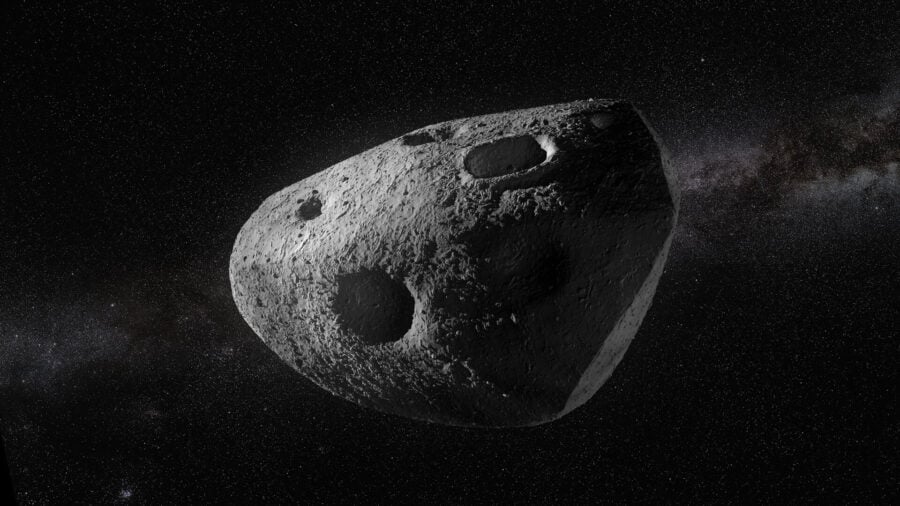
On Friday 13 April 2029, something will happen that has not happened in recorded human history. A rock roughly 375 metres across, wide enough to swallow several city blocks and heavy enough to reshape a coastline if it ever hit, will slide past Earth at a distance of just 32,000 kilometres. Closer than the satellites that carry your television signal. Close enough, in fact, to be visible to the naked eye for up to two billion people on Earth, a dim moving point tracking across the sky on a Friday evening. Apophis, once flagged as the most hazardous known asteroid in the solar system, is coming to visit. And this time, we’ll be ready.
Events like this occur only once every 5,000 to 10,000 years for an object of this size. Which makes what happened at the Embassy of Italy in Berlin on 7 May rather significant: the European Space Agency and the Japan Aerospace Exploration Agency signed a formal cooperation agreement to send a spacecraft to meet Apophis before the flyby, escort it through Earth’s gravitational clutches, and record what happens to an asteroid when our planet gets its hands on it.

Ramses: ESA’s mission to rendezvous with asteroid Apophis
The mission is called Ramses, short for Rapid Apophis Mission for Space Safety, and it is scheduled to launch in 2028 with enough time to rendezvous with the asteroid before closest approach. The plan is to shadow Apophis as it swings past, watching how Earth’s gravity tugs and kneads the rock, perhaps shifting loose material across its surface, perhaps stretching it slightly, perhaps triggering small landslides in the regolith. Nobody knows quite what to expect, which is rather the point. “Until now, we have had to travel deep into the solar system to study asteroids and interact with their surfaces,” ESA noted in its announcement. “With Apophis, for the first time ever, nature is bringing an asteroid to us and conducting the experiment itself.”
A New Kind of Space Experiment
The science here is harder to overstate than it might first appear. Deflecting an asteroid, should we ever need to, requires knowing not just where it is but what it is made of, how its interior is structured, and how it responds to external forces. Tidal forces from a planetary flyby are, in a sense, a natural stress test: the same gravitational gradient that raises tides in Earth’s oceans will act on Apophis, and by comparing before-and-after measurements of the asteroid’s shape, spin rate, and surface features, scientists expect to learn things about asteroid interiors that no amount of remote observation could tell them.
JAXA brings substantial hardware to the partnership. The Japanese agency will provide the spacecraft’s lightweight solar arrays, an infrared imager for surface mapping, and crucially, the launch itself aboard its H3 rocket. ESA handles spacecraft design, integration, and operations. It is a clean division of labour, built on existing trust: JAXA has already contributed to ESA’s Hera mission, currently en route to the Didymos binary asteroid system, where it will assess the aftermath of NASA’s DART impact from 2022. Planetary defence, it turns out, has become one of the more reliable foundations for international space cooperation.
“Planetary defence is, by definition, a global responsibility,” said ESA Director General Josef Aschbacher at the signing in Berlin. “With today’s signatures, ESA and JAXA are moving decisively from shared intention to concrete implementation, translating commitment into mission-level cooperation. This partnership builds on trust, technical excellence and a shared determination to protect our planet.”
JAXA President Hiroshi Yamakawa was rather more restrained in his remarks, as is perhaps customary, but the cooperation itself tells the story. The two agencies first committed to expanding large-scale collaboration back in November 2024. Now, roughly eighteen months later, they have a signed mission agreement, a prime contractor (OHB Italia, selected by ESA), and a launch window that is not moving, because the asteroid most emphatically is not waiting. Apophis reaches its closest point on 13 April 2029 regardless of diplomatic timelines.
The Rock That Once Kept Astronomers Up at Night
It is worth pausing on what Apophis actually represents, scientifically and historically. When it was discovered in 2004, initial calculations suggested a roughly 2.7% probability of impact with Earth in 2029 (later ruled out) and a smaller but still alarming chance in 2036. For a few days, it held the highest Torino Scale rating ever assigned to a known object. Planetary scientists were, to put it mildly, paying close attention. Subsequent observations refined the orbit and eliminated both impact scenarios, and then again in 2021 ESA formally ruled out any impact for at least the next hundred years. The asteroid is safe. But it is also, perhaps because of that history, one of the most thoroughly scrutinised rocks in the solar system, which means Ramses will arrive at an object about which scientists already have strong hypotheses to test.
Chief among them is the question of whether the flyby will alter Apophis’s rotation. Some models suggest the tidal forces could change its spin state, potentially shifting it into a tumbling mode. Whether that actually happens, and if so how quickly, will depend on properties of the asteroid’s interior structure that remain poorly constrained. This is exactly the kind of measurement you cannot make from Earth-based radar alone. You need to be there.
Two CubeSats are also joining the Ramses spacecraft, small secondary instruments that will deploy around the asteroid and provide additional observing angles. The whole assembly will accompany Apophis throughout the flyby, which means Ramses is less a probe in the traditional sense and more of a chaperone, keeping company with something that has no particular interest in being accompanied.
There is something almost philosophically odd about this arrangement. For most of human history, asteroids have been passive objects, things we look at, worry about, occasionally send missions to after months or years of interplanetary travel. Apophis inverts that. It is coming here, bringing its secrets with it, offering itself up (involuntarily, to be fair) for the most intimate study any near-Earth asteroid has yet received. ESA and JAXA signing a cooperation agreement in a Berlin embassy is, in its way, humanity’s formal RSVP to nature’s invitation. They plan to make the most of it.
Whether or not you can spot Apophis yourself on that April evening in 2029 will depend on where you live and how dark your skies are. But the data Ramses collects during those hours could shape how we respond to asteroid threats for generations. The next close shave, whenever it comes, will find us considerably less ignorant than we were in 2004.
Frequently Asked Questions
Will Apophis actually hit Earth during the 2029 flyby?
No. Apophis poses no impact risk in 2029, and ESA formally ruled out any impact for at least 100 years in 2021. The flyby will bring it to within about 32,000 kilometres, closer than some satellites, but that is still an enormous miss by any meaningful measure. The scientific value of the event lies precisely in the fact that it passes very close without hitting.
Why does it matter that Earth’s gravity will reshape Apophis during the flyby?
Understanding how an asteroid responds to tidal forces tells scientists a great deal about its internal structure, whether it is a solid rock or a loosely bound rubble pile, for instance. That distinction is critical for planetary defence planning: a solid object responds very differently to a deflection attempt than a loosely consolidated one. Ramses will measure these effects in real time, producing data that no Earth-based telescope could obtain.
How is this mission different from previous asteroid missions like Hayabusa2 or DART?
Hayabusa2 and DART required years of travel to reach their target asteroids deep in the solar system. Ramses is unusual in that the target is coming to us, meaning a 2028 launch is sufficient to intercept it. The mission is also primarily observational rather than involving surface contact or impact, focusing on recording how a close Earth flyby naturally alters an asteroid rather than testing artificial deflection techniques.
What role does JAXA play, and why involve two space agencies?
JAXA provides the H3 launch vehicle, lightweight solar arrays, and an infrared camera; ESA handles spacecraft design and mission operations. Combining resources allows both agencies to do more than either could manage alone, and it reflects a broader trend in planetary defence where international cooperation is increasingly seen as essential. Apophis belongs to no single nation’s sky.
Could Ramses data help protect Earth from future asteroid threats?
That is explicitly the goal. By measuring how tidal forces affect Apophis, scientists will build better models of asteroid behaviour under gravitational stress, which informs how we might deflect a threatening object in the future. The mission also tests international cooperation frameworks that would be essential in any genuine planetary emergency, when the ability of multiple space agencies to act together quickly could matter enormously.