The Ghostly Particles That May Have Built the Universe’s First Monster Black Holes

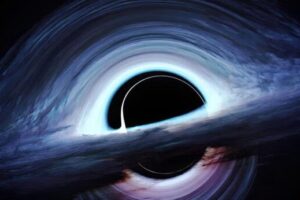
Dark matter decays could be the missing ingredient explaining how giant black holes formed before the first stars

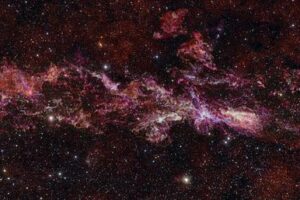
Before the first star had ignited, before any galaxy had taken shape, the universe was full of gas: cold, pristine, mostly hydrogen, floating in the dark. In certain pockets of that gas, something was happening at a scale almost too small to calculate. Particles of dark matter, drifting invisibly through the fog, were quietly decaying. … Read more

A Four-Legged Robot Just Showed How to Search for Life on Mars 3X Faster

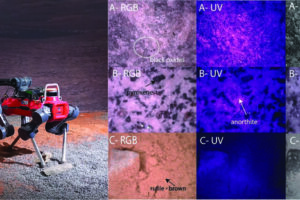
On the left: the robot performing autonomous measurements of a rock with MICRO and Raman. On the right: examples of images from the microscopic imager (MICRO) returned by the robot, showing the texture of three different lunar analogue materials in RGB, UV, and IR.

The robot’s arm descends toward a pale, flat rock. Twelve centimeters. Eight. Five. A foam ring makes contact, a time-of-flight sensor confirms the distance, and a UV light flickers on inside the instrument housing as the microscope locks focus. The image appears on a screen across the room: gypsum, its crystalline texture mapped at millimeter … Read more

Hubble Witnesses Cosmic Demolition Derby

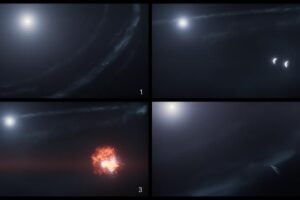
This artist’s concept shows the sequence of events leading up to the creation of dust cloud cs2 around the star Fomalhaut. In Panel 1, the star Fomalhaut appears in the top left corner. Two white dots, located in the bottom right corner, represent the two massive objects in orbit around Fomalhaut. In Panel 2, the objects approach each other. Panel 3 shows the violent collision of these two objects. In Panel 4, the resulting dust cloud cs2 becomes visible and starlight pushes the dust grains away from the star.

Astronomers thought they’d found an exoplanet. For years, a bright dot called Fomalhaut b orbited a nearby star, reflecting starlight through clouds of dust. Then it disappeared. When Hubble looked again in 2023, a different bright spot had materialized elsewhere in the same debris belt, 23.4 astronomical units away from where the first one had … Read more

Mars Orbiter Finds Rock, Not Water, Under South Polar Ice

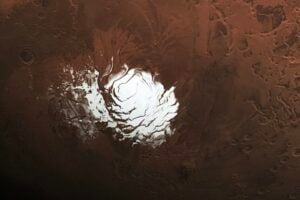
The European Space Agency’s Mars Express orbiter captured this view of Mars’ south polar ice cap Feb. 25, 2015. Three years later, the spacecraft detected a signal from the area to the right of the ice cap that scientists interpreted as an underground lake. Credit: ESA/DLR/FU Berlin, CC BY-SA 3.0 IGO

That underground lake on Mars? Probably just rock and dust. A new analysis from NASA’s Mars Reconnaissance Orbiter, published in Geophysical Research Letters, suggests the bright radar signal beneath Mars’ south pole—the one that looked so much like a subglacial lake—is more likely coming from buried rock than liquid water. The study also demonstrates how … Read more