

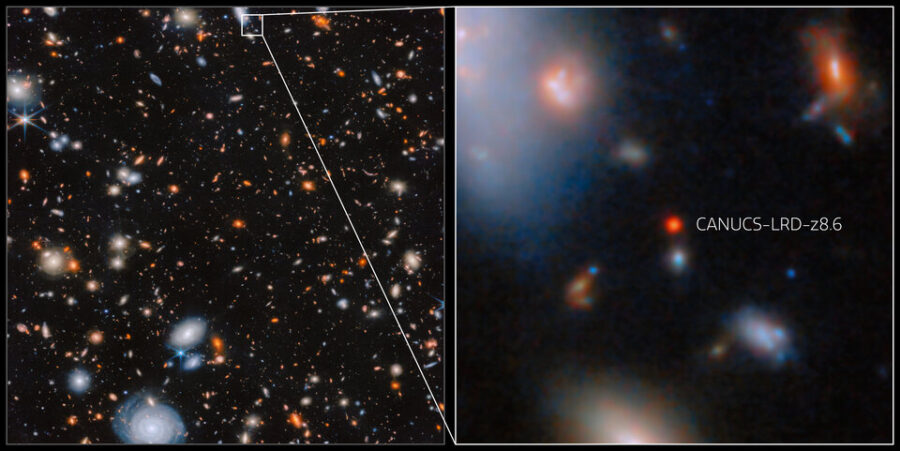
A supermassive black hole spotted just 570 million years after the Big Bang is growing faster than its host galaxy can keep up, defying astronomers’ expectations about how the early universe assembled itself.
The discovery, made using the James Webb Space Telescope, reveals a cosmic heavyweight that weighs in at 100 million times the mass of our sun. That’s roughly 100 times more massive than the black hole in galaxy GN-z11, despite being only 150 million years older. What makes this finding particularly striking is not just the black hole’s heft, but its relationship to the galaxy around it: the galaxy appears to be struggling to match its central monster’s appetite.
“We’ve observed a galaxy from less than 600 million years after the Big Bang, and not only is it hosting a supermassive black hole, but the black hole is growing rapidly, far faster than we would expect in such a galaxy at this early time,” said Roberta Tripodi, lead author of the study and a researcher at the University of Ljubljana in Slovenia.
“This challenges our understanding of black hole and galaxy formation in the early Universe and opens up new avenues of research into how these objects came to be.”
The galaxy, designated CANUCS-LRD-z8.6, belongs to a mysterious class of objects astronomers call Little Red Dots. These compact, distant galaxies glow with a distinctive reddish hue and have been turning up in Webb surveys with surprising frequency over the past three years. Their nature remains hotly debated: some appear dominated by active black holes, others by elderly stars, and many show evidence of both.
Signs of a Monster at Work
Webb’s Near-Infrared Spectrograph detected broad emission lines of hydrogen-beta radiation, indicating gas swirling at more than 1,000 kilometers per second around a central point. The telescope also spotted high-ionization lines of carbon and nitrogen, signatures of intense radiation that only powerful black holes can produce. Together, these features paint a picture of an actively feeding supermassive black hole.
The galaxy itself measures less than 70 parsecs across, about 230 light-years, making it extraordinarily compact. Within this tiny volume, the team estimates roughly 5 billion solar masses worth of stars are packed together, undergoing vigorous star formation at a rate of about 50 solar masses per year. Yet the central black hole already outweighs what local universe relationships would predict for a galaxy of this size.
“The spectral features revealed by Webb provided clear signs of an accreting black hole at the centre of the galaxy, something that could not have been observed with previous technology,” said Dr. Nicholas Martis, who helped analyze the data.
“What makes this even more compelling is that the galaxy’s black hole is overmassive compared to its stellar mass. This suggests that black holes in the early Universe may have grown much faster than the galaxies that host them.”
Challenging the Models
The discovery poses problems for current theories of black hole formation. To reach 100 million solar masses in just 570 million years requires either starting from unusually massive “seeds,” accreting matter at or above the theoretical Eddington limit, or both. Most standard computer simulations fail to reproduce such rapid growth, because feedback from the growing black hole typically prevents it from gathering material this quickly.
Some modified models that allow for super-Eddington accretion, where black holes consume matter faster than classical physics suggests they should, can explain CANUCS-LRD-z8.6’s existence. These models predict that short bursts of extreme feeding could create overmassive black holes relative to their host galaxies, which is exactly what the team observed.
The galaxy’s low metal content adds another layer of intrigue. With less than 10 to 20 percent of the sun’s metallicity, CANUCS-LRD-z8.6 appears to be one of the most metal-poor objects of its stellar mass observed at such high redshifts. This suggests recent or ongoing accretion of pristine gas, possibly fueling both the star formation and the black hole’s growth simultaneously.
Prof. Marusa Bradac, who leads the research group, believes CANUCS-LRD-z8.6 may represent an evolutionary link between early massive black holes and the brilliant quasars that dominated the universe a billion years later. The team plans follow-up observations with the Atacama Large Millimeter Array to study the cold gas and dust in more detail.
The results appear in Nature Communications.