On the night of 18 February, engineers at the Space Telescope Science Institute pointed the James Webb Space Telescope at an almost empty patch of sky and waited. They were looking for a rock roughly 60 metres across, hurtling through the void many millions of kilometres from Earth. At that distance, in Webb’s narrow field of view, it would appear as something barely brighter than background noise. Finding it at all would require the kind of precision that makes astronomers quietly nervous.
They found it. And then they found it again, eight days later.
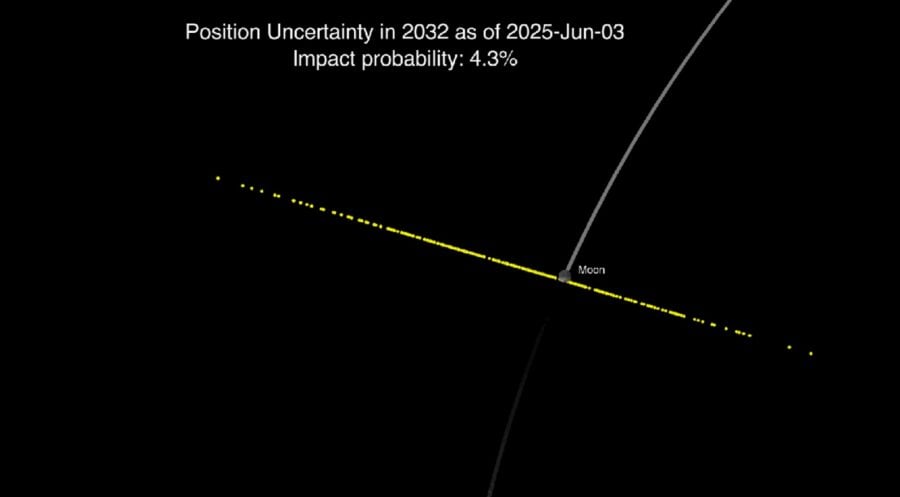
Those two observations, taken together, were enough to answer a question that had been hanging over planetary defence for the better part of a year: would asteroid 2024 YR4 hit the Moon on 22 December 2032? Experts from NASA’s Center for Near-Earth Object Studies at the Jet Propulsion Laboratory in California have now confirmed it will not. The asteroid will instead pass the lunar surface at a distance of around 13,200 miles (roughly 21,200 kilometres), and the 4.3% impact probability that had briefly made it the subject of serious scientific attention has been retired entirely.
It’s worth pausing on that figure. Four percent is not large. Most people shelling out for a lottery ticket face worse odds of winning. But in planetary defence circles, where the standard threshold for concern sits below one percent, a 4% chance of a 60-metre object striking the Moon was, by any measure, worth taking seriously.
The asteroid had a complicated history even before the Moon became a worry. Discovered in late 2024 by the NASA-funded ATLAS station in Chile, YR4 caused a brief stir in early 2025 when the initial trajectory calculations suggested a small but non-trivial chance it might hit Earth. More observations quickly ruled that out. But as the asteroid faded from view that spring, a residual lunar risk clung to it, with odds that sat stubbornly above the discomfort threshold. The next chance to observe it directly was, in principle, 2028.
The problem is that orbital uncertainty compounds with time. The further you push your prediction into the future, the wider the cone of possible positions becomes, and a rock that seems safely off-course today could, with the wrong initial conditions, land anywhere inside a large ellipse. To tighten the prediction for 2032, astronomers needed new data, and to get new data they needed to find an object that was, by spring 2025, essentially invisible to every telescope on Earth or in low orbit.
Webb, it turned out, was different. The telescope was built to study galaxies billions of light-years away; its sensitivity and infrared instruments were designed for targets so faint they are, in practice, undetectable by anything else humanity has put in space. An international team coordinated through ESA’s Near-Earth Object Coordination Centre and NASA’s CNEOS, led by the Johns Hopkins Applied Physics Laboratory, identified two narrow windows in February 2026 when the geometry might allow Webb to catch YR4 against a sparse star field. The position of those background stars was known with extraordinary precision thanks to ESA’s Gaia mission, itself a decade-long project to map the sky in three dimensions. The idea was to measure where YR4 appeared relative to those stars, then work backwards to its orbit, then push that orbit seven years into the future.
It is, in a sense, the most elaborate way imaginable to rule out a four percent chance of something hitting the Moon. But the maths demanded it, and on 26 February, the second observation confirmed what the first had suggested: the orbit was tighter than expected, the uncertainty cone had shrunk, and the Moon was safe.
What the episode demonstrates, as much as anything, is how the pipeline of planetary defence actually works now. The old picture, familiar from films, was of a sudden discovery, a desperate scramble, and a last-minute intervention. The reality is more bureaucratic and more reassuring. Surveys catch objects early; automated systems flag the ones with non-zero impact probabilities; follow-up observations refine the orbit; and the vast majority of cases, once enough data comes in, resolve themselves. YR4’s Earth risk evaporated within weeks of discovery. Its lunar risk lasted longer only because it disappeared from view before more data could be collected.
There are still gaps. Objects approaching from the direction of the sun are hard to spot in advance (a separate ESA mission called Neomir is in development partly to address this). And a 60-metre object is at the lower end of what current surveys reliably detect; something that size, hitting an inhabited area, would be roughly comparable to the Tunguska event in 1908, which flattened around 2,000 square kilometres of Siberian forest. We got away with Tunguska because there was nobody there. We might not always be so fortunate.
For now, though, the answer is unambiguous. ESA’s planetary defence team confirmed on 5 March 2026 that 2024 YR4 poses no danger to the Moon, to Earth, or to anything else we need to worry about before the next century. The Webb telescope, pointed at a patch of near-empty sky and told to find a speck of rock it wasn’t really designed for, did the job. The Moon, one assumes, is unbothered.
Link: https://www.esa.int/Space_Safety/Planetary_Defence/Asteroid_2024_YR4_will_not_impact_the_Moon
Discover more from European Space Agency Tracker
Subscribe to get the latest posts sent to your email.