
In 2016, Steven Maier and Martin Seligman published a paper in Psychological Review correcting the theory that had made both of them famous. The work behind it was done in dogs and rats. Their conclusion was that the standard account of learned helplessness, taught in introductory psychology for five decades, had the central mechanism the wrong way round.
We are writers, not clinicians. What follows is a reading of the research, not medical advice.
The correction matters because the popular version of learned helplessness has drifted a long way from what the experiments showed, and the drift runs toward implying more about human despair than the animal work can carry.
What the triadic experiments did, in animals
Seligman and Maier’s 1967 design used three groups. One group of dogs could switch off an electric shock by pressing a panel with their noses. A second group received shocks of identical duration and intensity, yoked to the first, but nothing they did made any difference. A third group received no shock.
A day later the animals were tested in a shuttlebox, where escaping required only stepping over a low barrier. Maier and Seligman describe the well-replicated result of that design as roughly two thirds of the no-control group failing to learn to escape, against about 90 percent of the other two groups learning it easily. Research moved quickly from dogs to rodents while keeping the same three-group structure.
The original interpretation was cognitive. Animals in the yoked group had learned that outcomes were independent of their responses, and that lesson carried into a new situation where it was no longer true.
The correction is also an animal finding
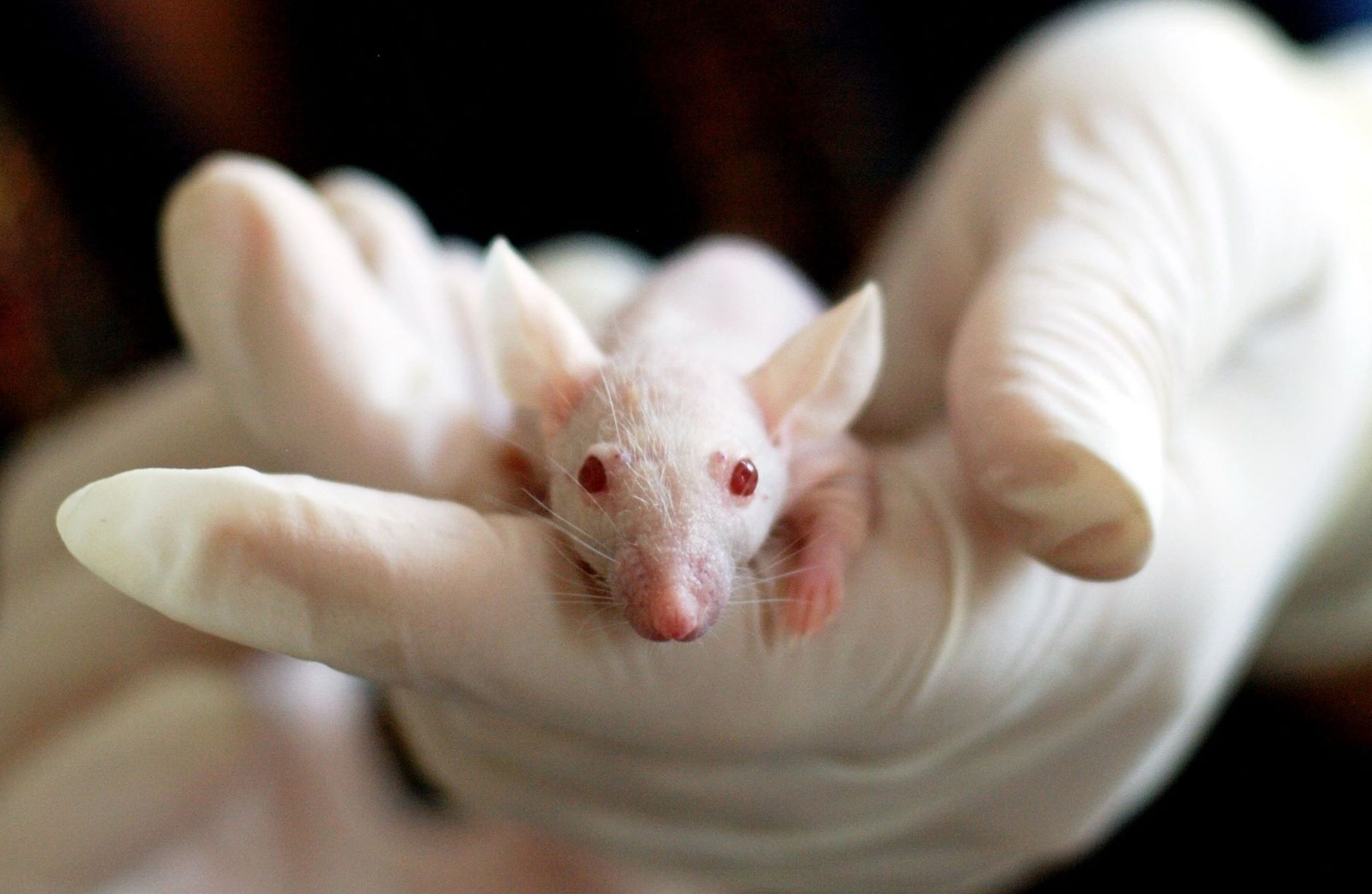
This needs saying before anything else. The 2016 paper synthesizes about fifty years of laboratory work in rats and dogs, resting on lesion, inactivation and direct-stimulation studies that cannot be run in people.
Maier and Seligman state the reversal bluntly: “the original theory got it backward.” In their account, passivity during prolonged inescapable shock is the unlearned baseline response, while detected control activates prefrontal circuitry that inhibits the dorsal raphe.
The animals in the yoked group did not acquire helplessness. They did what an animal does when something painful continues and nothing it tries changes that, which is to stop.
What the animals with control learned was the control.
What the circuit work found
In rats, the passivity and the heightened fear trace to the dorsal raphe nucleus, a small brainstem structure dense with serotonin neurons. Prolonged uncontrollable shock keeps those cells firing and leaves the structure sensitized for days afterward. Stimulate it directly and the passive, fearful behavior appears with no stressor present. Block it during inescapable shock and the behavior does not appear at all.
The more interesting result sits in the prefrontal cortex. A circuit running from the prelimbic region to the dorsomedial striatum appears to register whether control is available. A separate population of prelimbic neurons projects down to the dorsal raphe and inhibits it.
One experiment carries much of the argument. When the detection circuit was inactivated, rats that could escape, and did escape, still finished up passive and fearful as though the shock had been inescapable. Escaping was not sufficient. Registering that escape was possible was the part that counted.
The authors put it this way: it is the presence of control, not the absence of control, that is detected by prelimbic medial prefrontal circuits. Uncontrollability is not a signal the brain goes looking for. It is what remains when nothing switches the default off.
Where this stops being about people
Very little of this revised neural mechanism has been demonstrated in humans, and the authors say so. Human experiments have produced behavioural escape deficits, but they do not establish that the same cell populations and circuits cause human hopelessness.
In a 2023 review in Frontiers in Psychiatry written with Michael Baratta, the same two researchers list what remains open: sex differences in humans are unknown, the correspondence between the rat prelimbic cortex and any human prefrontal region still needs establishing, and the translation to psychotherapy needs testing. The 2016 paper adds a technical obstacle of its own. Human brain imaging cannot resolve the cell populations involved, and the authors note that the prelimbic neurons doing the work in rats would not contribute measurably to a standard imaging signal.
Researchers outside that group have been blunter about the wider problem. In a 2020 paper in Alternatives to Laboratory Animals, S. Clare Stanford argues that no experimental intervention has yet produced a set of abnormalities in animals that would qualify as a model of depression, because the features defining the human condition are subjective and cannot be measured in an animal. Stanford also records that some researchers read the learned helplessness procedure as closer to post-traumatic stress than to depression, and that the paradigm is now rarely used in places with strict animal-welfare rules.
Stanford’s review independently supports the conceptual shift toward default passivity. It is a methodological critique, however, not an independent replication of the specific rat-circuit experiments summarized by Maier and Seligman.
What the human measure can and cannot do
A widely used clinical and research measure of the related but distinct construct of hopelessness is the Beck Hopelessness Scale, and its record as a predictor is more mixed than its reputation suggests.
A 2007 meta-analysis in Psychological Medicine by Dean McMillan and colleagues, summarized in the NHS Centre for Reviews and Dissemination database, pooled ten studies covering 3,775 people. For suicide, across four cohorts totaling 2,559 people, the standard cut-off had a sensitivity of 80 percent, with a 95 percent confidence interval running from 68 to 90. Its specificity was 42 percent.
Those two figures pull against each other. High sensitivity means the scale caught most of the people who later died. Specificity of 42 percent means it also flagged well over half of the people who did not. Across six cohorts and 1,216 people the self-harm results repeated the pattern, and the reviewers concluded that the low specificity made the scale unlikely to be useful for deciding who should receive treatment.
The scale marks out a group at raised risk. It cannot pick the individuals within that group, and the reviewers put the size of the risk below what earlier estimates had claimed.
What would settle it
The 2016 paper is unusually candid about its own gaps. The link between the circuit that detects control and the circuit that acts on it has not been identified. The mechanism of the detection itself, the authors write, is not known. Whether the brain registers a lack of contingency outside painful situations, where the uncontrollable thing is food or an unsolvable puzzle, is described as needing further research.
A registered protocol published in PLOS ONE in 2021 by Xin Song and Iris Vilares set out to test a computerized human version of the triadic design against measures of anhedonia. It is a protocol rather than a result, and its authors flagged the weakness in advance: a participant in a laboratory can stop whenever they choose, which undercuts the premise of uncontrollability before the experiment starts.
Anyone worried about their own state of mind, or about someone else’s, is better served by a conversation with a doctor or a local crisis line than by any questionnaire score.
So the position today is that a fifty-year-old theory has been revised by the people who built it, the revised circuit account is supported in rats, and the corresponding neural mechanism has not yet been established in people experiencing hopelessness.