

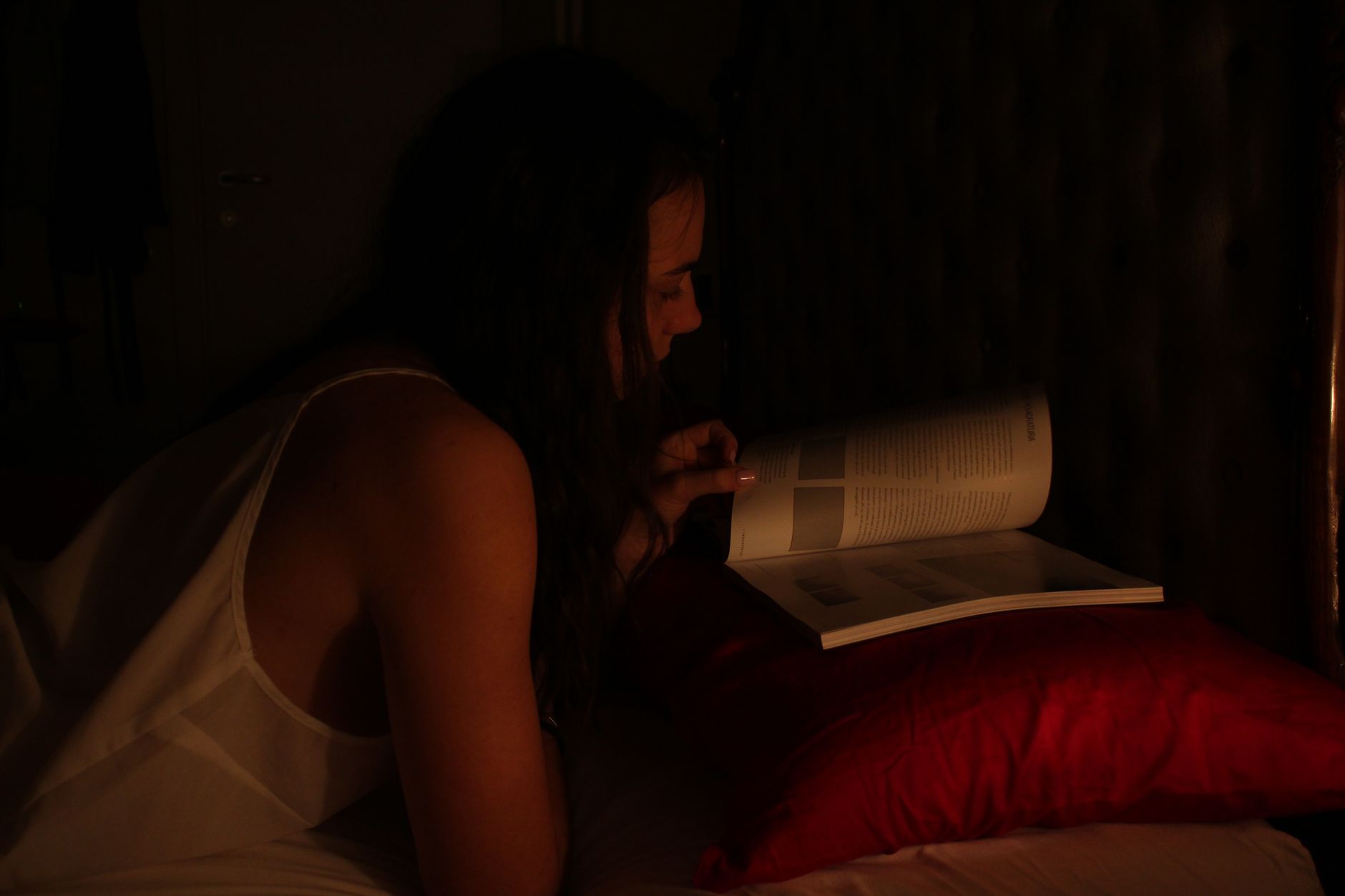
Reading before bed is one of the most commonly dispensed pieces of sleep advice, and unusually for a folk remedy, it has actually been put to the test. The results are encouraging but more specific than the headlines suggest, and the most interesting finding is not that reading helps you sleep, which it modestly does, but that the object you read from can quietly reverse the benefit. Read the right way, a book at bedtime is a genuinely useful wind-down; read the wrong way, on a glowing screen, the same habit can work against the sleep it was meant to protect.
Reading in bed really does help, a little
In the People’s Trial, researchers led by Elaine Finucane recruited 991 adults and randomly assigned half to read a book in bed for 15 to 30 minutes before sleep for a week and half not to. Among 774 participants who completed the outcome assessment, 42% of the reading group and 28% of the control group reported improved sleep quality—an absolute difference of 14 percentage points (95% confidence interval 8 to 22 points).
Two things are worth noticing about this. The first is that the effect, while real, is modest and measured by people’s own reports of their sleep, so it is a nudge rather than a cure, and it will not rescue a serious sleep disorder. The second is how unusual it is to have any randomized evidence at all for this kind of everyday advice, most of which rests on tradition and plausibility rather than a controlled test. Here the test was run, and reading came out ahead. The likely reason is not mysterious: a book is an absorbing but low-arousal activity that occupies the mind gently while displacing the more stimulating things people otherwise do in bed, and that quiet shift of gear is exactly what the transition into sleep requires. As a signal to the body that the day is closing, turning pages appears to work.
The surprising part is what you read from
The genuinely counterintuitive finding is that the benefit depends heavily on the medium, because reading the same words from a bright screen changes the physiology entirely. In a study published in the Proceedings of the National Academy of Sciences, Anne-Marie Chang and colleagues had participants read from a light-emitting tablet on some evenings and a printed book on others, and found that the glowing device suppressed the sleep hormone melatonin by more than half, delayed their internal body clock, made them take longer to fall asleep, and left them groggier the next morning, while the printed book did none of these things.
This reframes the whole recommendation. Much of what we call the benefit of reading before bed is really the benefit of reading from print rather than a screen, because the alerting light of a phone or backlit tablet tells the brain, at precisely the wrong hour, that it is still daytime. Someone who swaps a paper novel for the same novel on a bright phone may be undoing the calming effect of the reading with the stimulating effect of the light, and wondering why the habit everyone praised is not helping. The lesson is not that screens are evil but that the wind-down value of bedtime reading is tied to keeping the light low, which a printed book does automatically and a luminous device does not.
How to actually use this
A few honest limits keep this in proportion. The sleep-quality benefit from the trial was modest and self-reported, the screen study was small, with only a dozen participants and a fairly extreme dose of evening light, and reading before bed is not universally soothing: a gripping thriller or an infuriating news article can raise your arousal rather than lower it, which is the opposite of what you want. The habit helps because it calms, so anything that reads at bedtime as exciting or upsetting forfeits the point.
Put together, the practical version is simple and well supported. Reading before bed is one of the better-evidenced wind-down routines available, but its value comes from a particular form of it: a printed book, or at least a non-luminous e-ink reader in a dim room, holding something absorbing enough to pull you in but calm enough not to wind you up, for fifteen or twenty minutes as a deliberate closing of the day. Done that way, the surprising benefits are real, a somewhat easier drift into sleep, a gentler landing, and a body clock left undisturbed. Done on a bright screen with a page-turner you cannot put down, bedtime reading can quietly sabotage the very rest it was supposed to deliver. The habit is sound; the details are where it lives or dies.
Correction, 16 September 2026: The lead author’s name and the randomized-trial result were corrected: 42% of the reading group and 28% of controls reported improved sleep, a 14-point difference with an 8–22-point confidence interval.