

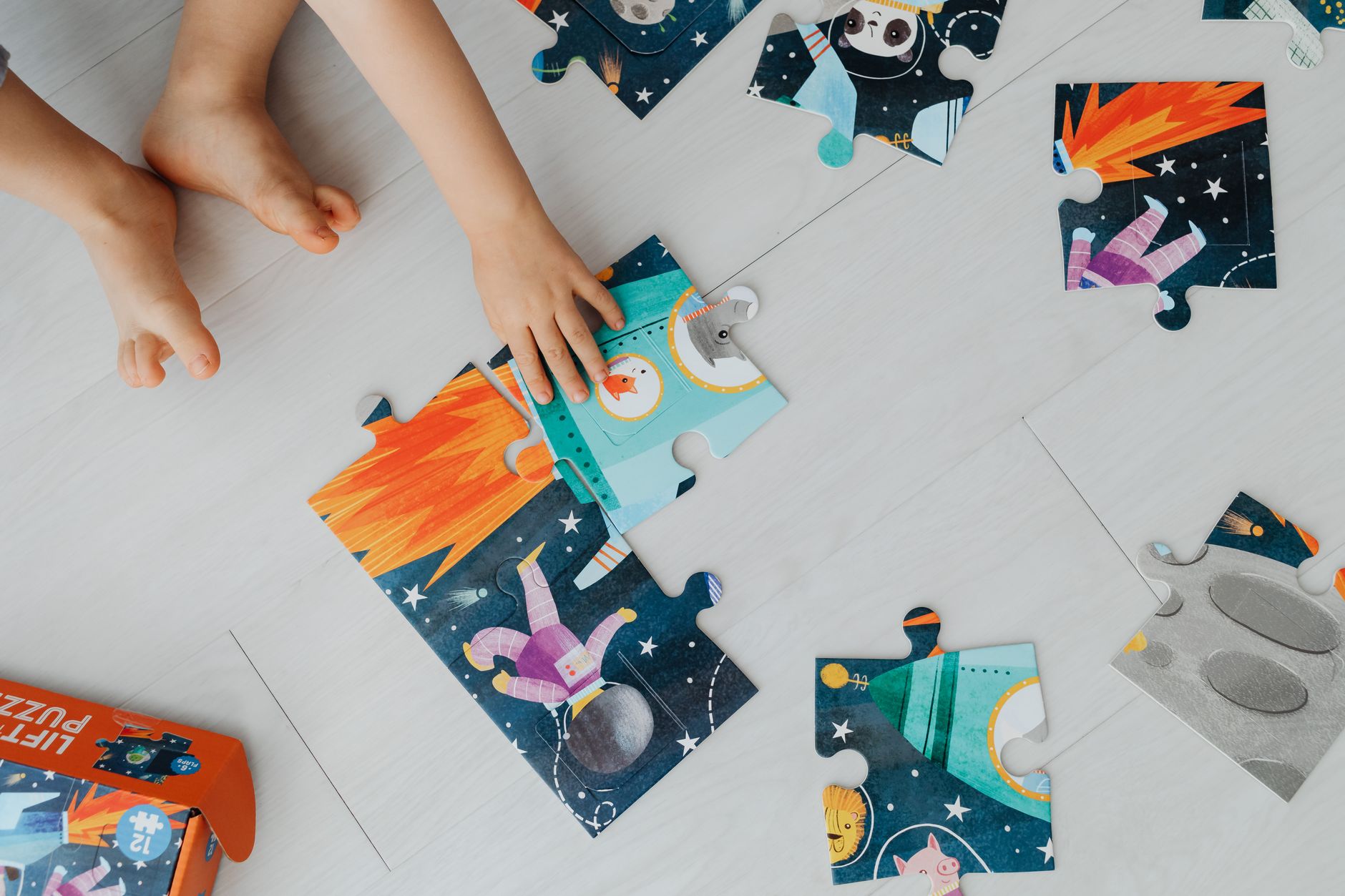
The box will usually tell you the puzzle is good for your child’s brain. It rarely says which part, or how much, or on what evidence. The honest version of the claim is narrower than the packaging, and also more interesting: the best research does not show that puzzles make children generally smarter. It links them to one specific skill, and that skill happens to matter later on.
That is worth untangling, because the gap between what the studies show and what the marketing implies is exactly the sort of thing that gets lost in the aisle.
What the research actually found
The most cited study here comes from Susan Levine and colleagues at the University of Chicago, published in Developmental Psychology in 2012. Rather than testing children in a lab, the researchers recorded 53 children and their parents at home, in ninety-minute sessions every four months, between the ages of about two and four.
They simply watched what families did. About half the children were seen playing with puzzles at least once. Then, when the children were four and a half, the researchers gave them a task that involved mentally rotating and combining flat shapes, a measure of what is called spatial transformation.
The children who had played with puzzles did better on that task, even after the researchers accounted for differences in parents’ income, education, and how much they talked to their children. More puzzle play, and more complex puzzles, went with stronger spatial performance. It is a clean, specific result about a clean, specific ability.
Why you should not read it as proof
Here is the part the box leaves off.
This was an observational study, not an experiment, and that distinction carries most of the weight.
Nobody randomly assigned puzzles. The families chose whether to own them and play with them, which means the puzzle children differed from the others in ways beyond the puzzles. Wealthier parents in the study offered puzzles more often, and while the researchers controlled for income and education, statistical controls never remove every difference. It remains possible that the sort of home that produces puzzle play also produces spatial skill through some other route entirely.
The lead author said as much at the time, noting that further work would be needed to show whether puzzle play actually causes the gains. The sample was also small, just 53 families, which is a reason for caution rather than alarm, but a reason all the same.
So the accurate sentence is not “puzzles build spatial skills.” It is closer to “young children who play with puzzles tend to have better spatial skills, for reasons not yet pinned down.”
The skill in question is not trivial
What keeps this from being a shrug is the other end of the story. Spatial ability, the thing puzzles are associated with, is one of the better-evidenced predictors of where children end up academically.
In a large longitudinal analysis published in 2009, Jonathan Wai, David Lubinski and Camilla Benbow followed students across decades and found that spatial ability measured in adolescence predicted later achievement in science, technology, engineering and mathematics, even after accounting for verbal and mathematical ability. Spatial skill, they argued, is a talent that standard testing tends to miss.
Put the two findings together carefully and you get a chain, not a guarantee: early puzzle play is associated with spatial skill, and spatial skill is associated with later success in technical fields. Each link is a correlation. Stacking correlations does not turn them into a promise that a jigsaw makes an engineer.
What to actually take from this
None of this argues against puzzles. They are cheap, absorbing, and plausibly connected to a genuinely useful ability, which is more than can be said for a lot of toys marketed at the same shelf. If a child enjoys them, that is reason enough, and the possible spatial payoff is a bonus rather than a purchase order.
There is one finding worth more attention than the headline. In the same study, boys were given more complex puzzles than girls, and their parents used more spatial language, words like edge, corner, rotate and flip, while playing. Boys also did better on the later task.
That points to something more actionable than buying more puzzles. It suggests that how an adult talks during the play, and whether girls are handed the same challenge as boys, may matter as much as the puzzle itself. The object on the table is only part of it.
The words around it appear to be the rest.