

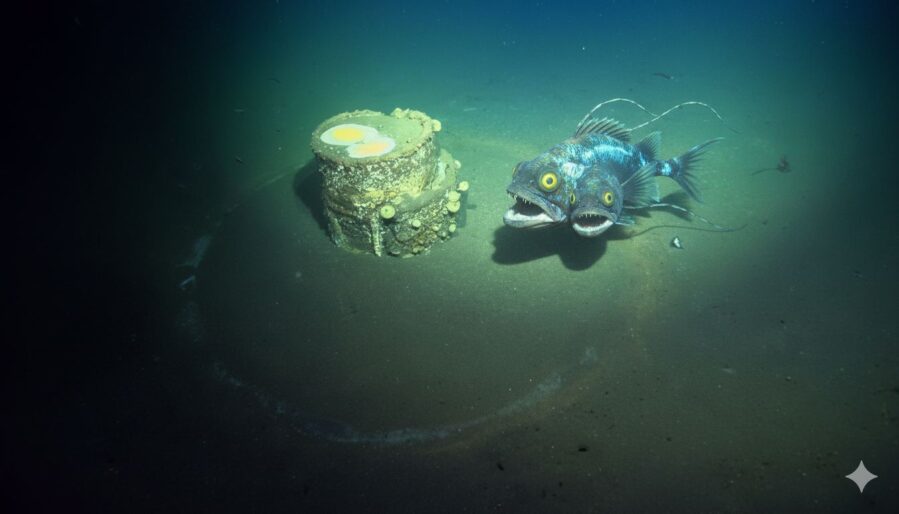
In the dark waters between Los Angeles and Catalina Island, barrels of industrial waste continue to bleed into the sea. For decades, many assumed the rusting cylinders contained nothing but DDT sludge, the pesticide already infamous for contaminating California’s coast. But new research led by UC San Diego’s Scripps Institution of Oceanography reveals a different culprit inside at least some barrels: highly caustic alkaline waste.
That corrosive cargo has been sitting on the seafloor for more than half a century, leaking slowly and transforming patches of sediment into concrete-like crusts. It has even created strange ecosystems resembling hydrothermal vents, where only extremophile bacteria can survive.
“One of the main waste streams from DDT production was acid and they didn’t put that into barrels,” said Johanna Gutleben, a Scripps postdoctoral scholar and the study’s first author. “It makes you wonder: What was worse than DDT acid waste to deserve being put into barrels?”
The Halo Mystery
The trail began with halos. During surveys in 2021, researchers noticed eerie white rings encircling some barrels on the seafloor. The halos resisted easy explanation. DDT contamination didn’t increase near them, and the seafloor had hardened to the point that coring devices bounced off. Only when samples were tested back on land did the truth emerge: the sediments had a pH around 12, as caustic as household drain cleaner.
Chemical reactions with seawater produced brucite, a magnesium mineral that cemented sediment into solid crust. As the brucite slowly dissolved, it kept the surrounding sediments alkaline, making the environment unwelcoming to most marine life but surprisingly hospitable to specialized microbes.
“It’s shocking that 50-plus years later you’re still seeing these effects,” said Paul Jensen, emeritus marine microbiologist at Scripps and senior author of the study.
A Legacy of Legal Dumping
From the 1930s through the early 1970s, companies were allowed to dump barrels of waste at designated offshore sites. Along with pesticides came refinery sludges, military explosives, radioactive materials, and chemical byproducts no one bothered to catalogue. Federal records are patchy at best. Estimates suggest thousands of barrels lie scattered across the basins off Southern California, some intact, others ruptured and leaking.
DDT itself was mostly piped directly into the sea rather than containerized. But sediments in the region still hold extreme concentrations, far above federal safety thresholds, and long-term contamination continues to move up the food chain. The alkaline barrels add yet another layer to this toxic legacy.
Impacts Hidden and Visible
The alkaline plumes form tight, hostile zones around each leaking barrel, reducing small-animal diversity and allowing only extremophiles to persist. In one sense, that might sound like a minor local effect compared to the vast spread of DDT. But the very persistence of these halos after half a century underscores how little scientists understand about the durability of such wastes.
And then there is the unnerving economic angle. Removing contaminated sediments would likely cost billions and risk stirring toxins back into the water column. Doing nothing, however, leaves fisheries, tourism, and public trust in regulatory oversight caught in a slow, corrosive drag.
What Comes Next
Researchers are now using halo presence as a visual shorthand for identifying barrels that likely held alkaline waste. That could allow faster mapping of the contamination field. At the same time, experiments are underway to see whether deep-sea microbes can slowly degrade the DDT entrenched in sediments. Mechanical removal, as Jensen bluntly put it, would probably do “more harm than good.”
The Los Angeles dump sites are grim reminders that yesterday’s waste solutions are today’s ecological riddles. The real surprise may be not what was dumped, but how stubbornly it endures.
Explainer: What Is Alkaline Waste?
When chemists talk about something being alkaline, they mean it has a high pH (greater than 7), the opposite of acidic. Household bleach, cement slurry, and some industrial byproducts are strongly alkaline. In seawater, a leak of caustic alkaline liquid can trigger unusual mineral reactions. In this case, the waste reacted with magnesium to form a mineral called brucite, which cemented seafloor sediments into a hard crust. The high pH also limits which microbes can survive, creating conditions similar to those found near natural hydrothermal vents or alkaline hot springs.
Journal: PNAS Nexus
DOI: 10.1093/pnasnexus/pgae376