

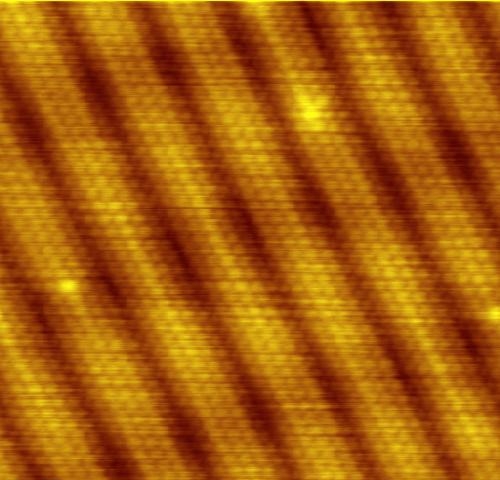
The moment the pressure rises into the realm where atoms start second guessing their loyalties, gold reveals a side of itself that almost never emerges on Earth.
A new study from Lawrence Livermore National Laboratory, published in Physical Review Letters, captures that transformation with unusual clarity, pushing the metal to pressures that approach the interiors of giant planets and watching its crystal structure reorganize in real time. Using the National Ignition Facility and the OMEGA EP Laser System, the research team recorded gold shifting from its familiar face centered cubic pattern into a body centered cubic arrangement at around ten million atmospheres.
The work leans on a familiar but rarely interrogated assumption in high pressure science. Gold is a standard calibrant, the yardstick for countless experiments that measure how matter behaves under crushing force. If its own behavior is off by a fraction, the entire field skews. That is why the researchers set out to measure gold’s structure directly at the highest pressures ever achieved for the element, using tailored laser pulses and billionth of a second X ray diffraction snapshots to catch atoms before heat could scramble them.
The Moment Structure Gives Way
The study hinges on a deceptively simple question. How long can gold hold its face centered cubic lattice as pressure climbs, and what emerges when it finally yields? Under ordinary conditions the structure is stable and predictable. Earlier theories, however, disagreed about where the transition should occur, and some hinted at intermediate phases that had never been observed cleanly. To confront those uncertainties, the scientists used ramp and shock ramp compression that increase pressure smoothly enough to keep the metal in a solid state during the measurement window.
Amy Coleman, a scientist at Lawrence Livermore National Laboratory and an author of the study, underscored how recent technical advances made these measurements possible. Within a single billionth of a second, X rays recorded the arrangement of atoms before thermal motion washed the pattern away. The timing is brutal but essential, and it reveals a story more complicated than a simple structural flip.
“Only recently have facilities like NIF had the capability to both create these pressures and to take a snapshot of what happens to atoms inside the sample,” said Coleman. “This is the first definitive look at gold’s crystal structure under such extreme compression, and it finally resolves long standing disagreements between theory and experiment.”
The results show face centered cubic order persisting far deeper into the pressure spectrum than many models forecast. In some shots the lattice holds until roughly twice the pressure of Earth’s core. Only then does the body centered cubic structure begin to appear. But the real surprise is that the two forms coexist. Instead of vanishing cleanly, face centered cubic peaks linger beside the new pattern, suggesting a transition that unfolds in a mixed landscape of competing arrangements. It is a rare glimpse of a phase boundary in motion, more intricate and contested than the sharp lines theory had drawn.
Rewriting a Standard
Because gold underpins so many high pressure measurements, these findings ripple through the entire discipline. If calibrations assume the wrong structure, every inferred pressure in every related experiment drifts by a corresponding amount. That is why refining gold’s phase behavior is not just an academic exercise but a structural correction for multiple research areas, from modeling the interiors of massive planets to developing materials that survive extreme environments.
“Knowing precisely how gold behaves ensures that every other experiment using it as a calibrant, from studying planetary cores to designing new materials, is grounded in a robust and validated understanding of gold’s behavior,” said Coleman.
The study also exposes gaps in current theoretical models. Some predicted earlier transformation points. Others underestimated the stability of the face centered cubic structure. By combining ramp and shock ramp compression paths and collecting in situ diffraction across a broad range of pressure temperature states, the researchers provide a foundation that future models will need to match rather than approximate.
Nothing in the press release or the study abstract indicates how long the experimental campaign took or how many researchers contributed, but the facilities involved and the precision of the timing suggest a large, coordinated team working across specialized hardware. What emerges from that effort is a clearer view of a metal that has long served as a silent yardstick. Under a trillion pascals, gold does not behave like a passive standard. It shifts, argues with itself, occupies two structures at once, and in doing so resets the reference point for an entire field.