

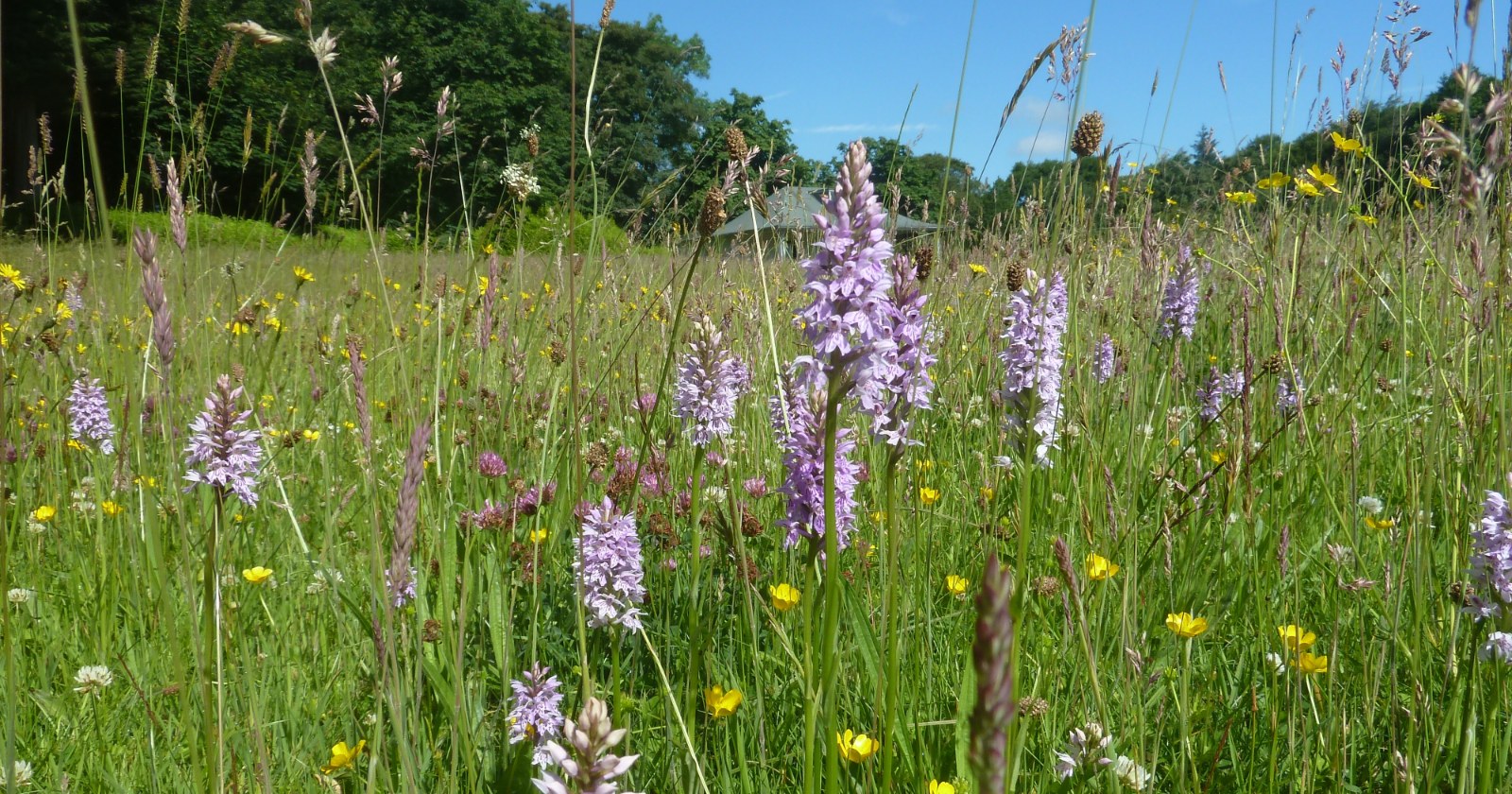
A 1.7-hectare field in North Norfolk that was farmed with fertilisers and other agrochemicals until its last crop of oilseed rape in 2005 had become a species-rich hay meadow by 2022 without any seed being sown. The number of plant species recorded across the field rose from 63 in 2011 to 86 in 2022, and the number not recorded anywhere else in plant surveys of its 1-kilometre grid square went from none to 11.
The only regular management was an annual hay cut from 2011 onward, with the cuttings baled and taken away, plus hand-pulling of ragwort before each cut. Orchids were among the first newcomers, in 2013, and after 2016 one species was so abundant that the surveyors stopped mapping individual plants.
The study, by Carl Sayer of University College London and three co-authors, was published in Restoration Ecology on 29 June 2026 and is open access. Its title makes the argument directly: “No need to seed”.
Six fallow years before the first hay cut
The field, known as Sayer’s Old Meadow, lies in the village of Bodham. According to UCL it is owned by the lead author’s father, Derek Sayer, who is one of the paper’s co-authors. It was pasture for dairy cows until the 1950s, then alternated between arable crops and sown ryegrass grazed by cattle until the early 1970s, after which it was permanently arable: wheat, barley, oats, sugar beet, once potatoes, and from the late 1990s oilseed rape. The paper says fertilisers and other agrochemicals were applied every year during that arable phase.
After the final rape harvest in 2005 the field lay fallow for six years. Conservation management began in 2011, with most of the field cut and baled each August or September. A small wet area in the north and an adjoining north-eastern block left to develop into willow woodland were not cut.
That approach runs against the usual practice in meadow restoration. Agri-environment schemes and many conservation projects sow commercial or locally collected seed, and some strip topsoil or plough deeply to reduce fertility first. The paper says UK studies of grassland recovery on former arable land appear to be limited to a four-year, multi-site experiment in southern England published in 2002, which compared natural regeneration with seeding and concluded that, at least over that short period, seeding after deep cultivation worked best.
The order in which the newcomers arrived
Carl Sayer and a friend, Pete Robinson, surveyed the field every two years from 2011 to 2019 and again in 2022, after Covid-19 stopped the planned 2021 survey. Each time they recorded every species along two fixed lines of twelve 1-metre-square plots, and walked the whole field in parallel lanes until 10 to 15 minutes passed without a new find.
In 2011 and 2013 the plots were dominated by grasses and by weedy species such as field horsetail and creeping thistle. Common field weeds including scarlet pimpernel and the common poppy were gone by 2013 and were not seen again. Grass cover in the plots fell from 93 percent in 2011 to 64.7 percent in 2017, while cover of clovers, vetches and other legumes rose from almost none to 52.7 percent. Each group’s cover was estimated separately and the plants overlap, so the figures can add up to more than 100 percent.
The average number of species in a single square-metre plot roughly doubled. The paper does not give the figures in its text, but its chart shows about 9 species per plot in 2011 and about 18 by 2019 and 2022, and UCL’s news release describes the change as “around 10 in 2011 to almost 20 in 2022”.
The first southern marsh orchid, the earliest of the locally scarce arrivals, appeared in 2013 as a single flowering spike in the south-west corner, while 12 spikes of common spotted orchid were found in that corner and the centre of the field. By 2016 common spotted orchids occupied large parts of the field, and after that, the paper’s results say, they were too abundant to map. By 2022 they grew across the whole meadow, often densely.
Yellow rattle, a partly parasitic plant that taps the roots of its neighbours, was first found in 2016 in a single 2-square-metre patch. By 2022 it made up 8.8 percent of the plant cover in the survey plots, and the authors suggest its parasitism is a likely explanation for the decline of Yorkshire fog, a dominant grass, and of legumes between 2017 and 2022.
The paper’s “locally scarce” label is defined against a detailed local benchmark: species that did not appear in extensive plant surveys of all habitats, chiefly hedges, field margins and arable fields, in the same 1-kilometre grid square. The 11 present in 2022 included the southern marsh orchid, yellow rattle, common centaury and wild carrot, along with five sedges such as greater tussock-sedge. The common spotted orchid, though widespread, is not on the list.
Seeds with no obvious route to the field
How the rarer plants arrived is the part the authors cannot explain. The orchids are the easy case, because their dust-like seeds travel on the wind. Most of the others have no such help, and the field sits in a mainly arable landscape.
The nearest old species-rich grassland is the churchyard of Bodham’s 13th-century church, 0.9 kilometres away, but it holds only one of the locally scarce species that turned up in the meadow: field wood-rush, which the meadow’s surveys recorded in 2019 but not in 2022. Four valley fen grasslands 3.4 to 4.7 kilometres away together hold all the locally scarce species present in the meadow. The contractor who cuts the hay otherwise works on species-poor commercial grassland, which the authors say makes machinery an unlikely route.
Yellow rattle is the hardest to account for. Its nearest known population is 3.4 kilometres away, its seeds are not thought to lie dormant in the soil, and their large size is thought to limit dispersal to within a few metres of the parent plant. The authors suggest deer as the most likely carriers, noting that muntjac, roe deer and red deer are all common locally. They did not test that, and the paper itself says the farmland between the meadow and the fens probably greatly reduces the chance of animals carrying seed across.
They also point to the soil. The field is free-draining and sandy, and the paper says fertiliser use was “probably not as intensive as for many United Kingdom farmed fields due to the small-scale nature of the Sayer family farming operation”. The paper says how soil nutrients changed during the study is unknown, and the seed bank in the soil was not examined before the field was abandoned.
What a single family field can settle
The paper is candid that this is a single site. It says the survey was “restricted to two transects on the western side of the meadow”. Its own methods section, however, places the same two transects “on the eastern side of the field”, so which half the plot data describe is unclear from the text.
The site is also unusually well placed for a long study. UCL says the family’s ownership ensured the hay cut could be kept up through the eleven years of the study, and the paper says it guarantees the meadow’s management from here on. It also means that two of the paper’s four authors are the landowner and his son.
The study had no comparison field, seeded or otherwise, so it cannot say whether sowing would have produced a richer or poorer meadow in the same time, only what this field became when left unsown. The authors describe the meadow as moving toward three nationally valued grassland types, but they say whether it will reach them “is unknown” and that more management or deliberate introductions of species might yet help.
The coverage has rounded the story up in places. The UCL release describes a two-hectare field and says the researchers made no interventions other than hay cutting; the paper gives 1.7 hectares and describes ragwort being pulled by hand every year. ScienceDaily’s headline, “Scientists left this farm field alone. Thousands of orchids appeared”, goes further: the field was cut for hay every year, and the “thousands” is Sayer’s own description in the release rather than a count, since the paper stopped mapping orchids once they became too numerous.
Sayer’s case for trying the approach more widely rests on local character as well as cost; the paper says natural regeneration has the “potential to save money”. “Natural plant recovery better safeguards genetic diversity than seeding and ensures that local species thrive, making meadows less generic,” he said in the release. The study did not measure genetic diversity. The paper notes that the vast majority of seeded agri-environment grasslands and field margins in the region are dominated by oxeye daisy, a knapweed and bird’s-foot trefoil, all of which are present in Old Meadow but rare.
What the paper offers against the single-site objection is precedent from abroad. It says similar recoveries have been recorded on many former arable fields in continental Europe, especially dry grasslands in Romania, the Czech Republic and Hungary, usually over 10 to 20 years and less often 20 to 40. Old Meadow, 17 years after its last crop, sits inside that range, and the paper says research of this kind is widely lacking in the United Kingdom.