

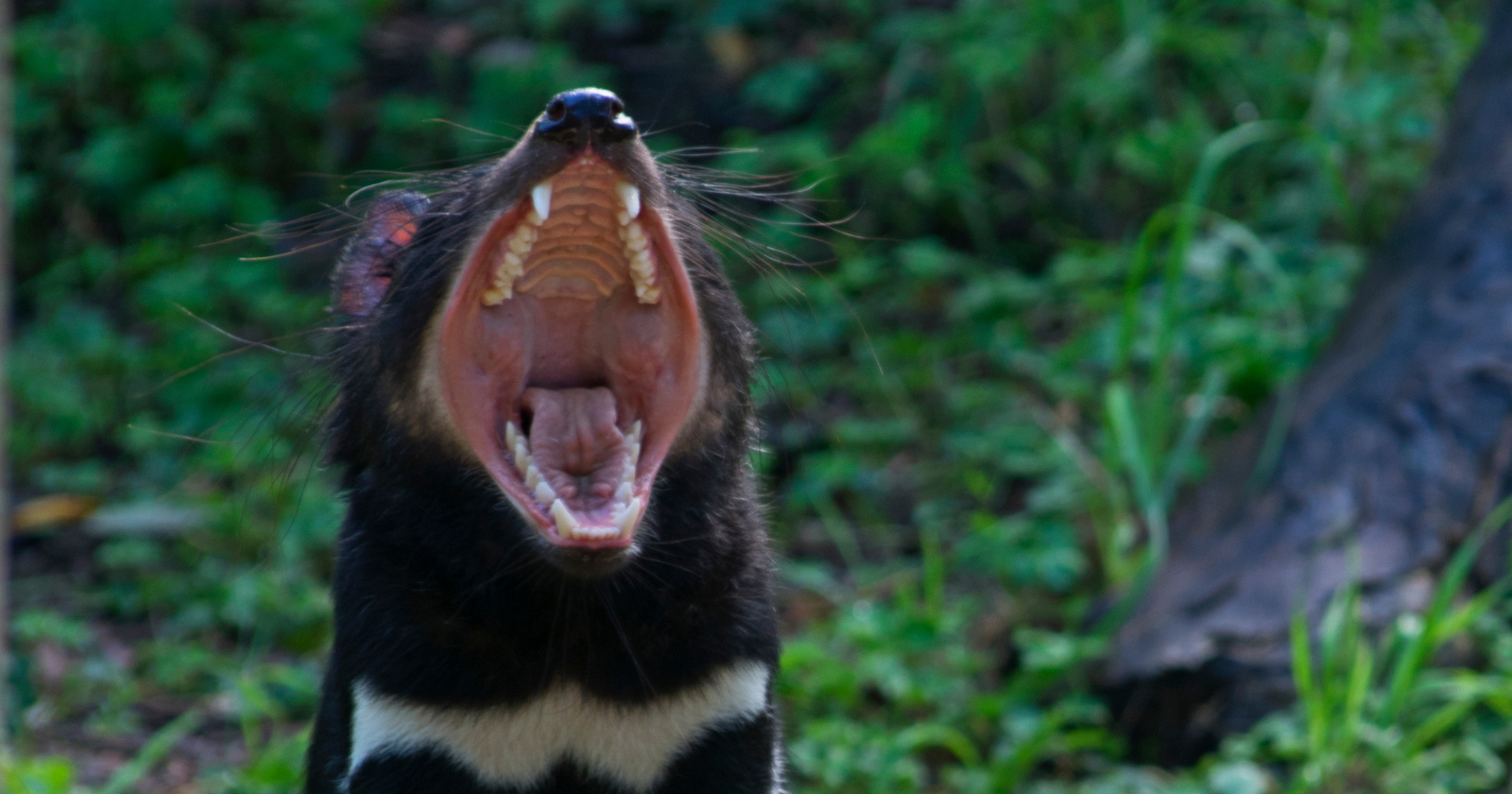
Tasmanian devil remains have come out of more than 120 Quaternary deposits across Australia. Until now, not one of them was in the Pilbara. Two specimens from the Juukan 2 rock shelter on Puutu Kunti Kurrama and Pinikura country have changed that, and the shelter they came from no longer stands.
The first specimen is a right lower jaw fragment carrying two molars, recovered in situ from Holocene sediments. The second is the broken front half of a lower premolar, picked out of 4 mm sieve residues under laboratory conditions on country, from deposits laid down before the Last Glacial Maximum.
Between them sits roughly 35,000 years with no diagnostic devil bone in it at all. The study, first published on 10 September 2026 in Archaeology in Oceania, bridges that gap not with more teeth but with chewed rubbish.
How you identify a devil from half a premolar
The jaw fragment is the straightforward one. Its two molars are similar in size and tribosphenic rather than shearing, which rules out a dingo. Reduced metaconids, slight posterior cingulids and buccally placed hypoconids separate it from thylacine and from the quolls, leaving Sarcophilus.
Body mass estimated from the first molar comes out at 7.3 kg. Estimated from the second molar, from the same jaw, it comes out at 14.2 kg. The paper presents this as a size range consistent with the living species rather than the larger extinct ones, and a reader should resist the urge to split the difference, because no single figure was measured.
The premolar is where the piece sharpens. Its identification rests on the crown sitting buccally off the long axis of the jaw, a feature the authors say occurs among Australian mesocarnivores only in Sarcophilus, plus a small enamel protuberance matching the buccal cingulid on devil premolars.
Against that, the tooth is roughly a quarter smaller than it should be. Its anterior width is 2.9 mm, where adult comparative specimens run 3.6 to 4.5 mm for the first premolar and 3.9 to 4.7 mm for the second. The authors attribute the shortfall to extensive enamel flaking, possibly caused by heating, which would have stripped material from the original surface.
They are careful about what that leaves them with. The identification, they write, is tentative, given the size discrepancy and the heavily obscured condition of the crown. They are also unsure which tooth position it occupied. This matters more than it might appear, because the older of the two specimens is the one anchoring every headline figure in circulation.
Why neither tooth was dated directly
Both ages come from the sediments around the specimens rather than from the specimens themselves. The paper gives the reason plainly: direct dating was not appropriate because of cultural sensitivities surrounding destructive sampling. Ageing a tooth by radiocarbon means consuming part of it.
For the jaw fragment, charcoal from hearth features 7 mm above and 46 mm below the find gave calibrated ages of 6,920 plus or minus 80 and 7,310 plus or minus 60 years before present, measured by accelerator mass spectrometry at Waikato and calibrated against the southern hemisphere curve. The bracket is tight because the two charcoal samples sit within 53 mm of each other.
For the premolar, two optically stimulated luminescence samples returned ages of 44,480 plus or minus 1,980 and 45,025 plus or minus 2,090 years, bracketing the specimen to between 42,500 and 47,115 years ago. The authors report that the equivalent dose distributions are consistent with intact sediment, showing little sign of burrowing or other disturbance that might have moved a small tooth down the profile.
Indirect dating is normal practice and the brackets here are unusually well controlled. It is still worth naming which object carries the date. A tooth dated by the charcoal beside it is making a slightly different claim than a tooth dated by its own carbon.
The ten bones behind the clean-up crew
The coverage has settled on an appealing image: devils working as a clean-up crew on the waste left by human butchery, for tens of thousands of years. The paper does argue something close to that. The evidence is thinner than the framing suggests.
Of 8,086 catalogued bone specimens from the site, 1,002 showed chewing or gnawing. Most could not be used. Analysis needs bones with secure stratigraphy, no acid-digestion damage, and at least five measurable tooth pits, and only 55 specimens cleared all three bars.
Those 55 were matched against published measurements from controlled feeding experiments, by comparing mean pit length and width and assigning each specimen to whichever reference animal it sat closest to. Ten came out closest to Tasmanian devil.
That is 18.2%, and it is not the largest group. The counts across the 55 specimens ran as follows:
- Monitor lizard, 14
- Human, 11
- Tiger quoll, 10
- Tasmanian devil, 10
- Eastern quoll, 9
- Dingo, 1
The single dingo-like specimen is discounted by the authors as pit-size overlap, since human was the second-closest match and the more plausible one on chronological grounds. The devil-like specimens do recur across the sequence, appearing in pre-glacial, post-glacial and Holocene deposits, which is the pattern the continuity argument needs. None appear in the Last Glacial Maximum layers. The paper states directly that the assemblage cannot be attributed to a single agent.
Digested bone gives a second line. Across 263 fragments the median maximum length is 10.30 mm, sitting inside the range published for the larger spotted-tailed quoll and approaching the single archaeological figure available for devils. The largest fragment, at 30.2 mm, exceeds what has been recorded as possible in wild quoll scats, which points toward something with a bigger jaw.
One detail deserves flagging. Controlled experiments on bone digested by devils have been run, but the data is unpublished and enters this paper as a personal communication. The clearest comparator for the central claim is not yet in the literature.
What the forty-five-thousand-year figure rests on
Strip the argument back and it runs like this. One securely identified jaw at about 7,000 years. One tentatively identified premolar at about 45,000 years. Ten chewed bones out of 8,086 that resemble devil work more than anything else tested. From those, a claim of sustained devil presence, and sustained devil association with human waste, across 45,000 years.
Each step is reasonable. The accumulation is where the confidence gets ahead of the material, and the phrase doing the most work is “at least 45,000 years”, which describes the span between the oldest and youngest evidence rather than a record of occupation running through it.
This field has been caught by exactly that before. Earlier work went through the published devil dates and discarded the ones that could not be trusted, a cull that left the youngest accepted mainland fossil sitting at around 25,500 years. The 2018 study that reset the timeline got there by generating 24 new devil ages of its own, not by reinterpreting the surviving ones. Individual specimens have carried more weight in this debate than they turned out to bear.
The dingo explanation sits on even less. The paper’s discussion presents disruption by dingoes as the likely trigger for the devils’ disappearance, in line with the prevailing hypothesis in the field. Its own chewing data contains a single dingo-like specimen, which it then argues against. Competing explanations, including changes in human hunting technology and climate instability, get a fair hearing in the introduction and no test in the results.
Mainland extinction itself is now well constrained, at between 3,179 and 3,227 years ago, synchronous with the thylacine. The dingo’s arrival shortly before that is the correlation the field has been arguing over for decades. This paper adds a site to the map. It does not settle the cause, and does not claim to.
A site that cannot be re-excavated
The Juukan 2 rock shelter was destroyed on 24 May 2020 by a blast connected to development of Rio Tinto’s Brockman 4 mine. The rock-shelter structure was lost, but later excavation found that much of the archaeological deposit remained intact beneath the blasted overburden. A 2024 study placed human occupation at the site as early as 47,000 years ago, and its author list includes the Puutu Kunti Kurrama and Pinikura Aboriginal Corporation alongside the archaeologists.
A devil tooth from the gorge was announced publicly during a 2024 Society for American Archaeology conference, as part of work carried out with the Traditional Owners after the destruction. The September 2026 paper supplies the formal description: the anatomy, the dating, a second and far older specimen, and the first attempt to read the chewed bone.
The authors note that comprehensive taphonomic and faunal analysis of the deposit is still underway and will appear in later publications. The paper also says excavation and comprehensive sediment dating remained in progress. Future findings therefore are not limited to material that had already been boxed and sieved when the study appeared.
What cannot be recovered is the destroyed rock-shelter structure and any archaeological context the blast erased. Whatever the Pilbara has left to say about its devils must now come from the surviving deposit and the material already recovered.