

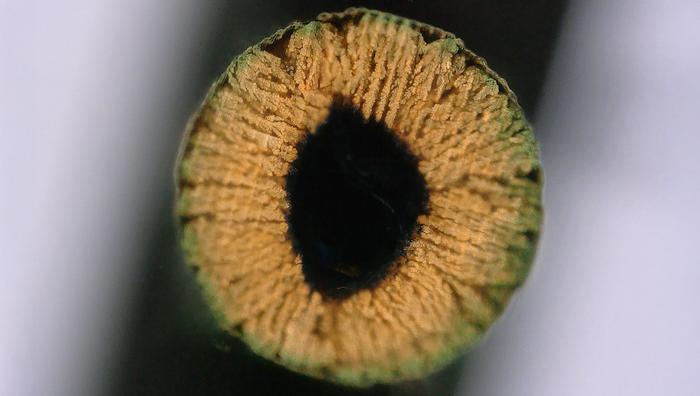
Most 3D printing happens in reverse: you build something up, layer by layer, until you have a finished product. But researchers at Switzerland’s EPFL have turned that logic on its head with a technique that grows metals and ceramics inside water-based gels, producing structures 20 times stronger than conventional methods while shrinking far less in the process.
The work, published in Advanced Materials, solves one of additive manufacturing’s most persistent headaches. Traditional methods for printing metals start with polymer templates infused with metal precursors, then burn away the polymer to leave the metal behind. The problem? The final parts shrink by 60 to 90 percent and end up riddled with pores that sap their strength.
“Our materials could withstand 20 times more pressure compared to those produced with previous methods, while exhibiting only 20% shrinkage versus 60-90%,” says PhD student and first author Yiming Ji.
Building Metal From the Inside Out
The EPFL team, led by Daryl Yee, took a different path. Instead of pre-loading their gel with metal, they printed blank hydrogel scaffolds first. Then came the clever part: they repeatedly soaked these scaffolds in metal salt solutions, converting the salts into tiny metal-containing nanoparticles that permeated the structure. After five to ten of these growth cycles, a final heating step burned away the hydrogel, leaving behind dense metal or ceramic objects that retained their original shape with remarkable fidelity.
The technique is chemically elegant. By cycling between infusion and precipitation, the researchers bypassed the fundamental limitation that has hobbled similar approaches: the amount of metal you can dissolve in water. Each cycle deposits more metal particles inside the gel’s structure, building up concentrations that would be impossible to achieve through simple soaking. The team demonstrated the versatility by fabricating intricate lattice structures called gyroids from iron, silver, and copper.
From Lab Curiosity to Industrial Potential
The shrinkage reduction matters beyond mere dimensional accuracy. When parts shrink less, they warp less too. That opens doors to applications that demand precision: biomedical implants, catalytic converters, advanced sensors. The team fabricated centimeter-scale iron stents and gears that held their intended geometries, something that proved impossible with standard methods.
The resulting materials are not just better shaped but genuinely stronger. Compression tests showed iron structures made with the new process could handle about 5 megapascals of pressure, compared to 0.2 megapascals for conventionally made counterparts. That 25-fold improvement stems from achieving densities above 80 percent of theoretical maximum, versus the porous, crack-riddled structures typical of high-shrinkage processes.
“Our work not only enables the fabrication of high-quality metals and ceramics with an accessible, low-cost 3D printing process; it also highlights a new paradigm in additive manufacturing where material selection occurs after 3D printing, rather than before,” Yee summarizes.
There is something almost biological about the approach, this notion of growing materials inside a scaffold rather than assembling them. The team even demonstrated functional ceramics, creating hard magnetic strontium ferrite structures by infusing their iron oxide scaffolds with strontium salts before the final heating step. The modularity suggests possibilities beyond structural parts.
The method still has practical constraints. The repeated soaking steps make it slower than conventional metal printing, though the team is working on robotic automation. And the technique works best for structures with wall thicknesses below 300 micrometers, complementing rather than replacing industrial metal sintering for larger parts. But in that niche, particularly for reflective metals like copper and silver that resist laser sintering, the gel-growth approach offers capabilities that existing technologies cannot match.
What makes this work compelling is not just the improved specifications but the conceptual shift. By decoupling the printing step from material selection, the researchers created a platform where a single printed scaffold can become any of dozens of different metals or ceramics. That flexibility, combined with the strength improvements and reduced warping, could finally move metal 3D printing from prototyping curiosity to production reality for complex, small-scale parts.