

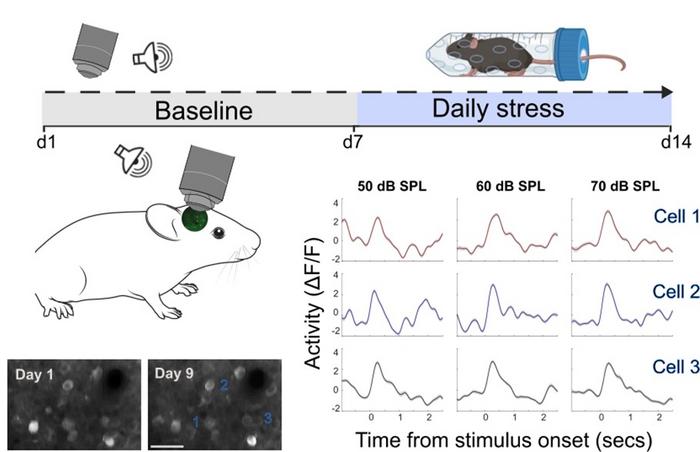
After a week of stress, mice show changes in how their brains process sound, reducing how well they perceive loud noises, according to a study published February 11th in the open-access journal PLOS Biology led by Ghattas Bisharat, from the Ben-Gurion University of the Negev in Israel, and colleagues.
Repeated stress has negative impacts on mental health that can go beyond psychiatric disorders. They can also cause changes in how we perceive the world, making us jump at loud noises, or become easily irritated by scratchy sweaters or offensive odors. To understand how repeated stress can impact how the brain processes sensory information, the authors of this study exposed mice to the stress of being trapped for half an hour in a small space daily over the course of a week. They then measured how their brains processed sound.
After a week of stress, the animals’ ability to hear—measured in the auditory brainstem—remained normal. However, in the auditory cortex, stressed animals had higher spontaneous neuronal activity. In response to sounds, somatostatin-expressing inhibitory cells showed a higher response, while parvalbumin-expressing neurons and putative pyramidal neurons were less sensitive. In a behavioral task that required the stressed mice to categorize sounds as loud or soft, they were more likely to report louder sounds as soft, which indicates a reduced perception of loudness. While the current study is in mice, the results show that repeated stress could change how animals perceive and respond to the world around them.
The authors add, “Our research suggests that repeated stress doesn’t just impact complex tasks like learning and memory—it may also alter how we respond to everyday neutral stimuli.”
Citation: Bisharat G, Kaganovski E, Sapir H, Temnogorod A, Levy T, Resnik J (2025) Repeated stress gradually impairs auditory processing and perception. PLoS Biol 23(2): e3003012. https://doi.org/10.1371/journal.pbio.3003012