

In September 1994, a New South Wales National Parks officer named David Noble was doing what he did most weekends — canyoning in the Blue Mountains, the vast, rugged wilderness of sandstone gorges that stretch inland from Sydney.
He had abseiled into a particular narrow canyon he had never explored before, deep in Wollemi National Park about 150 kilometres northwest of the city. The canyon was tight, wet, sheltered from wind and sunlight, its floor cool with rainforest humidity. As he walked along the canyon bottom, he noticed a stand of trees he did not recognise.
Noble had a good working knowledge of Australian botany. He worked in the park. He knew, roughly speaking, what should be growing where. These trees were something else. Tall, unusually knobbly-barked, with fern-like foliage he could not place. Curious rather than certain, he broke off a small branch and took it home in his backpack.
He passed the branch to botanists at the Royal Botanic Gardens in Sydney a few days later. Their reaction, over the following weeks, would be one of the most extraordinary in the history of modern botany.
The tree that shouldn’t have existed
What Noble had picked up in the canyon was a branch of a tree from a lineage that scientists had, for at least the previous century, been completely certain was extinct.
Its closest matches were not in any living plant. They were in the fossil record. Sediment layers from the Cretaceous period — the last age of the dinosaurs, between roughly 145 and 66 million years ago — contained fossil pollen and fossil leaf impressions that looked almost identical to what Noble had brought back. The most similar fossil pollen, called Dilwynites, appears in Australian sediments dating back around 90 million years. Its last known appearance in the fossil record is in rocks approximately 2 million years old.
Then, in the entire geological record, silence. The tree that produced that pollen appeared to have disappeared from the surface of the Earth.
Until, in September 1994, a park ranger walked past a stand of them in a canyon in New South Wales.
The Royal Botanic Gardens team formally described the tree as a new genus and species in 1995. They named it Wollemia nobilis: Wollemia for the national park where it was found and nobilis in honour of David Noble.
What was hiding in the canyon
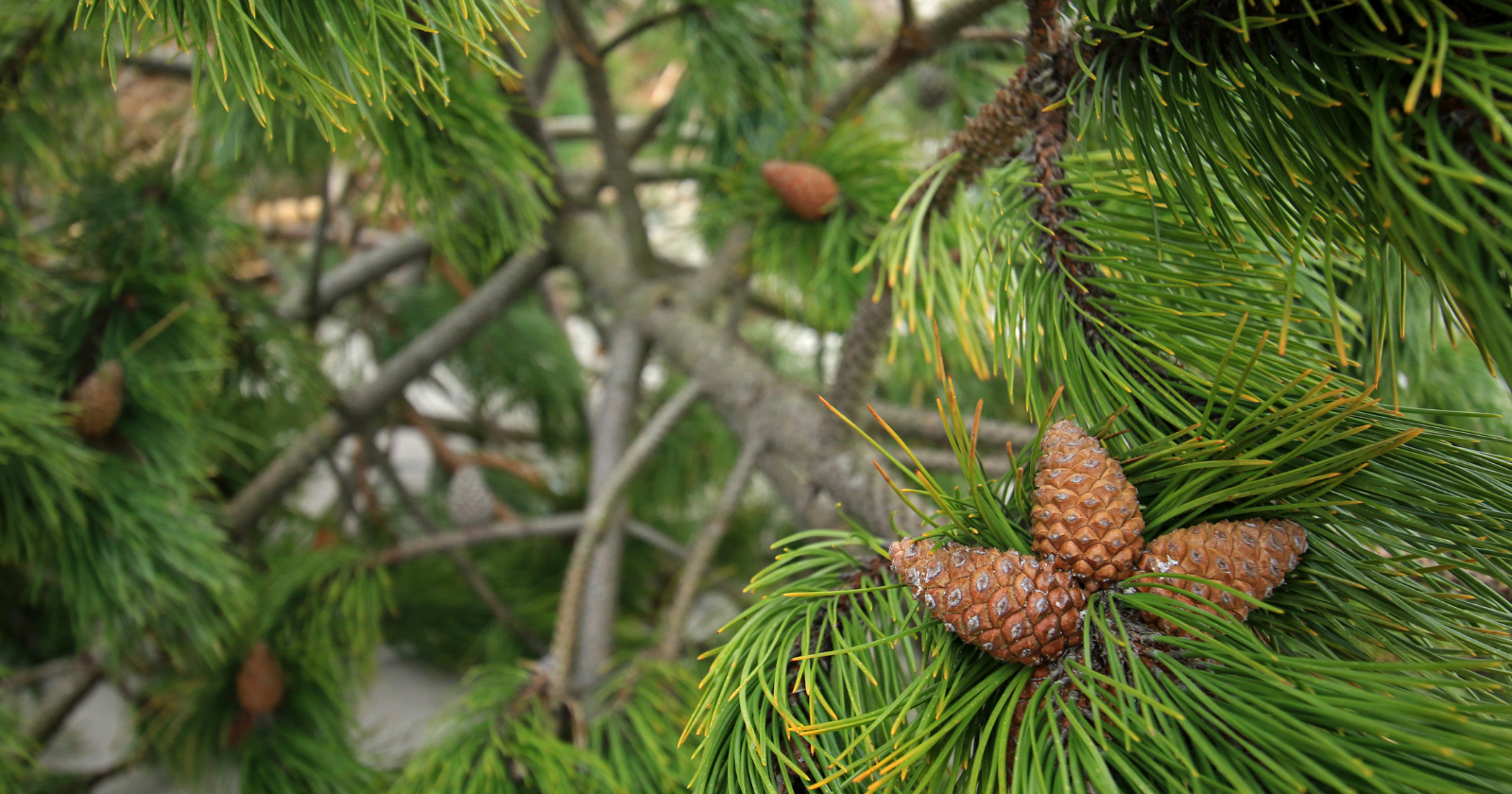
The Wollemi pine belongs to a conifer family called Araucariaceae — the same broad family as the monkey puzzle tree of Chile and the Norfolk Island pine planted decoratively in shopping-centre car parks worldwide. What made the Wollemi pine different was not just that it was a member of that family, but that it was so completely unlike any of the living members. When the botanists compared its cones, its needles, and its cellular structure, it turned out to belong to its own separate genus — a lineage entirely of its own, previously known only from fossils.
The question of how a species could survive for perhaps a hundred million years, hidden in a single canyon, is genuinely difficult to answer.
The best current theory is that the Wollemi canyon is what ecologists call a refugium — a small pocket of exceptionally stable microclimate that survived while the world around it changed beyond recognition. Australia has drifted north across half a hemisphere over the last 90 million years. Its inland seas have vanished. Its climate has aridified dramatically. Its fire regimes have transformed. Almost everything that was living on the Australian landmass 90 million years ago is now either gone or unrecognisably evolved.
The Wollemi canyon appears to have held on to its ancient conditions. Cool. Wet. Sheltered from fire by the sandstone walls around it. Protected from the drying continent by its own particular geology. Generation after generation of pines have grown, produced seeds, sometimes coppiced new growth from their own roots, and quietly persisted while the world outside the canyon changed into a place none of their ancestors would recognise.
What’s still there
The wild Wollemi pine population is genuinely tiny.
Older sources describe “fewer than 100” wild trees. A 2023 genome paper describes approximately 60 individual trees and associated ramets across four nearby locations. The 2019–2020 bushfires came dangerously close to the grove, and a firefighting effort using aircraft and specialised sprinklers helped protect the wild population.
The trees themselves are also strangely uniform. Genetic sequencing has revealed that the Wollemi pine population has almost no genetic variation — the trees are, essentially, clones of a small handful of ancestors, likely inbred through repeated bottlenecks over hundreds of thousands of years. This makes the species uniquely vulnerable. A single introduced disease, a single generation-killing fire, and the wild population would be gone.
The Australian government has therefore kept the exact coordinates of the wild grove classified since the moment the tree was identified. The general area is public knowledge. The specific location is not. Botanists and conservationists who visit must undergo full decontamination procedures before entering the canyon, and even so, in 2005, the fungal disease Phytophthora cinnamomi was detected among the wild trees — almost certainly introduced by unauthorised visitors who had bypassed the protection protocols.
The wild population is now under a permanent conservation program with a global metacollection of cultivated Wollemi pines held at botanical gardens around the world, so that if the wild grove is ever lost, the species will not go extinct with it.
What Noble’s canyon reminds us
The Wollemi pine’s discovery matters beyond its specific biological rarity.
It is a reminder, at a time when we are told the natural world has been almost completely catalogued, that entire chapters of Earth’s living history can still be quietly waiting in canyons the maps have not properly explored. The last great “living fossil” discovery before the Wollemi pine was the coelacanth, a fish thought to have been extinct for 65 million years until one turned up in a South African fisherman’s net in 1938. Between the coelacanth and the Wollemi pine, more than half a century passed. Similar surprises are almost certainly still ahead.
Somewhere, right now, in a canyon in New South Wales whose coordinates only a handful of people know, roughly 60 trees are growing that should not, by every model of what species survive and which do not, still be alive. They have been growing there quietly since long before there were humans on Earth to notice.
They are still growing. Almost nobody has ever seen them.