

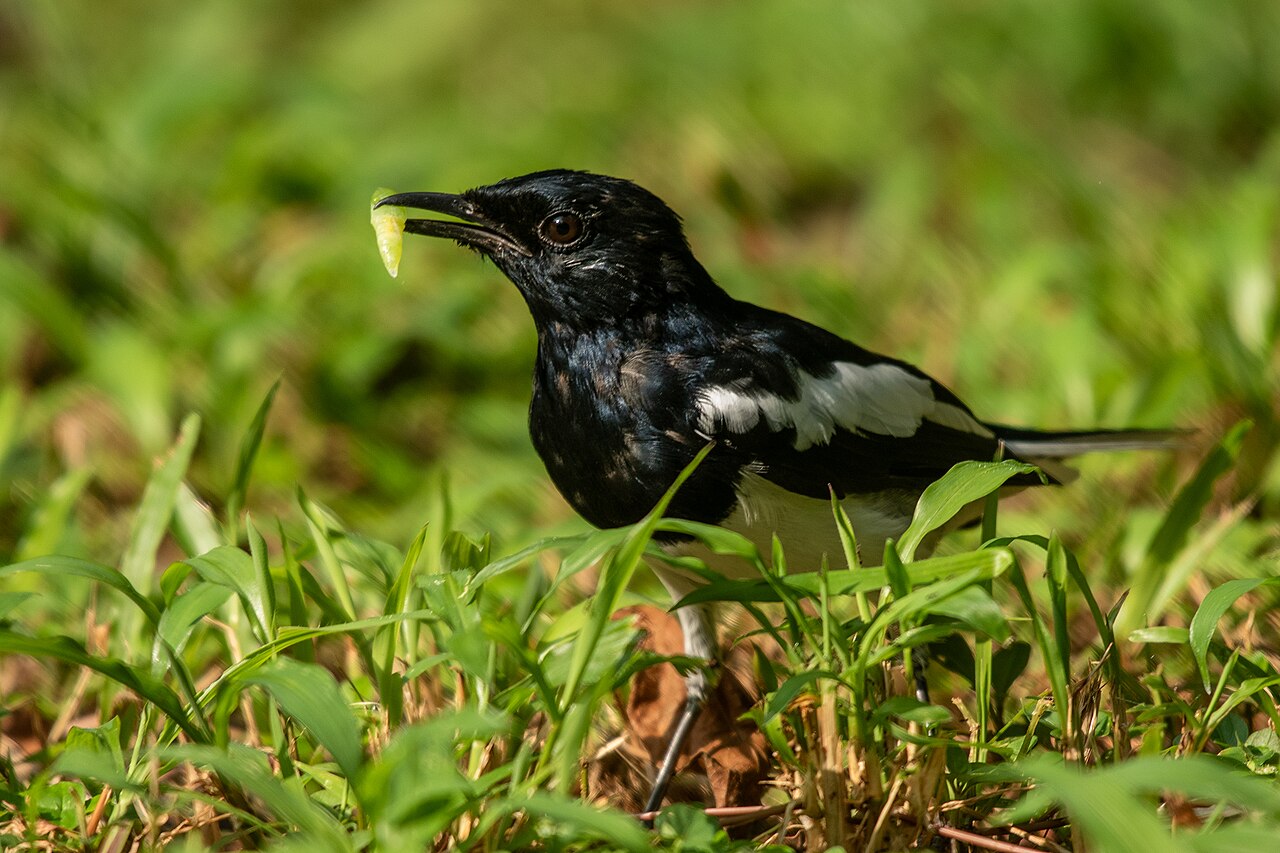
Count them: five. That was the entire global population of the Chatham Island black robin in 1980 — five birds, among them a single breeding pair, the female known as Old Blue and the male known as Old Yellow. Forty-six years later, about 350 adults live on two pest-free islands in the Chatham group, and every one of them descends from Old Blue. A single female, who reached 14 years of age, stands at the base of the entire living family tree of her species. The arithmetic of the species runs through one bird.
That arithmetic is the reason the bird has just been handed New Zealand’s most public ornithological honour. Karure, the Chatham Island black robin, won the 2026 Bird of the Year competition, with the result issued by Forest & Bird on Monday 21 September 2026. The campaign was managed by the Chatham Islands Landscape Restoration Trust, on behalf of a bird found only on Rēkohu/the Chatham Islands — an archipelago that lies about 800 kilometres east of mainland New Zealand and supports 20 per cent of the country’s threatened bird species. The species is endemic to New Zealand, and in practice endemic to a far smaller area than that: the only black robins anywhere are on two restricted nature reserves in the Chathams.
A population small enough to count one by one
The black robin’s decline is recorded in whole numbers rather than estimates, because for a time there were few enough birds to count each one. Introduced rats and cats, which followed human settlement, had eliminated the species everywhere except Little Mangere Island by 1900. When wildlife officers surveyed Little Mangere in 1972 they found 18 black robins. By 1976 only seven remained. Those seven were moved to Mangere Island, where 120,000 trees had been planted to provide shelter.
The move did not immediately arrest the slide. By 1980 two more birds had died, none had bred, and the world total stood at five, including the only fertile female, as the Department of Conservation’s account of the species records. Recovery proceeded from one breeding pair: Old Blue and Old Yellow.
The date is worth stating precisely. The five-bird, single-pair minimum belongs to 1980 — after the translocation, after the tree planting, at the point where the programme’s remaining options were one pair and whatever could be done to lift the number of young they produced.
Cross-fostering and the case model it produced
New Zealand Wildlife Service staff boosted productivity by cross-fostering black-robin eggs and young to Chatham Island tits, which took on the work of incubating and rearing them. The fostering programme went on to become an international case model for saving endangered birds.
DOC shares the credit three ways: Old Blue, Old Yellow and the foster species together prevented extinction. Old Blue’s longevity mattered to the outcome. Reaching 14 years old gave the recovery effort seasons it could not otherwise have had, and it is why DOC records that all black robins alive today descend from the last breeding female.
The habitat requirements have not changed since. Black robins prefer lowland coastal forest with canopy cover and invertebrate food, and — the non-negotiable condition — no feral cats, rats or possums. That combination now exists for them in exactly two places: Maung’Rē/Mangere and Hokorereoro/Rangatira, also known as South East Island. Access to both islands is restricted. Both are nature reserves managed by the Department of Conservation.
Why about 350 adults is still Nationally Critical
The recovery is real and it is measurable, but the species’ official conservation status has not shifted: the black robin remains Threatened–Nationally Critical. Three constraints explain why about 350 adults, counted after the latest breeding season, should not be read as safety.
The first is space. Forest & Bird notes that suitable habitat on the two small islands is nearly at capacity, and that the good territories are already occupied. Continued growth depends on establishing a third population, and therefore on securing more safe habitat. Any third site must meet the same conditions as the first two: lowland coastal forest, canopy cover, invertebrate food, and no feral cats, rats or possums. A past attempt to establish another population, in a fenced covenant on Pitt Island, failed — possibly because of competition for food with introduced mice.
The second is predation. An accidental introduction of predators to Mangere or Rangatira remains a threat, and it is the same class of event that reduced the species to a single island in the first place. Both are restricted, pest-free nature reserves.
The third is written into the birds themselves. The bottleneck left today’s population with very similar DNA, because all of it traces back to one breeding female. Similar DNA is the direct legacy of the 1980 bottleneck, and DOC’s assessment of the consequence is blunt: a single disease could threaten all black robins. Genetic uniformity is part of the price of the rescue, and it is not a price that can be paid down quickly.
So the 2026 result reads better as an argument than a victory lap. A restoration trust campaigned for a bird from an island group supporting a fifth of New Zealand’s threatened bird species. Its status remains Nationally Critical, and continued growth requires more safe habitat and a third population. The black robin demonstrates that a species can be brought back from five individuals and one breeding pair — and how much work remains after that rescue.