

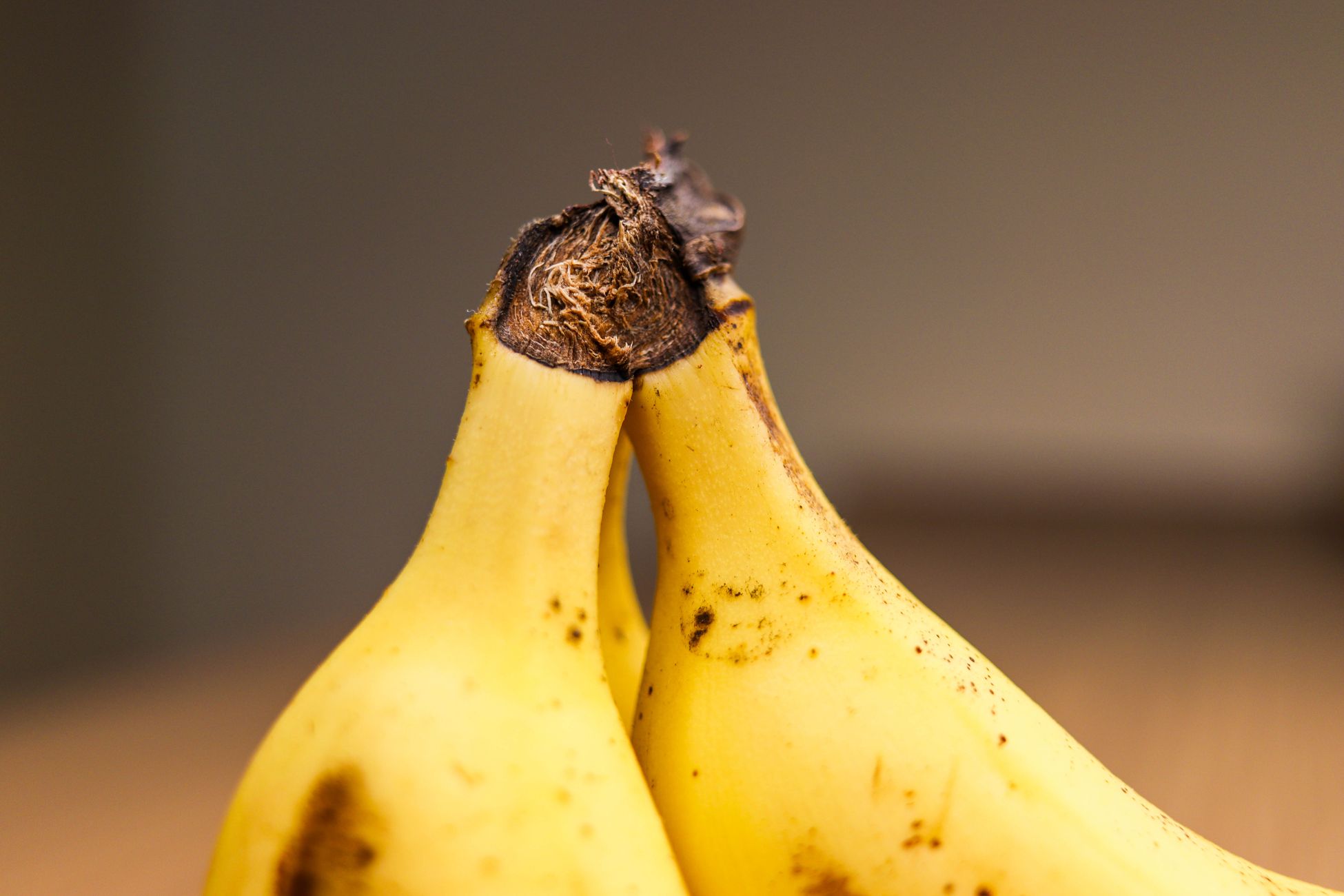
The phrase banana equivalent dose emerged in the 1990s as a way to explain to non-specialists why a truckload of slightly contaminated soil was not worth panicking about. The comparison went like this: eat one banana, and you absorb roughly 0.1 microsieverts of ionising radiation from the potassium-40 inside it. That is a real, measurable dose, delivered by a fruit sold at every corner shop, and it is so small that using it as a yardstick makes almost every headline-grabbing radiation number look absurd.
The banana is radioactive because potassium is radioactive. There is no way around it.
Bananas contain potassium, most of it stable potassium-39. But a fixed sliver of natural potassium is potassium-40, an isotope with a half-life of over a billion years. That isotope has been decaying inside every potassium-bearing thing on the planet since the planet formed, and it will keep decaying long after the Sun swells into a red giant.

The isotope that has been with us since the beginning
Potassium-40 decays in three ways. Most of the time it beta-decays into calcium-40. A smaller percentage of the time it captures an electron and becomes argon-40, releasing an energetic gamma ray in the process. That gamma is energetic enough that freight cars and truckloads of bananas have, on more than one occasion, set off radiation detectors designed to catch smuggled nuclear material.
The customs officers know. They wave the bananas through.
What makes potassium-40 an ideal reference dose is that it is universal. It is unavoidable. It is baked into a food eaten by billions of people every day. If you are alive and reading this, a small fraction of the potassium in your own body is potassium-40, decaying inside you right now, which means that you are, like everything around you, a little bit radioactive.
How the number 0.1 microsieverts got fixed
The dose per banana is usually cited as 0.1 microsieverts, or one ten-millionth of a sievert. That figure comes from a straightforward calculation: take the potassium content of an average banana, multiply by the fraction that is potassium-40, multiply by the known energy released per decay, and correct for how the body processes potassium.
The correction matters. The human body tightly regulates its potassium level, so eating a banana does not actually raise your long-term potassium-40 burden. Extra potassium in equals extra potassium out, usually within a day or so. The 0.1 microsievert figure is really an accounting convention rather than an added lifetime dose, which is one reason radiation physicists have always treated the banana equivalent dose as a teaching tool rather than a formal unit.
Still, as a yardstick, it works beautifully.
What one banana buys you, in radiation terms
A dental X-ray is equivalent to dozens of bananas. A cross-country flight from New York to Los Angeles is several hundred bananas, because cosmic rays penetrate the thin aluminium of a jet cabin at 35,000 feet far more easily than at sea level. A chest CT scan is tens of thousands of bananas. Living in a brick house for a year, thanks to trace uranium and thorium in the clay, adds a few hundred bananas to your annual dose.
The natural background radiation an average person absorbs in a year, from cosmic rays, soil, radon and the potassium in their own body, works out to tens of thousands of bananas.
Even the exclusion zone around Chernobyl, in most publicly accessible areas today, delivers less per hour than a couple of dozen bananas.

Why the comparison quietly breaks down
Radiation physicists were careful about one thing: the banana equivalent dose is a rhetorical device, not a scientific one. It fails at the edges, and it fails hard.
The reason is biology. Because the body holds potassium at a nearly constant concentration, eating more bananas does not stack doses the way a stack of X-rays would. Ten bananas is not ten times the dose of one banana in any meaningful long-term sense. The radiation dose you carry from potassium-40 is essentially fixed by your body mass, not by your fruit intake.
Different isotopes also behave completely differently once inside you. Iodine-131, the isotope released in reactor accidents, concentrates in the thyroid. Strontium-90 substitutes for calcium and lodges in bone. Comparing those to a banana, which passes through the gut and is flushed out, is like comparing a mosquito bite to a bee sting because both puncture the skin.
Bananas are not even the most radioactive food
Brazil nuts contain radium absorbed from soil by their trees’ unusually deep roots, and they are significantly more radioactive per gram than a banana. Potatoes, sunflower seeds, and other high-potassium foods also deliver more potassium-40 per serving than bananas do, simply because they contain more potassium.
The reason the banana got the naming rights is cultural. It is the fruit everyone recognises, the fruit in every lunchbox, the fruit in every cartoon. Nobody was going to call it the lima bean equivalent dose.
The real health consideration with high-potassium foods has nothing to do with radiation at all. It is potassium load in people with impaired kidney function, which is why nephrologists watch potassium intake closely in patients with kidney disease. The National Academies’ review of dietary reference intakes for potassium is framed around daily intake and health, measured in grams per day, not becquerels.
What the banana is really trying to say
The point of the comparison was to break a public-health deadlock. People were being asked to worry about doses measured in microsieverts, a unit meaningless to almost everyone. Journalists were reporting numbers without context. A 5 microsievert reading near a decommissioned facility would run as a scare headline, even though it corresponded to about fifty bananas, or one transatlantic flight leg.
Framing it in fruit did something no technical explanation could. It made the number small in the reader’s mind before the reader could decide it was big.
That is also why professional radiation protection bodies never formally adopted the unit. It works only as long as everyone understands it is approximate. The moment someone tries to use it to argue that therefore some serious exposure is fine because it equals only a few thousand bananas, the comparison collapses under the weight it was never meant to carry.
The bananas at the checkout are older than the solar system
The potassium-40 atoms in the banana in your kitchen were forged in the cores of stars. They drifted through the interstellar medium, got swept up in the cloud that formed the solar system 4.6 billion years ago, ended up in Earth’s crust, were pulled up through the roots of a banana plant in Ecuador or the Philippines, and are now sitting in a fruit bowl slowly emitting gamma rays.
Every second, in every banana on the counter, a handful of those atoms give up and turn into calcium or argon.
You eat the banana. Your body redistributes the potassium, keeps what it needs, dumps the rest. The gamma rays that were going to be emitted from that fruit are now emitted from you, at roughly the same rate, for the day or so it takes to clear the extra potassium. Then you are back to your baseline, the same rate every human has carried since Homo sapiens first walked out of Africa.
The fruit in the bowl is very slightly radioactive. So is the person eating it. So is the countertop, the concrete under the countertop, the granite it was quarried from, and the air moving through the room, laced with a few atoms of radon that seeped up from the bedrock last week.
The banana equivalent dose does not really tell you how dangerous radiation is. It tells you how ordinary it is.