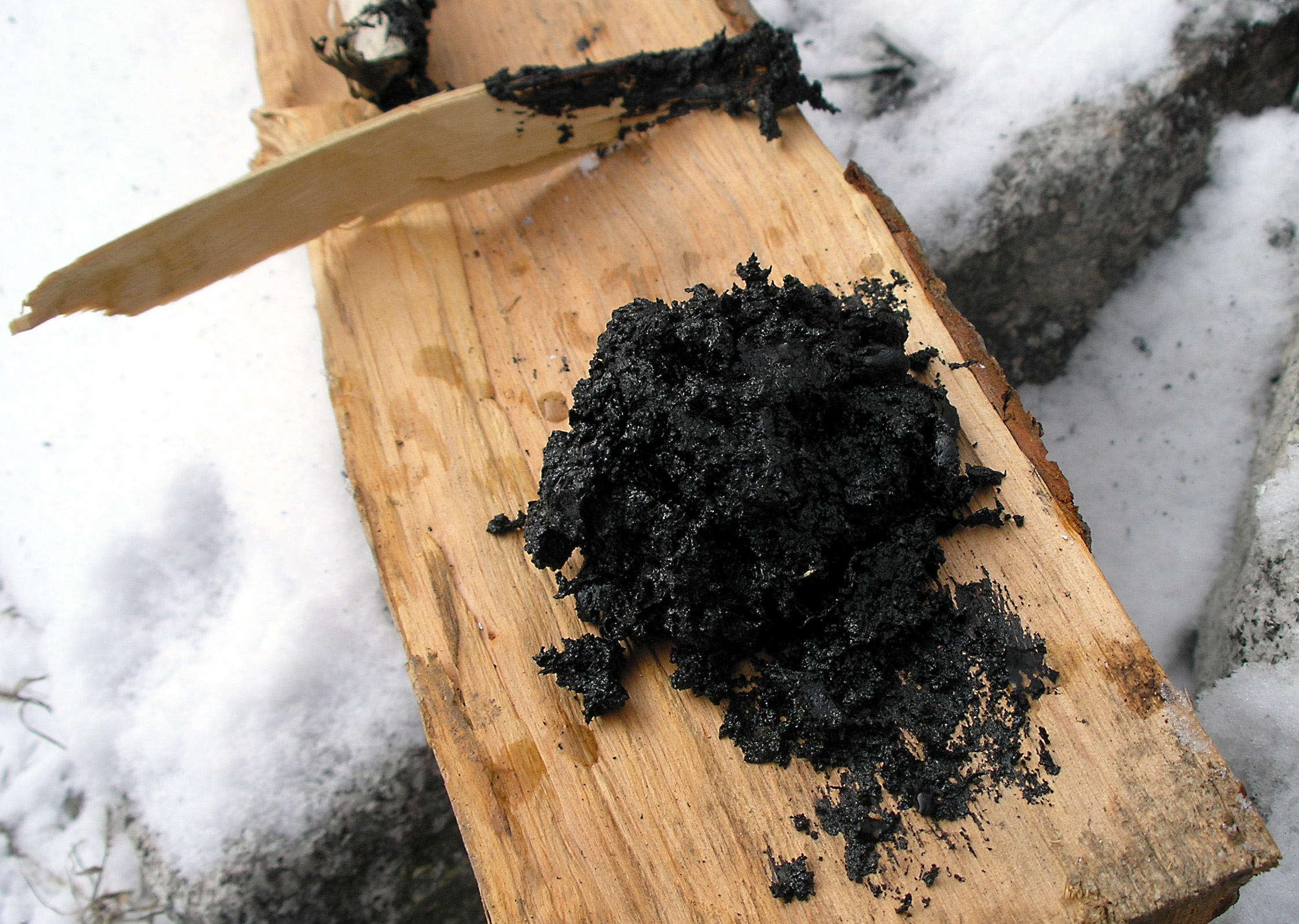
A dark, pliable lump about the size of a thumbnail came out of the mud at Syltholm, on the southern Danish island of Lolland, during excavations run by Museum Lolland-Falster ahead of construction on the Fehmarn Belt Fixed Link. It was birch pitch — tar cooked out of bark, used across Stone Age Europe as a glue for hafting stone tools — and someone had chewed it roughly 5,700 years ago and let it fall. That someone left behind enough of herself, sealed inside the tar, for a team led by Theis Jensen and Hannes Schroeder at the University of Copenhagen to reconstruct her entire genome without ever finding a bone or a tooth. The results were published open access in Nature Communications in December 2019.
That is the unusual part. Ancient human DNA normally comes from skeletal material — petrous bones, molars, the dense parts that hold molecules together for millennia. Here the source was a piece of processed plant resin that a person had softened in her mouth and discarded, and it functioned as an accidental sample tube.
Why a wad of tar keeps DNA better than most bones
Birch pitch is made by heating bark in a low-oxygen environment until it sweats a black, sticky tar. It hardens as it cools, so it has to be warmed again before use, and chewing is the simplest way to do that. Chewed pieces turn up at sites across northern Europe, often carrying tooth impressions. There are other reasons someone might work a lump in the mouth — the tar is mildly antiseptic, and it may have been used to ease toothache, clean teeth, or simply to pass the time — but the archaeological consensus is that most chewing was preparatory.
Whatever the reason, the material is close to ideal for molecular preservation. Birch tar is hydrophobic and antimicrobial; it locks out water and discourages the bacteria that would otherwise consume trapped DNA. At Syltholm, the pitch then spent five and a half millennia in waterlogged, oxygen-poor marine sediment, which kept temperatures stable and further slowed decay. The site itself is remarkable — a submerged coastal landscape with almost no human bone but abundant organic finds, including wooden tools, fish traps, and animal remains.
A complete genome from 2.3× coverage
The researchers recovered human DNA that made up a substantial share of the sequenced fragments — not a trace, but a dominant signal. From it they assembled a complete ancient human genome at an average depth of 2.3×, meaning each position in the genome was read a little over twice on average. That is shallow by clinical standards and enough for population genetics and for imputing many individual variants, though it leaves uncertainty at any single site.
The ratio of reads mapping to the X and Y chromosomes identified the chewer as female. The team’s press materials nicknamed her Lola, after Lolland. Her ancestry placed her with the western hunter-gatherers of mainland Europe rather than with the hunter-gatherer populations of central Scandinavia — a distinction that matters, because it suggests the people of southern Denmark at the start of the Neolithic were connected southward across what is now the Baltic coast rather than northward up the peninsula.
Running her imputed variants through HIrisPlex-S, the forensic prediction tool used to estimate pigmentation from DNA, produced a combination that has become familiar from other European hunter-gatherer genomes: she likely had dark skin, dark brown hair, and blue eyes. “Likely” is doing real work in that sentence. HIrisPlex-S returns probabilities, not portraits, and at 2.3× coverage some of the underlying genotypes are imputed rather than directly observed. She also carried the ancestral, non-persistent version of the lactase gene, meaning she almost certainly could not digest milk sugar as an adult — consistent with a population in which dairying had not yet reshaped the genome.
Duck, hazelnut, and the microbes in her mouth
The tar held more than one organism’s DNA. The team recovered an oral microbiome: the bacterial community that lived in her mouth, including commensal species and opportunistic pathogens. Among the non-bacterial sequences were fragments of Epstein-Barr virus, the herpesvirus that causes mononucleosis and infects most adults today — one of the oldest such detections from a directly sampled human source.
Then there was the food question. Alongside expected birch DNA (Betula pendula, the tree the pitch came from), the sequences included hazelnut (Corylus avellana) and mallard duck (Anas platyrhynchos), the latter represented by more than 50,000 reads. The authors propose that these may derive from a recent meal — a reasonable reading, and one they frame as a hypothesis rather than a finding. Plant and animal DNA can reach a mouth by other routes, and hazel wood and duck were both part of the ambient environment. What the sequences establish is presence; the dinner is an interpretation.
It is an interpretation with independent support, though. The faunal assemblage at Syltholm is dominated by wild taxa, including Anas species and hazelnuts, at a moment when farming was arriving in southern Scandinavia. The genome sits at that boundary: a woman with hunter-gatherer ancestry and no lactase persistence, chewing tool glue on a coast where people were still eating ducks and nuts from the wood.
The broader implication is procedural. Chewed birch pitch is common in northern European assemblages and has generally been catalogued as a curiosity of tool manufacture. It now reads as a biological archive — human genome, pathogens, oral flora, and the residue of what passed through a mouth — in places where skeletal remains were never preserved at all.