

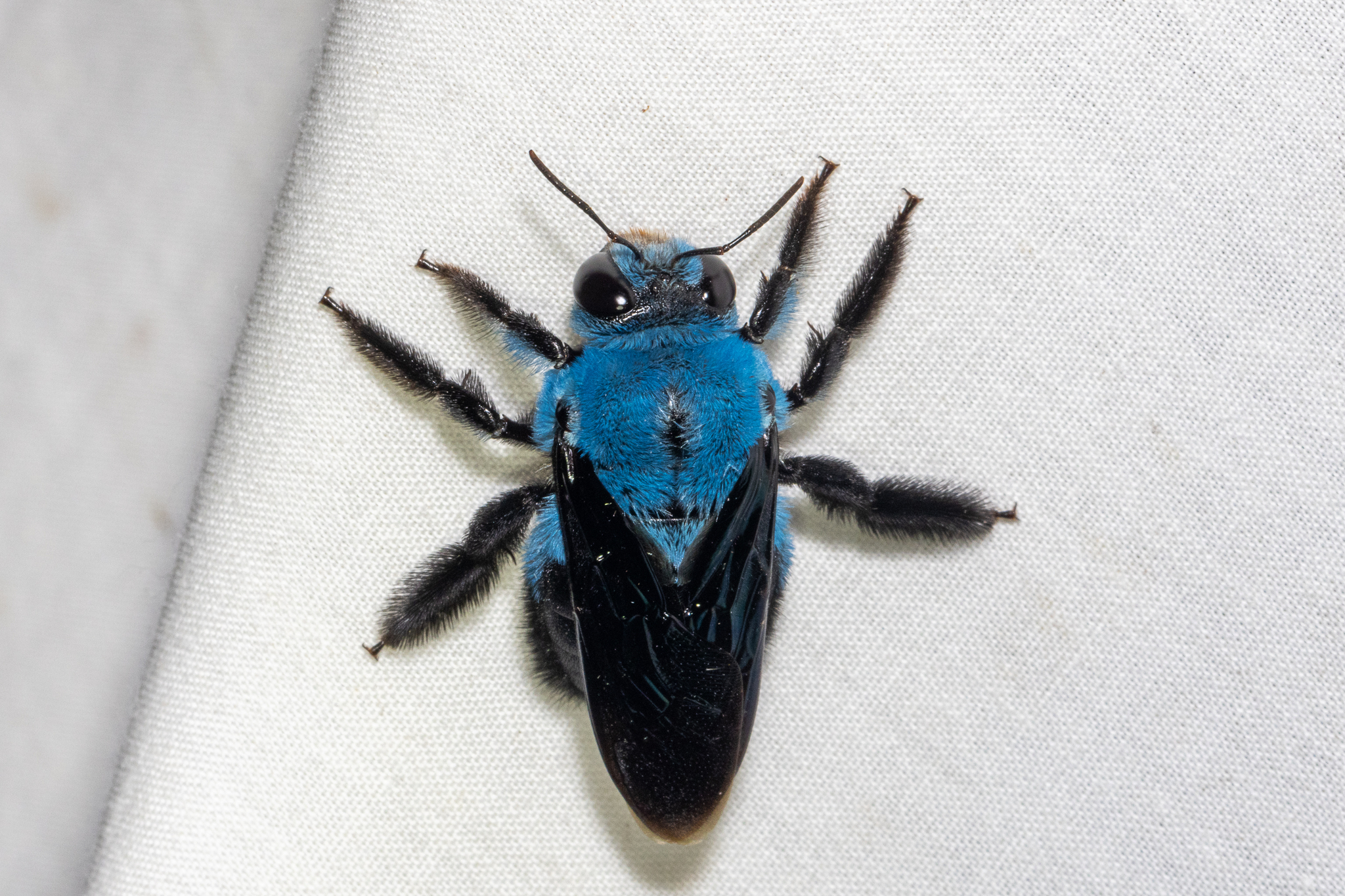
A blue carpenter bee working a tropical garden looks like a scrap of sky that got loose, and the temptation is to imagine a hive somewhere behind her — a colony, a queen, a comb. There isn’t one. Each female Xylocopa caerulea is her own architect, contractor, and food store: she chews a tunnel into wood, packs a mass of pollen and nectar at the far end, lays a single egg on that provision, walls the cell off, and begins the next one. The whole social apparatus most of us picture when we hear the word “bee” is missing, and what replaces it is a sequence of sealed rooms in a log.
The species is documented in Australian Geographic’s Creatura column by Bec Crew (30 April 2018), which puts the blue carpenter bee across Southeast Asia, India, and Southern China — South and Southeast Asia broadly, not Australia. It also puts a number on the impression the insect makes in flight: up to about 28 mm, against roughly 17 mm for a European honey bee. That difference reads as more than a measurement when the animal is in front of you. A honey bee is a detail. This is nearly an inch of hovering blue with an audible engine.
The coat, and who wears it
The blue is not pigment in a shell so much as fuzz. The dense pubescence covering the thorax and much of the abdomen carries the color, which is why the effect is powdery and matte rather than metallic — closer to velvet dusted with chalk than to a beetle’s polished sheen. Australian Geographic notes what almost every photograph confirms: it’s the females who wear it. Males of the species run more subdued, brown or greenish, and are easy to mistake for any number of ordinary large bees.
That split matters for a second reason. Among blue carpenter bees, only females carry a stinger — the male’s anatomy simply doesn’t include one, a rule that holds across bees generally. The insect is described as non-aggressive, and the practical upshot is that the bee most likely to alarm a gardener is also the one least likely to be interested in them. She is usually busy.
Blue is also just rare in animals, and rarer still in insects, where it more often comes from microscopic structure bending light than from any blue chemical. Nature hands out very little of it. Getting nearly an inch of it, self-propelled, into a stand of flowering trees is the kind of thing that stops people mid-sentence — and Australian Geographic frames it exactly that way, as a beauty that reads almost as an error in the natural palette.
One female, one tunnel, one cell at a time
The genus name is a description of method. Xylocopa means wood-cutter, and that is the work: a female bores into dead or weathered timber — trunks, branches, structural wood, bamboo — and excavates a gallery with her mandibles. She isn’t eating the wood. She’s making a corridor.
Then comes the provisioning, and this is where the honey bee analogy fully collapses. She gathers pollen and nectar and works them into a dense paste — bee bread — which she packs into the end of the tunnel. Australian Geographic describes carpenter bee stores as thicker and denser than what most people picture as honey, reaching for peanut butter or cookie dough as a texture comparison. Treat that as a popular description of a stiff brood provision, not as a claim about anything edible or jarred for people; the material is larval food, mixed and placed for a single grub, not a harvestable crop.
Onto that mass she lays one egg. Then she seals the chamber — typically with chewed wood pulp — and starts the next cell behind it, working back down the tunnel until the gallery is a line of closed compartments, each with its own sealed ration and its own occupant. There is no shared nursery, no forager caste bringing food to a growing brood, no queen issuing anything. Provisioning is finished before the larva exists to eat it. The mother’s investment in each offspring is complete the moment the plug goes in.
Australian Geographic does note a wrinkle worth hedging: carpenter bees are sometimes described as semi-solitary, with females occasionally sharing a common entrance hole. Even then, what’s shared is a doorway, not a society — the tunnels and the sealed cells behind it remain individual work.
Why this rearranges the mental model
The hive-and-queen image is a honey bee image, and honey bees are the exception dressed up as the rule. Most of the world’s roughly 20,000 bee species are solitary, and the blue carpenter bee is a large, conspicuous, photogenic demonstration of the majority case. It flies, it forages, it pollinates, it makes a nest — and it does all of that without a colony behind it.
Australian Geographic points out that Australia has no Xylocopa caerulea, but does have its own carpenter bees: the peacock carpenter bee, Xylocopa bombylans, and the green carpenter bees, Xylocopa aeratus. The blue one belongs to Asia. If you want to see it, that’s where you go.
What stays with you, after the color, is the architecture. A tunnel bored by one animal’s jaws. A packed mass of pollen and nectar at the end of it. A single egg placed on the store. A wall of chewed pulp closing the room. Then the same sequence again, one cell back — a corridor of sealed provisions built by a bee that never needed a hive to do it.