

By the first week of February 2022, a Georgia Department of Natural Resources fishing report put a number on a habit that Lake Allatoona had been keeping since the middle of the last decade: roughly 225 recycled Christmas trees newly placed around the Victoria Day Use Fishing Jetty, an effort then in its 16th year, and more than 3,500 trees sunk into the reservoir in total. Those figures reach us through a secondary summary of that DNR report, and they should be read as the program’s own accounting rather than an independent audit.
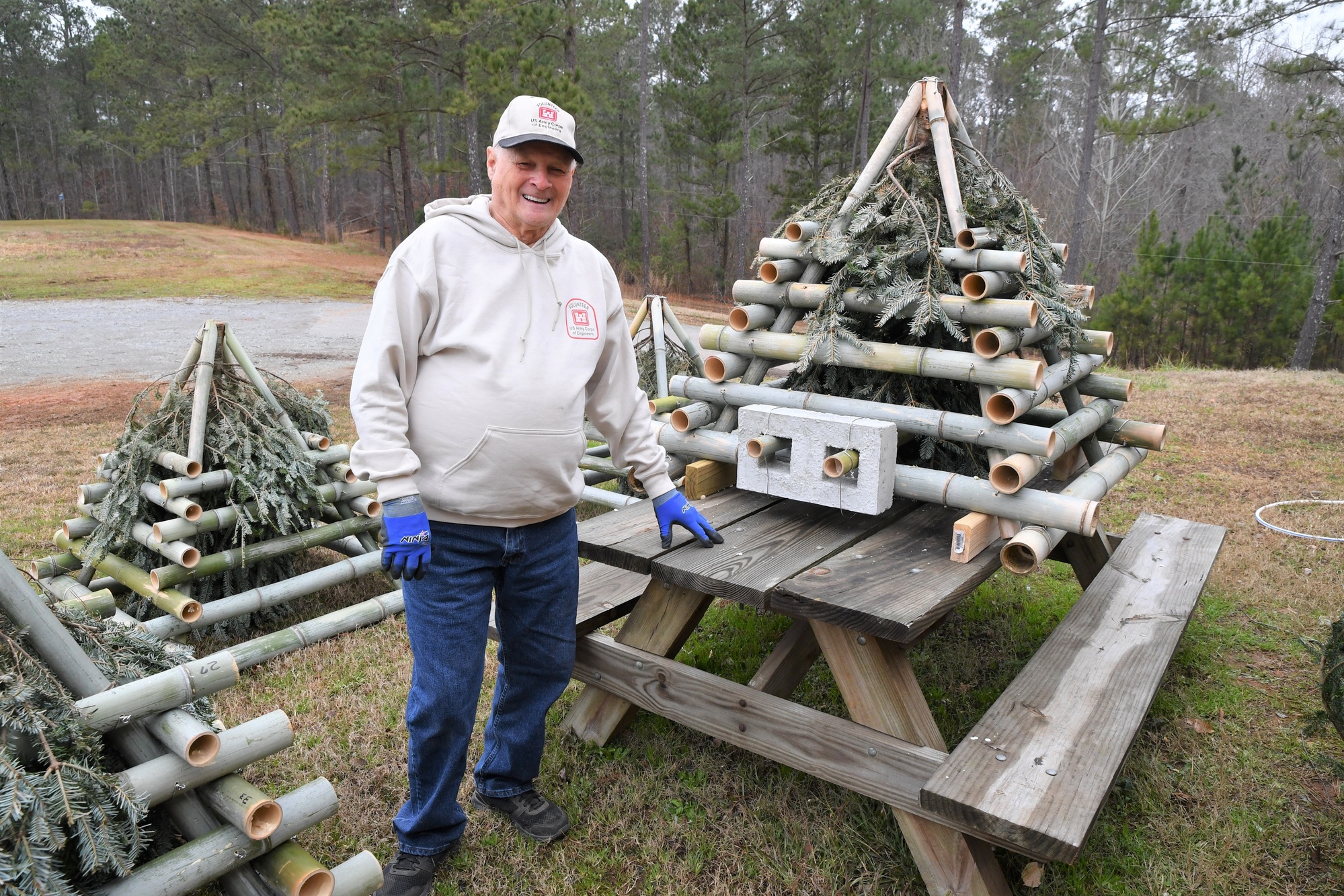
Ten days earlier, the U.S. Army Corps of Engineers had published its own account of the January install, written by Charles Walker, describing Allatoona Lake Rangers and volunteers working the exposed lakebed with donated firs. Working alongside them, a volunteer named Jimmy Moore had by then spent about six years doing something adjacent and stranger: cutting bamboo, tying it into pyramids, and sinking those into the same water as permanent scaffolding for the trees to lean against.
A discarded Christmas tree is, structurally, a cone of branching wood with hundreds of small interior gaps. That is very close to the definition of nursery cover for juvenile fish. The Allatoona program’s premise is that the object does not have to be redesigned to do the job — it only has to be weighted, anchored, and dropped in the right place, in the right month.
The seventeen-foot window
Timing is the part of this that has to be exact. Allatoona is drawn down in winter, and by the January install described in the Corps account, the pool sat roughly 17 feet below its normal level. That drawdown converts what is ordinarily boat-and-diver work into something closer to yard labor: rangers and volunteers walk out onto ground that will be under water by spring, place the material by hand, and let the returning pool do the sinking.
Chris Purvis, the lake’s lead ranger, described the pipeline plainly in the Corps story — the public donates live trees after the holiday, and those trees are converted into fish habitat and, the program hopes, better fishing. The mechanics are unglamorous and specific. A hole is drilled into the base of each trunk. The tree is set into a concrete base and secured with wire. Crews move to a different area of the lake each year rather than stacking every season’s donations in one spot, which spreads the structure across the reservoir instead of building a single artificial reef.
The local recycling channel that feeds this is older than the habitat use. Keep Bartow Beautiful’s Christmas tree collection dates to 2000; the fish-habitat component grew out of it in the mid-2000s, once the Corps and Georgia DNR came in as partners — the Corps dates the placement work to 2005, and the secondary summary of the DNR report describes a 2006 expansion. The reconciliation of those two dates is not something we can settle here; both point to the same handful of years.
Bamboo, tied into a pyramid
Moore’s contribution is the durable half of the system. A Christmas tree, submerged, eventually gives up its needles and then its fine branching — the very geometry that makes it useful. Bamboo does not, at least not on the same schedule.
Moore builds pyramids from it, according to the Corps account, and trees are placed into the pyramid structure rather than simply beside it. The pyramids are anchored. Cinder blocks are added along the sides so the assemblies can be sunk into deeper parts of the lake, past the shallow shelf where hand-placed trees naturally end up. That is a meaningful extension: it moves the cover into water where fish hold in different seasons and where placing anything by hand would otherwise be impractical.
His stated reasoning, paraphrasing what he told the Corps, is about scale rather than species — smaller fish can get inside the structure and stay protected from larger fish, and unlike the trees, the attractors do not deteriorate. He said he had been building them for six years. He also said he believes the work has helped the lake’s fish population and habitat. That last part is his assessment, offered as a builder’s judgment, not a measurement.
Moore moved to Allatoona from Tennessee in 2016, and a July 2021 Corps profile gave his age at the time as 81 — which places the six years of pyramid-building almost exactly across his tenure on the lake.
What is claimed, and by whom
The partner list is longer than the two organizations that usually get named: the Corps, Georgia DNR’s Wildlife Resources Division, Marietta Bassmasters, Keep Bartow Beautiful, and Boy Scouts, all appearing in the Corps account of the program’s volunteer base.
On outcomes, the strongest statement on record comes from Jim Hakala, a region fisheries supervisor with Georgia DNR, who is quoted in the Corps story as saying the project has significantly improved fishing at the lake. Purvis, for his part, described the ambition in terms of volume — thousands of trees installed over the life of the program, with more than 200 going in that year alone, a figure that lines up closely with the roughly 225 in the February DNR report.
What does not exist in either account is a fish count. There is no before-and-after population survey attached to these numbers, no catch-rate series, no species-level result. The claim that fishing improved is the claim of the people running and using the program, and it is worth holding at that distance.
What is verifiable is the object itself, and its second occupation. A fir cut in November and lit in December spends January being drilled, set in concrete, wired to a bamboo frame, and walked out onto dry lakebed seventeen feet below where the water will be in a few months. Then the reservoir comes back up over it, and the tree spends the rest of its structural life as cover — needles first, then branches, then just the shape it left behind inside the bamboo.