
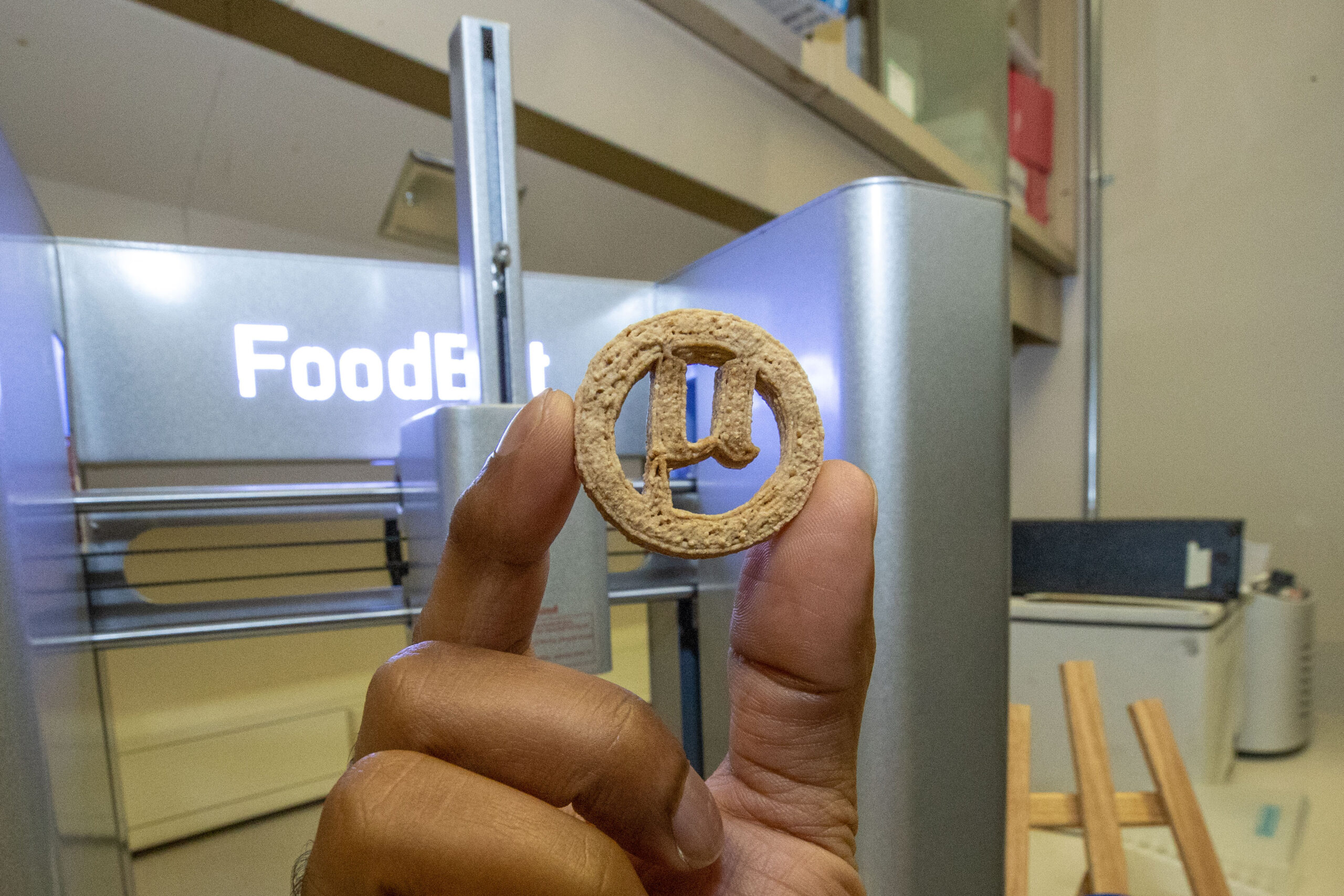
On Monday in Chicago a cookie came out of a 3D printer looking like the Greek letter mu. The carbon in it had been a PET bottle and a corn stalk in Carbondale. Sandhya Jayasekara, a graduate student at Southern Illinois University, presented it at the American Chemical Society’s fall meeting. The team calls the cookies µBites, said microbites. ACS says the data show they are safe. The lab still does not have institutional approval to taste them.
That is the whole job, stated as a reuse. Discarded bottles and corn leaves are broken down, yeasts are asked to rebuild the carbon as food, and a printer lays the paste into a cookie. The hunger speech can wait. The cookie is the fact.
Bottles into broth
PET is the clear plastic in soda and water bottles. It is full of carbon. Food is also carbon. Lahiru Jayakody, an associate professor at SIU Carbondale, told ACS that was the point of the work: they had been trying to upcycle plastic into something more valuable, and food is a carbon product. “Microbes are very clever,” he said. “So we are using their traits to solve the problems we created.”
The first machine is not a yeast. It is a tank. Geology professor Ken Anderson built a method he calls oxidative hydrothermal dissolution: water and oxygen, high temperature, high pressure, until PET and corn stalks come apart into pieces a microbe can eat. ACS’s Headline Science account puts that breakdown inside a 32-step safety process meant to leave a food-safe liquid, not a melted bottle. The liquid goes into a bioreactor.
Jayakody and Jayasekara programmed a variety of yeasts, including baker’s yeast, to treat that liquid as feedstock. The yeasts rebuild it as proteins, fats and acids. Fiber, starch and sweetener are still added by hand. The cookie is not a closed loop yet. Jayakody has said he wants the yeasts to make those last three as well. They do not, so far.
What the yeasts were asked to make
A protein paste does not smell like a bakery. Jayasekara’s job was to make the reuse palatable without pretending the bottle is gone. One baker’s-yeast strain now makes vanilla flavouring from plant biomass. ACS names the molecule in the video as vanillin. A different strain takes ethylene glycol, a piece of PET, and turns it into beta-carotene, the pigment in carrots, which the body can convert to vitamin A. That is the gold colour. That is also a vitamin the bottle did not have.
The mix goes through a 3D food printer, layer by layer, so each cookie is the same shape and the same portion. ACS’s video says the print is then microwaved to finish. The photograph SIU released is a hand holding a mu-shaped cookie in front of the printer. The new job of the bottle is that object: a printed, protein-rich biscuit whose flavour and colour were also built by yeast.
NASA did not bake these. ACS says the work was funded by the NASA Deep Space Food Challenge and an NSF CAREER grant. The meeting was in Chicago, at McCormick Place, in a student research symposium. Jayasekara gave the talk on 24 August under the title “Engineered yeast consortia for converting plastic and biomass-derived compounds into valuable food additives.”
A cookie that is still waiting
ACS is careful on the mouth. The data, the press release says, show µBites are safe to eat. Taste tests have not been cleared. What they have tested is aroma. Most of the people asked said they would be willing to eat the cookies in a resource-limited situation. That is not a tasting panel of a supermarket biscuit. It is a smell test of a prototype whose carbon used to be trash.
None of this is a meal yet, and none of it is a recycling slogan. A bottle and a stalk went into hot, oxygenated water in Carbondale. Yeasts rebuilt that carbon as protein, vanillin and beta-carotene. A printer in Chicago extruded a cookie. The cookie exists. It has not been bitten. That is the second life, as far as it has gone.