

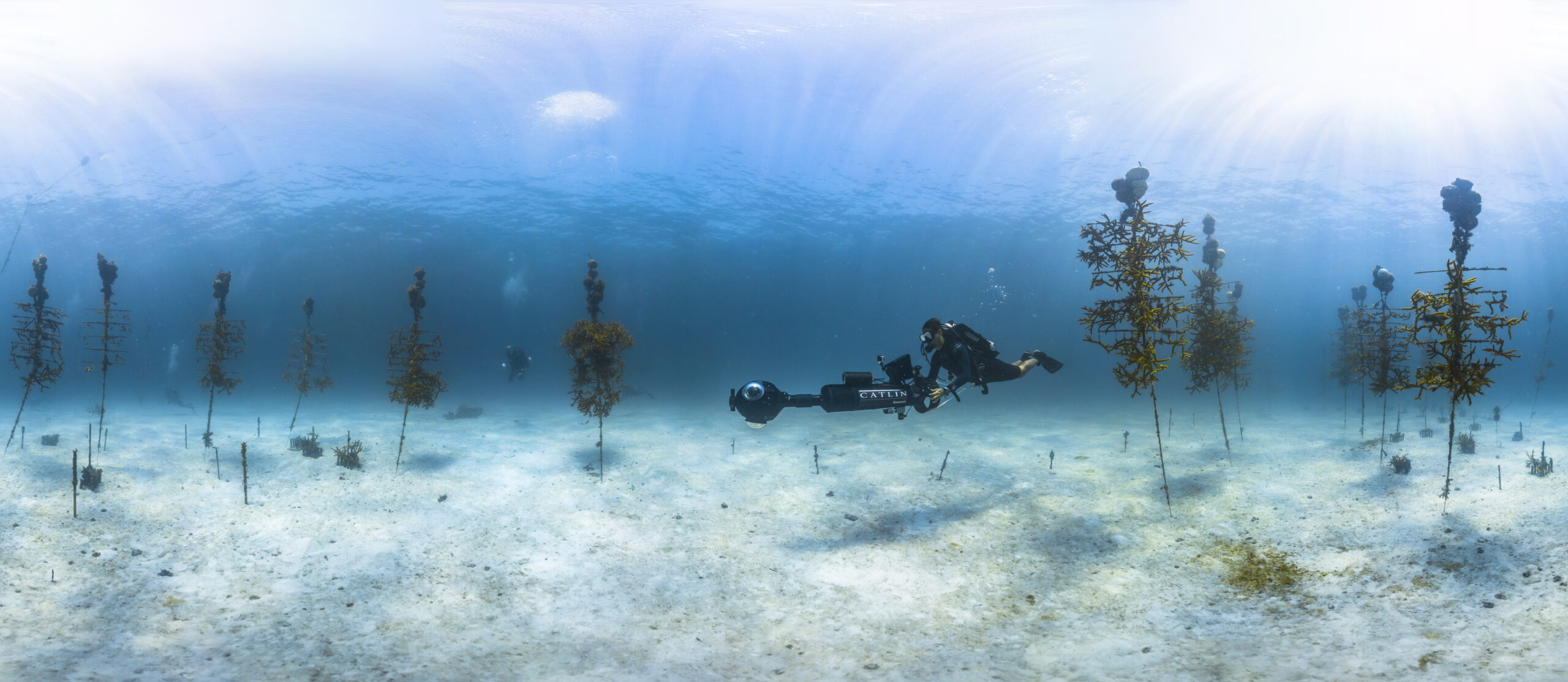
In 2001, Florida Keys tropical-fish collector and live-rock aquaculturist Ken Nedimyer launched an ocean-based coral farm with his daughter Kelly as her 4-H project, according to a Divers Alert Network profile. Six years later, Nedimyer founded the Coral Restoration Foundation. Today, its Coral Tree nurseries span the Florida Keys, while the design has been adopted by restoration groups around the world.
The chronology matters because the familiar image of pale PVC trees standing in blue water, with coral fragments suspended from monofilament, belongs to a later chapter. The 2001 farm did not yet use Coral Trees; CRF dates that design to 2011. Nedimyer’s earlier work began with staghorn corals that naturally settled on his live rock as early as 1996, and he reattached pieces when they broke off.
The project that decided not to sell
Nedimyer’s day job put him in the water constantly and gave him an unusual relationship with coral growth. Live-rock aquaculture involves placing rock on a permitted seafloor lease and allowing marine life to colonize it. The DAN account says Nedimyer began noticing staghorn coral growing naturally on some of that rock in 1996.
The original aim of the father-and-daughter project was commercial rather than restorative. Aquarium hobbyists wanted branching corals, and legally farmed coral appeared to offer an alternative to wild collection. In a 2009 interview with CORAL Magazine, Nedimyer said the idea developed from Kelly’s 4-H project and that they initially planned to raise coral for the aquarium trade.
The corals were never sold. Instead, Nedimyer said, the project shifted toward outreach, education and eventually restoration. That change became more significant as staghorn and elkhorn populations declined and NOAA Fisheries listed both species as threatened in 2006.
A nursery intended to supply aquariums and one intended to restore reefs can look similar underwater, but their destinations are different. One sends its corals into private tanks, while the other returns them to damaged reefs. Nedimyer’s growing stock of healthy branching corals became more valuable as restoration material than as commercial inventory.
2007, and then the tree
Nedimyer founded the Coral Restoration Foundation in 2007, formalizing work that had grown from the family project. A popular summary of the story compresses the early years into a single arc. The important distinction is that CRF was founded in 2007, while the specific Coral Tree design appeared four years later.
In a 2011 paper published in AACL Bioflux, Nedimyer, Kevin Gaines and Stephanie Roach described the Coral Tree Nursery as a new approach to growing corals in an ocean-based nursery. The paper identifies Nedimyer as the design’s inventor and distinguishes it from earlier suspended-line, floating-net and seafloor-rack methods. That primary publication supports the historical attribution more directly than a later organizational summary.
The design is deliberately simple. A vertical PVC trunk with horizontal arms is tethered to the seafloor and held upright by a subsurface float, allowing the structure to move with waves and currents. Coral fragments hang from its branches on wire or monofilament without resting on the bottom.
Suspending the corals reduces the surface available for nuisance algae and limits access for benthic predators such as snails and worms. The 2011 paper also attributes improved growth to greater water flow and the absence of a substrate holdfast requirement. Its light, inexpensive components make each tree relatively easy to install, adjust and reproduce.
CRF’s current nursery page says branching corals grown this way can become reef-ready in six to nine months. It describes the Tavernier nursery off Islamorada as covering approximately 1.5 acres and holding more than 500 Coral Trees. Crucially, CRF assigns the capacity to raise more than 50,000 corals annually to its nurseries collectively, not to the Tavernier site alone.
What the nurseries hold now
CRF describes Tavernier as the world’s largest in-situ coral nursery and says it belongs to a network extending along the Florida Keys. The organization currently reports approximately 600 genotypes across more than 20 coral species in its Florida nurseries. The Coral Tree design has also been adapted for other coral species and adopted beyond Florida.
Genetic tracking is a less visible part of the operation. Producing large numbers of one clone would also reproduce the same vulnerabilities, while maintaining multiple genotypes helps preserve variation within depleted coral populations. CRF therefore describes its nurseries not only as production sites but also as living repositories of genetic diversity.
The trees are practical hardware, built from lightweight materials and designed to hold corals in the water column while they grow. The corals carry the longer history: descendants of colonies cultivated through a father-and-daughter project, redirected from aquarium sales toward reef restoration. What began as a 4-H coral farm in 2001 had become a foundation by 2007 and, through the Coral Tree introduced in 2011, part of a restoration method now used far beyond the Florida Keys.