


Hallgrímskirkja rises 74.5 metres over central Reykjavík in a fan of white concrete ridges that step outward from the belltower like a frozen splash of lava, and the architect who drew it, Guðjón Samúelsson, spent the last years of his life sketching a church meant to look as if it had cooled out of the ground rather than been poured onto it. Construction began in 1945, the year Iceland was still finding its footing as a new republic, and the last stone was set in 1986, forty-one years later. Samúelsson never saw it finished. He died in 1950, with only the crypt complete, and the building he imagined kept growing above his drawings for another three and a half decades.
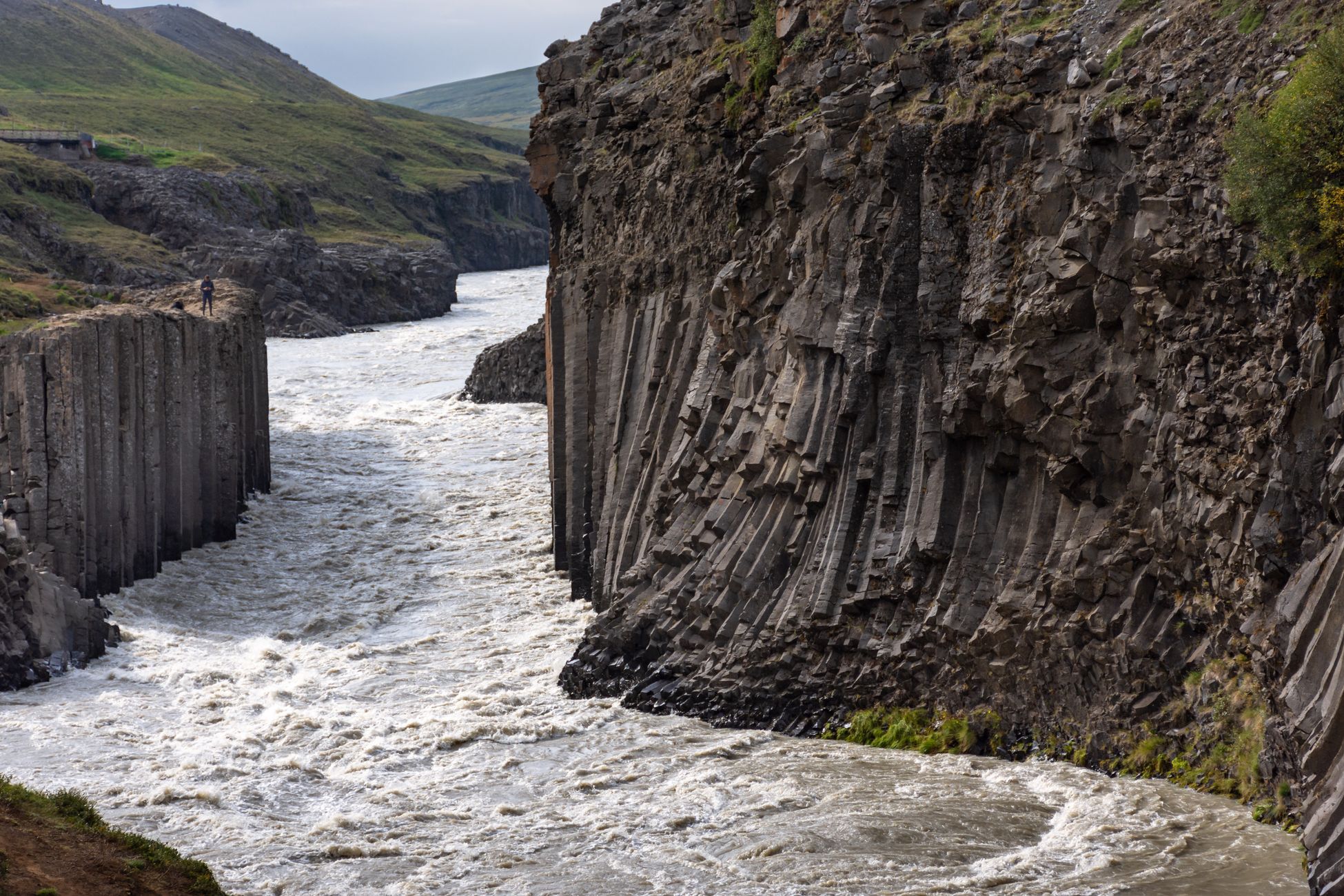
The shape he chose was not gothic, not classical, not Nordic-modern. It was geological. The stepped wings on either side of the tower are meant to echo the basalt columns that fracture into tidy hexagonal pillars along Iceland’s coasts and canyons, at places like Svartifoss and Reynisfjara, where cooling lava cracked itself into what look like organ pipes carved by a very patient god.

A church built to look like cooling lava
Basalt columns form when a thick flow of lava cools slowly and evenly from the top down. As the rock contracts, it cracks in a pattern that minimises surface energy, and the cracks meet, most often, at 120-degree angles. The result is a honeycomb of six-sided pillars, sometimes five-sided, sometimes seven, packed shoulder to shoulder like pencils in a jar. Iceland, sitting astride the Mid-Atlantic Ridge, is essentially made of the stuff. Cliffs of it fringe the south coast. Waterfalls tumble over ledges of it in the interior.
Samúelsson had already used the motif before. As Iceland’s state architect from 1919 until his death, he shaped much of the country’s public face in the early twentieth century — the National Theatre in Reykjavík, finished in 1950, uses the same basalt-column vocabulary along its facade. The theatre was a rehearsal. Hallgrímskirkja was the aria.
The church is named for Hallgrímur Pétursson, a seventeenth-century Icelandic poet and Lutheran minister whose Passíusálmar, or Passion Hymns, are still read aloud on Icelandic radio every Lent. Choosing a poet’s name for the country’s largest church was itself a very Icelandic decision. The country has more writers per capita than almost anywhere on Earth, and a national identity braided as tightly to language as to landscape.
Forty-one years of pouring concrete
Work on the crypt began in 1945. The nave went up through the 1950s and 1960s. The tower, the part everyone photographs, wasn’t finished until 1974. The main church body, with its soaring interior and 5,275-pipe Klais organ, was not consecrated until 26 October 1986. By then Reykjavík had grown around it. Television had arrived in Iceland. The Cold War was ending. A generation of Icelanders had been baptised in the crypt of a church whose roof did not yet exist.
The slow pace was not a matter of indecision. Iceland in 1945 had roughly 130,000 people. Pouring a 74.5-metre concrete tower in a country that small, in a climate where the working season is short and the wind off the North Atlantic is relentless, meant building whenever there was money and weather. Funds came in fits. Volunteer labour filled gaps. The church took shape the way a glacier moves — imperceptibly on any given day, unmistakably across decades.
Concrete was the obvious material. Iceland has no native forests to speak of and imports most of its timber, but it has volcanic aggregate in almost limitless supply. A concrete church made from Icelandic sand and gravel, shaped to look like Icelandic basalt, felt less like a building than a piece of the island standing up.
Why the hexagons matter
The hexagonal geometry Samúelsson borrowed is not decorative. It’s the signature of a physical process, and one that shows up wherever a material shrinks uniformly as it cools or dries: mud flats, ceramic glazes, the surface of drying paint, and, most dramatically, cooling lava. The Giant’s Causeway in Northern Ireland and Devils Postpile in California are the same phenomenon on different continents. Iceland just happens to have more of it than anywhere else, distributed across a landscape small enough to drive around in a weekend.
The hexagonal geometry follows the same crack-propagation logic mathematicians use to describe how contracting materials settle into the shape that costs the least energy, and the eye tends to read such shapes as calming rather than aggressive, even when rendered in hard materials like concrete or steel. A wall of right angles reads as engineered. A wall of stepped hexagonal ridges reads as grown. Samúelsson could not have cited the neuroscience — he was drawing in the 1930s and 1940s — but he understood the effect intuitively.
The tower, the poet, and the Viking out front
Standing at the top of Skólavörðustígur, the street that climbs from the harbour, Hallgrímskirkja closes the view like a curtain. It is the tallest church in Iceland and, for a long stretch of the twentieth century, was one of the tallest structures of any kind in the country. The tower holds an observation deck reached by a lift, and on a clear day the view stretches from Mount Esja in the north to the Reykjanes peninsula in the south, taking in the entire capital region.
In front of the church, on a plinth facing the sea, stands a statue of Leif Erikson — the Norse explorer who, according to the sagas, reached North America around the year 1000, roughly five centuries before Columbus. The statue was a gift from the United States in 1930, marking the thousandth anniversary of the Alþingi, Iceland’s parliament and one of the oldest continuously functioning legislative assemblies in the world. It was placed on the hill before the church behind it existed. For years, Leif looked out over an empty foundation.
Inside the concrete
The interior is startlingly plain. Where a European cathedral would have gilding and side chapels and centuries of accreted iconography, Hallgrímskirkja has white walls, tall narrow windows, and a nave that funnels the eye toward a west-facing organ rather than a traditional east-facing altar. The Klais organ, built by the German firm Johannes Klais Orgelbau and installed in 1992, weighs about 25 tonnes and has 5,275 pipes ranging from the length of a pencil to the height of a two-storey house. Concerts fill the church several times a week in summer.
The acoustics were an accident of the geometry. Concrete is a hard, reflective surface, and the tall stepped interior creates a long reverberation — around seven seconds in the empty nave, closer to four when the pews are full. Organists talk about learning to play into the delay, letting chords bloom and overlap the way they would in a much older stone building.
A landscape rebuilt as architecture
The idea of borrowing forms from the natural world for buildings has a name now — biophilic design — and a growing body of evidence behind it. Patterns and materials drawn from nature can shift how people feel inside a space, lowering physiological markers of stress and improving mood, as explored in recent examinations of biophilic living. Advocates writing for general audiences have made similar points about the psychological cost of purely rectilinear urban environments and the relief that natural forms bring even when reproduced in concrete or steel.
The mathematical intuition runs in the other direction too: a 2025 analysis found that trees drawn by human artists across centuries and cultures obey the same fractal branching rules as real trees, as if the eye recognises the correct proportions even when the hand can’t articulate them.
Samúelsson was working from a simpler instinct. He wanted a national church that felt Icelandic without resorting to imported medieval templates, and the island itself supplied the answer. The basalt columns of Svartifoss, where a waterfall drops through a cathedral of black hexagonal pipes, had already been shaping Icelandic painters and poets for a century by the time he began drawing. Turning that geology into a facade was a matter of translation.
A finished building, still cooling
Hallgrímskirkja was consecrated forty-one years, four months, and a handful of days after ground was broken. The country that finished the building was not the country that started it. Iceland in 1945 was a rural, fishing-based society of 130,000 people, only a year into full independence from Denmark. Iceland in 1986 had a service economy, colour television, a booming music scene and just over 240,000 people. The church tracks that change in strata, the way a lava flow records the season it hardened in.
Stand at the base of the tower on a winter morning and the concrete reads almost blue in the low sun, the stepped ridges throwing hard shadows that repeat all the way up the facade. The wind off Faxaflói Bay smells of salt and, faintly, of sulphur from the geothermal plants that heat the city. It is the same wind that cooled the lava the church was designed to remember. Forty-one years to build, and the rock it imitates took a few weeks.