

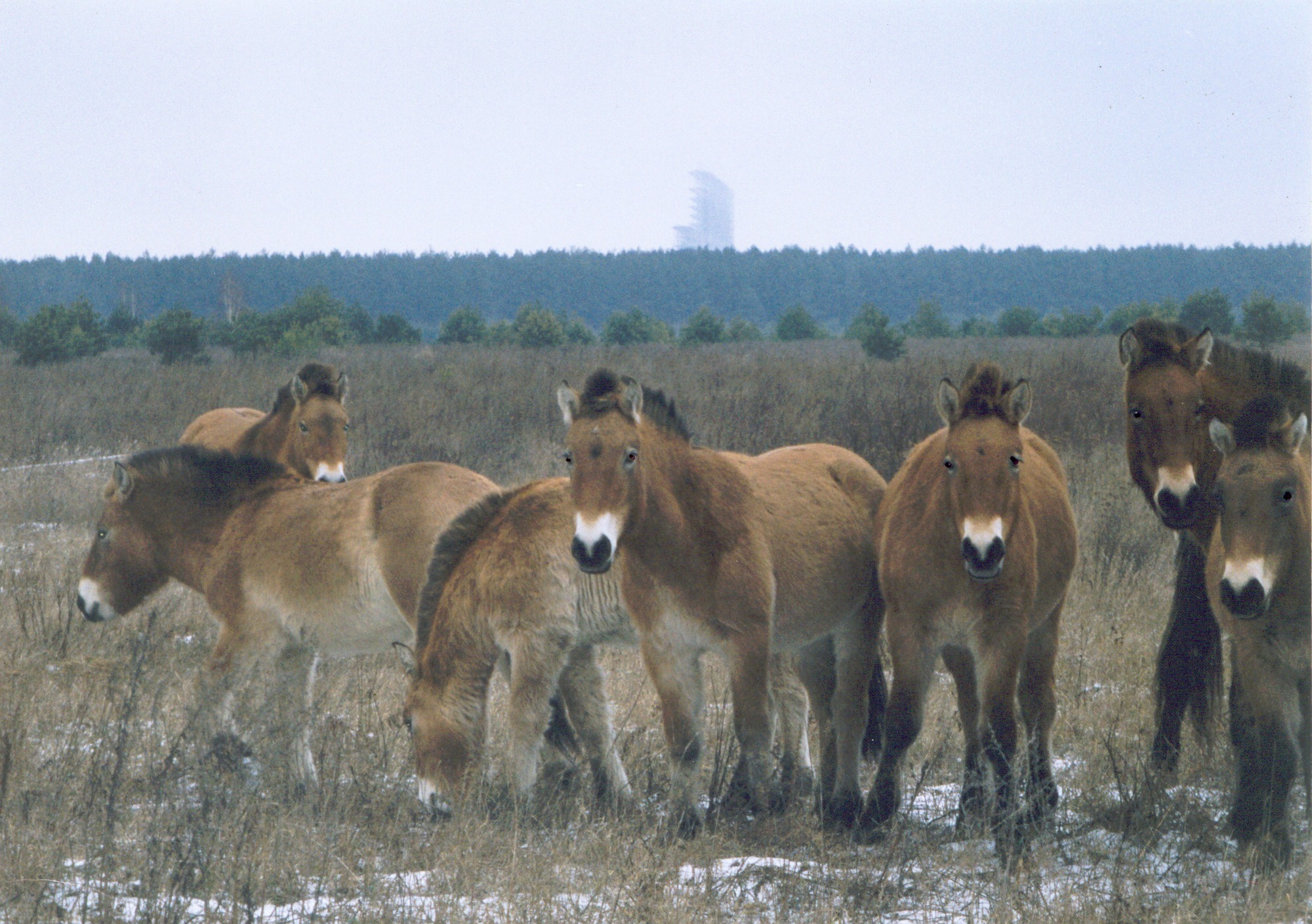
The founding story of Chernobyl’s Przewalski’s horses is less tidy than the familiar “31 horses released in 1998” shorthand. The program began in 1998, but the primary account says several groups arrived across 1998 and 1999: 28 horses from the Askania Nova Biosphere Reserve, including 10 males and 18 females, plus three males from the local zoo of the Lozovski stud-farm. The program was intended to establish a free-ranging population while restoring biodiversity and ecological balance in the abandoned landscape, according to the researchers who followed the population through its first decade.
Not all 31 animals became free-ranging founders. Eight died during transportation or soon afterward from injury or stress. The survivors were kept in large acclimatization enclosures for periods ranging from a few weeks to eight months before being released. The 2009 account ultimately identified two stallions and 15 mares from Askania Nova as the founders that reproduced successfully.
The species itself also needs a little more caution than the old description of the “last horse never domesticated” allows. Przewalski’s horses disappeared from the wild during the twentieth century and survived through captive breeding, but the deeper history of their relationship with humans remains disputed. A 2021 Scientific Reports reassessment of the Botai archaeological evidence argued that the assemblage is better explained by mass harvesting of wild Przewalski’s horses rather than early domestication. That makes an absolute claim about the species having either definitely been domesticated or definitely never domesticated harder to defend.
Thirty-one arrivals, followed by a difficult first decade
The early population grew quickly once breeding began. The first-decade study recorded peaks of 65 horses in 2003 and 2004 before the total fell to roughly 50 in 2007. By the end of 2008, researchers counted 64 animals.
Illegal hunting was a documented part of that decline, but it should not be made more certain than the records allow. Of 55 free-ranging horses lost between 1999 and 2006, researchers could determine the cause of death in only 18 cases. Thirteen of those determined deaths were attributed to poaching. The authors therefore concluded that illegal hunting accounted for more than 70 percent of deaths for which a cause could actually be established, while most losses remained unexplained.
That distinction matters. The population history demonstrates that the horses could reproduce and persist in the exclusion zone, but it does not isolate radiation, poaching, habitat, disease, or any other factor well enough to reduce the story to a single cause.
What the 2018 survey actually found
The most precise snapshot came from camera-trap work conducted in 2018 and published in Theriologia Ukrainica. Researchers recorded 137 Przewalski’s horses in the Ukrainian part of the exclusion zone: 47 stallions, 66 adult mares and fillies, and 24 foals. At least four additional horses, a stallion, two mares, and a foal, were recorded at a remote site in the Belarusian exclusion zone.
The population was socially organized rather than simply scattered through the landscape. The survey described 13 harem herds with foals, four small non-breeding groups, about six stallion groups, and at least one solitary stallion. It also reported that some groups occupied territory spanning both the Ukrainian and Belarusian sides of the exclusion zone.
The Belarus animals were not merely isolated wanderers. The researchers reported that Przewalski’s horses crossed the Prypiat River during 2007–2010 and established a reproducing subpopulation. By 2018, almost all the animals recorded were second generation or later, with only two mares still bearing brands identifying them as members of the original introduced population.
The horses also proved less rigidly tied to open steppe than their traditional habitat description might suggest. The 2018 work confirmed a preference for meadows but found that the horses did not avoid forest habitat. That matters in Chernobyl, where woodland and reforested ground make up much of the landscape and can make direct visual population counts difficult.
What the rebound proves, and what it does not
A growing population in a radioactive landscape does not demonstrate that radiation is harmless. Population growth can coexist with biological costs at the level of individual animals, particularly when other pressures such as farming, traffic, development, and routine human disturbance have been sharply reduced.
The 2018 survey was primarily a study of population structure, distribution, and long-term dynamics. Its demographic results show that the horses reproduced successfully and adapted to local conditions. They do not provide a controlled test capable of isolating the biological effects of radiation from the many other ecological changes created when people largely withdrew from the landscape.
Nor was the original introduction designed simply as an experiment to see whether horses could survive contamination. The earlier program description was more practical: establish a free-ranging Przewalski’s horse population, enrich biodiversity in ecosystems altered by human activity, and help restore ecological balance.
The 2018 count is no longer the latest endpoint
The figure of 137 horses in Ukraine plus at least four in Belarus remains the documented result of the 2018 survey, which is why it belongs in the headline. But it should no longer be presented as the last reliable population information available.
A study published in Theriologia Ukrainica in December 2025 reported that the population had continued to expand. It estimated up to 200 Przewalski’s horses in the Chornobyl Biosphere Reserve and up to 50 more in the neighboring Polissky State Radioecological Reserve of Belarus. The same work described stable yearly reproduction during 2021–2025.
So the clean historical arc is no longer 31 animals followed by a final 2018 snapshot. It begins with several groups brought into the zone across 1998 and 1999, passes through a 2018 survey that documented 137 animals in Ukraine and at least four in Belarus, and continues into a population still reproducing and spreading more than a quarter-century after the introduction began.