

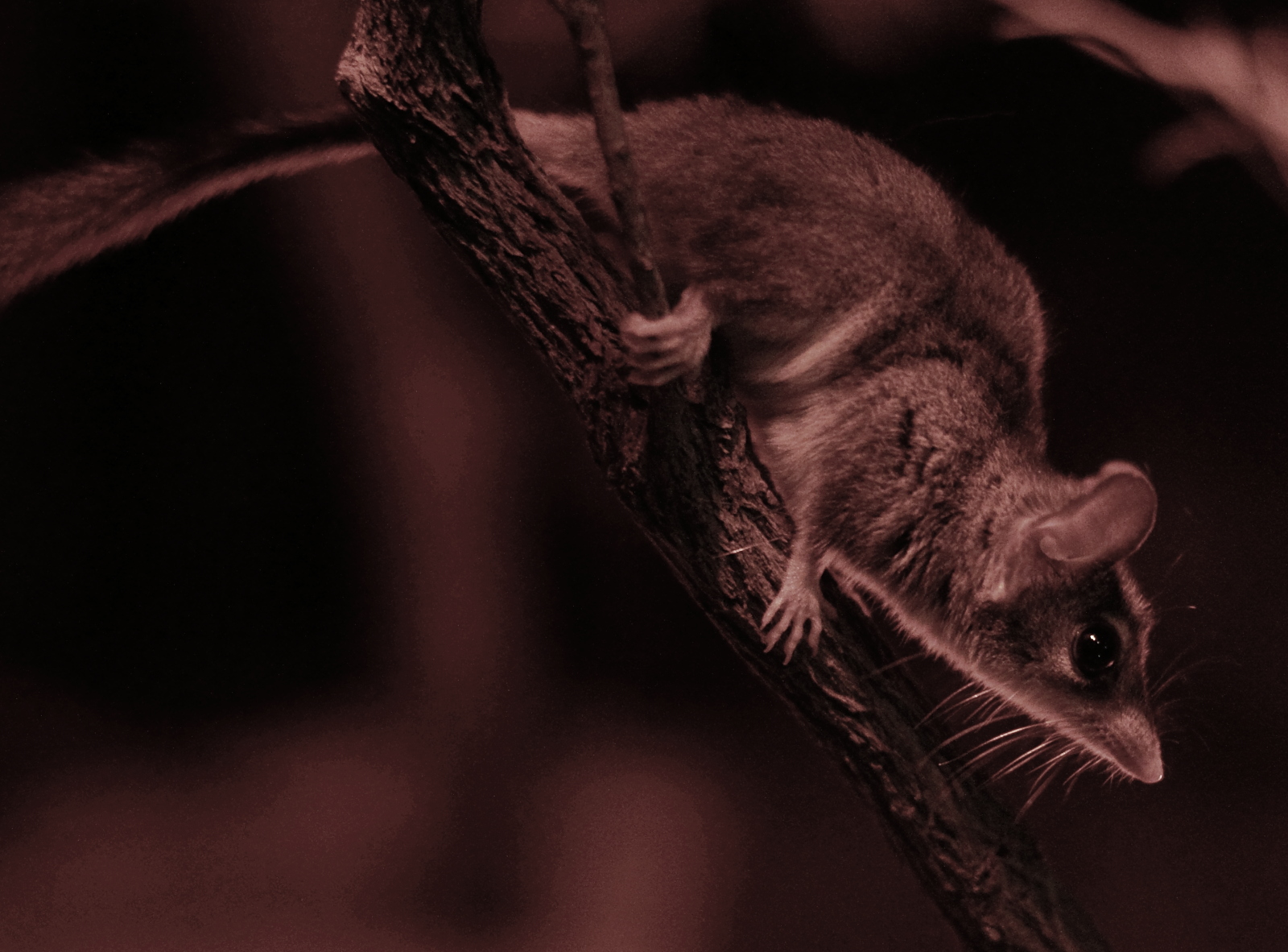
A red-tailed phascogale is the kind of animal you can spend a career not seeing. It is small, fast, and wary — a carnivorous marsupial built for slipping out of sight — and ecologists generally count themselves lucky to handle a handful in a survey season. So the number that came out of Western Australia’s Wheatbelt this month is worth sitting with: in the 2026 survey at Australian Wildlife Conservancy’s Mt Gibson Wildlife Sanctuary, field teams captured 48 red-tailed phascogales, more than double the 28 individuals caught in 2024, and the highest tally recorded since the species was returned to the site nine years ago inside a 7,800-hectare feral predator-free fenced area, according to AWC’s 10 September 2026 announcement.
Those figures are capture counts, not a census. They describe how many individual phascogales came into the hands of ecologists during a defined survey effort, not how many live inside the fence. That distinction matters for a species this cryptic, where detection can swing on weather, timing, and luck. But AWC’s ecologists read the jump as a signal that the population appears to be rebounding after a punishing stretch of years — an inference drawn from capture rates rather than a headcount.
Mt Gibson sits on Badimia Country, in a landscape where the Wheatbelt’s cleared farmland gives way to remnant woodland and shrubland. The phascogale is one of the mammals that vanished from much of that country during the last century, and AWC returned it to the sanctuary behind the predator-free fence nine years ago.
The dry years, and the rain that followed
Before the record, there was a trough. AWC describes the sanctuary as having been “incredibly dry” through the 2023–2024 drought, with the region logging one of its worst heat waves and just 171 mm of rain — the lowest rainfall on record for the Wheatbelt, according to AWC Field Ecologist Aliesha Dodson.
For a small insectivorous marsupial, that kind of year is not an abstraction. Rainfall drives plant growth, plant growth drives invertebrate abundance, and invertebrate abundance is the food supply. When the rain fails at the bottom of the chain, animals at the top of it feed less, breed less successfully, and raise fewer young. Capture numbers in 2024 — 28 individuals — came out of that squeeze.
Then the pattern flipped. AWC reports the Wheatbelt received 401 mm of rain after June 2024, followed by 319 mm in 2025. Two comparatively wet years stacked on top of the driest on record, and the sanctuary’s vegetation had the moisture to respond. AWC’s interpretation is straightforward: as conditions improved, phascogale numbers appeared to recover, and the 2026 survey picked up the difference.
It is a useful reminder of how tightly small mammals in semi-arid Australia are wired to rainfall. Populations here do not hold steady; they contract hard in drought and expand when the seasons allow. The 48 captures at Mt Gibson are best understood as the upswing of that cycle — measured, this time, inside a fence where the usual predators are not also taking a share.
What a record capture count does and does not mean
AWC names three contributing factors for the 2026 result, and the weather is only one of them.
The second is method. Survey timings were refined, which can meaningfully change how many animals a given trapping effort encounters. Shift the survey window and you can shift the count without the underlying population changing at all — one reason ecologists are careful about reading capture totals as abundance.
The third is the fence. Mt Gibson’s 7,800-hectare enclosure excludes feral cats and foxes, and the red-tailed phascogale is a species that feral cats hunt readily. Dodson notes that capture numbers this high are rare, and that the predator-free area is “doing exactly what it was designed to do” — holding a space where a small, vulnerable marsupial can ride out a drought and then multiply when the rain returns, rather than being picked off during the recovery.
So what the 2026 number does say is that more phascogales were detectable, and catchable, inside that fence this year than in any survey since reintroduction. What it does not say is how many phascogales are in there. No one is claiming 48 is the population, and no one is claiming the population doubled. Capture rates are an index — a tracked signal, compared against the same site’s earlier numbers — and the honest version of the news is that the index has risen sharply from a drought low to its highest point in nine years of monitoring.
Three sanctuaries, one on the west coast
Mt Gibson is one of three sanctuaries owned or managed by AWC that protect red-tailed phascogales, and the only one of the three on Australia’s west coast — which gives the site weight beyond its own fence line. The others sit inland in New South Wales: Mallee Cliffs National Park, which AWC manages in partnership with the NSW National Parks and Wildlife Service, and Scotia Wildlife Sanctuary, where AWC reintroduced the species last year.
Spreading a species across widely separated, individually protected populations is a hedge against the kind of year 2023–2024 turned out to be. A drought that flattens one region does not necessarily flatten the others; a single catastrophic event in one fenced area does not take the whole recovery with it. Mt Gibson’s role in that arrangement is to carry the western population, in the region where the western population now depends on protected habitat.
Which brings the September 2026 result back to its actual scale: 48 red-tailed phascogales captured in one survey, inside one 7,800-hectare predator-free fence, up from 28 captured in 2024 and the most since the animals were put back nine years ago. Not a population total — a capture count, taken in the same place, the same way, year after year, and now reading higher than it ever has.