

The thing that started it was a newspaper. Not a lab, not a grant, not a professor with a spare bench — a local paper in Fauquier County running the sort of story that families read over breakfast and then quietly worry about for the rest of the week: the tap water carried PFAS and microplastics, and there was no public money coming to filter it out. Households were on their own. In one of those households, an 18-year-old at Kettle Run High School decided that “on your own” could be read as an instruction rather than an abandonment, and started building.
Mia Heller’s parents did what a lot of concerned parents do — they bought an advanced home filtration system. And then they discovered the small print of modern water treatment, which is that membranes clog. They foul, they slow, they need replacing, and each replacement is another cost and another piece of spent plastic-adjacent hardware heading for a bin. Heller looked at that cycle of purchase and disposal and asked the question that turns a consumer into an inventor: what if the filter had no membrane at all?
The answer she arrived at, in the spring of 2024, sits in a Warrenton, Virginia garage and weighs about as much as a bag of flour. It has no mesh. It has no cartridge. It has magnetic oil.
The trick is that plastic likes oil
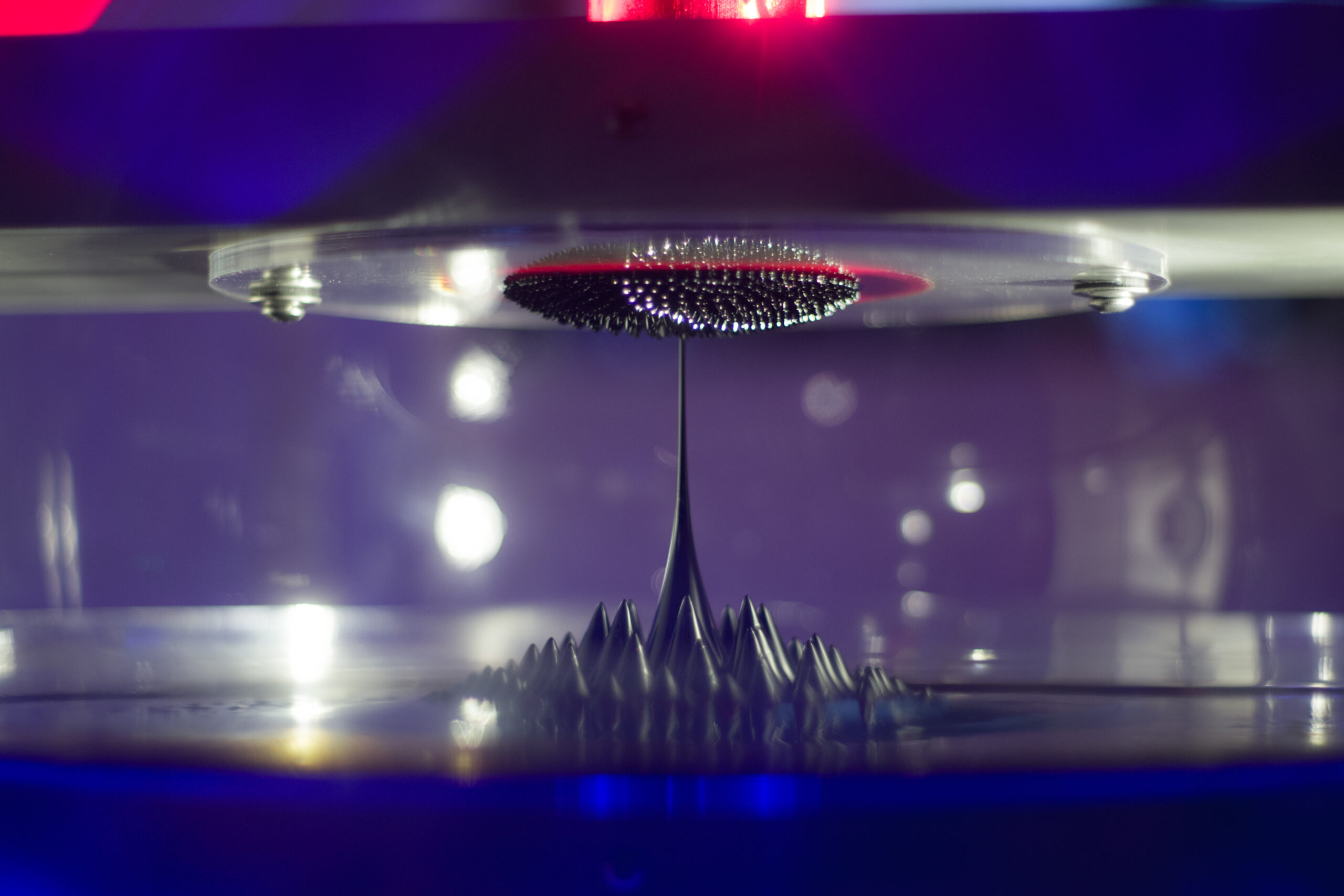
Ferrofluid is one of those substances that seems to have been designed by someone who wanted physics to look like a magic trick. It is a liquid seeded with nanoscale magnetic particles, suspended in oil, and when you bring a magnet near it, it spikes into black hedgehog crowns and moves like something with intentions. It has been used in loudspeakers, in spacecraft seals, in the sort of desk toy that people buy for engineers at Christmas.
Its usefulness here comes from chemistry rather than spectacle. Microplastics are hydrophobic — they would much rather associate with oil than with water. Drop ferrofluid into a contaminated sample and the plastic fragments bind to it. Then bring a magnetic field to bear, and the oil goes where the field tells it to go, dragging its cargo of polymer along for the ride. The water is left behind. Nothing has been strained; nothing has been trapped in a matrix that will eventually choke. There is no solid membrane to replace, because there is no solid membrane.
Heller did not arrive at the elegant version first. The early prototype, as described in Smithsonian magazine’s account of the project, was a spinning magnified vial — a way of watching the binding happen at all. It took roughly five iterations, worked through in a garage and a kitchen while she was also commuting to the half-day programme at Mountain Vista Governor’s School, to get to the closed-loop system: one in which the ferrofluid is not merely used but recovered, cleaned of its plastic burden and sent back round to do the job again.
That loop is the whole design philosophy in miniature. The membrane filter consumes itself. This one, in principle, keeps its working fluid.
Three modules, one litre, one number
The current prototype has three parts. There is a module holding roughly a litre of contaminated water. There is a store of ferrofluid. And there is a smaller core separation module where the magnetic work happens. It processes about a litre per pass, which is a deliberately modest ambition — Heller is thinking Brita jug, or under-sink unit, not municipal waterworks.
To find out whether any of it worked, she needed to measure cloudiness, so she built a turbidity sensor as well. Her testing produced the figure that has followed the project ever since: 95.52% of microplastics removed, measured by weight. Alongside it, a second and arguably more important number — 87.15% of the ferrofluid recovered and returned to the loop.
The 95.52% has been widely rounded up to “96%” in coverage, which is the sort of tidying that headlines do; the tested figure is the more precise one, and it is the one worth carrying around. What gives it context is the comparison: conventional drinking-water treatment plants, the ones already serving cities, achieve somewhere between about 70% and more than 90% microplastic removal. A garage prototype the size of a bag of flour, in its own inventor’s tests, landed at the upper end of that range.
The work took her to the Regeneron International Science and Engineering Fair in 2025 as a finalist, where it won a $500 award from the Patent and Trademark Office Society.
What a good idea still has to prove
Matthew J. Campen, the toxicologist at the University of New Mexico whose work on microplastics in human tissue has done a great deal to make the general public uneasy, has called Heller’s concept a great idea. He has also, sensibly, listed what it has yet to demonstrate. What happens to the residue — the concentrated plastic-laden waste that comes off the recovery step — and how is it disposed of? Does the process scale? Ferrofluid remains expensive in the quantities a municipal system would demand, which is one reason Heller herself is pointing at kitchens rather than treatment works.
She is notably unhurried about the commercial question. Speaking to Scholastic’s Upfront, she has been clear that she wants independent laboratory verification before anyone starts talking about a market.
That restraint is the most impressive engineering in the whole story. Any teenager can produce a percentage. It takes a rather rarer instinct to hold a number as good as 95.52% at arm’s length and say: someone else should check this first.