

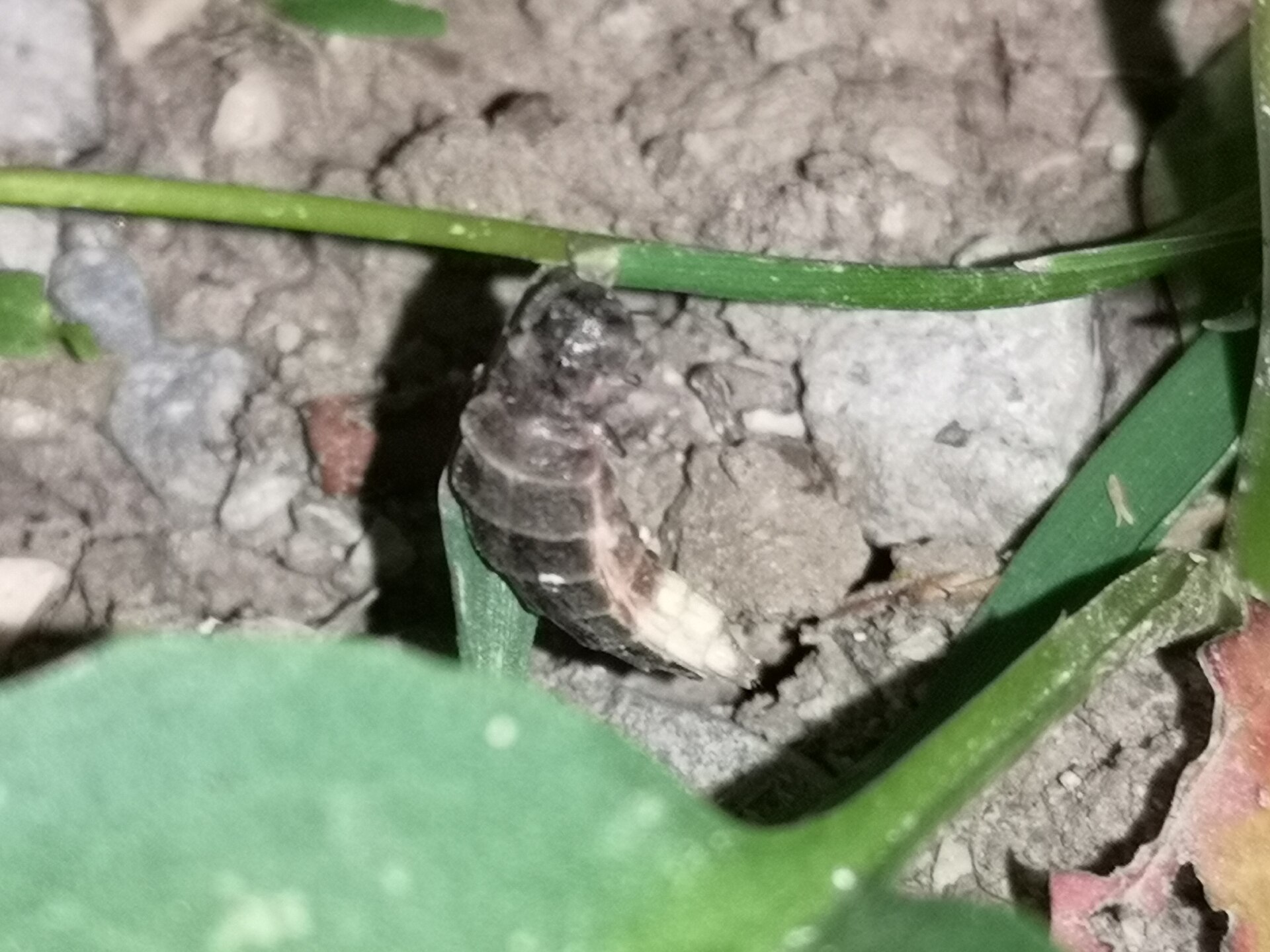
Twelve. That is the high count of glowing female common glowworms tallied by volunteers walking the grassy edges of Nosterfield nature reserve in North Yorkshire over successive weeks this summer, the first time the species has lit that ground in more than a century. The counts were reported on Monday, September 7, 2026, by the Guardian, which described volunteers for the Lower Ure Conservation Trust finding up to a dozen females holding their cool green lights above the sward on separate nights. Another 1,900 larvae, bred in captivity, are waiting to be released at the same reserve later this year.
The light itself is worth pausing on. Lampyris noctiluca is a beetle, not a worm, and the glow belongs almost entirely to the flightless adult female, who climbs a stem, twists the luminous underside of her abdomen upward, and waits. The winged male, who does not glow in any comparable way, finds her by that signal. A glowing female is therefore a specific piece of evidence: it means larvae survived, fed, pupated, and reached adulthood on site. It is the only readable receipt a glowworm reintroduction produces.
A garden shed in Bristol, and a two-year wait
The insects on the reserve this summer trace back to a small, authorized collection from a local donor site and a captive breeding operation run on close to no budget at all. According to the Guardian, the project was led by independent ecologist Pete Cooper, who gave his time free and reared hundreds of larvae in a garden shed in Bristol, working alongside volunteers who took the name “glow-getters.” Glowworm larvae are predators with a narrow taste: they hunt snails and slugs, subduing them with a bite and digesting them externally. Keeping hundreds of them alive means keeping a supply of mollusks alive too, which is why a shed full of trays is less charming and more logistical than it sounds.
The first larvae went out at Nosterfield in 2024. Then nothing visible happened, and nothing visible was supposed to happen. Common glowworms generally need about two years to reach adulthood, spending that time as larvae in rough grass, moving slowly, hunting at night, hiding by day. Summer 2026 was the first window in which the 2024 cohort could plausibly appear as glowing adult females. It did, at up to 12 of them.
That arithmetic matters for how the result should be read. A reintroduction that produces adults on schedule has cleared a real hurdle, because it shows the larvae found food, avoided being flooded or mown or eaten, and completed development in place rather than merely surviving a few weeks post-release. It does not yet show that the beetles can do it again without help.
Why a disused quarry turned into good glowworm country
Nosterfield has glowworm history. The Guardian notes that in 1909 the writer Edmund Bogg recorded glowworms at Nosterfield, and that quarrying subsequently contributed to their disappearance from the area. The recovery of the ground has been slow and deliberate. Since 1997, the Lower Ure Conservation Trust has been buying and restoring land here, beginning with the first 72 acres of disused quarry and expanding to nearly 600 acres under management. The underlying magnesian limestone, exposed and reworked by extraction, has been steered toward species-rich wetland and grassland. Bitterns and marsh harriers now use the site, which is a reasonable shorthand for how thoroughly the place has changed.
Glowworms ask for something less charismatic than reedbed. They want rough, undisturbed grassland with tussocks, damp margins, abundant snails, and, critically, darkness. A female’s signal only works if a male can see it, which makes artificial light a direct reproductive problem rather than an aesthetic one. The Guardian lists the broader pressures behind the UK’s glowworm decline as intensive farming, development, electric lighting, and simple tidiness, the habit of cutting and clearing rough grass until there is nowhere for a slow-moving larva to spend two years.
Simon Warwick, director of the Lower Ure Conservation Trust, credited Cooper’s persistence and the roughly 80 reserve volunteers who adjusted habitat management and went out to monitor for emergence, according to the Guardian’s account. Monitoring here means walking transects after dark, in summer, repeatedly, and counting points of light.
The next 1,900, and a test set for 2030
The 1,900 larvae now waiting for release were bred with help from volunteers at the Westbury Wildlife Park Foundation, and the Guardian reports that fundraising ceilidhs paid to upgrade breeding facilities there. Cooper is also working on formal standards and guidance for glowworm breeding, release, and habitat management, the sort of unglamorous document that determines whether a one-off success becomes a method other people can follow. A UK glowworm survey continues to collect public sightings, which is how most of what is known about the species’ distribution gets assembled in the first place.
The honest framing of this summer belongs to Cooper himself, who told the Guardian he will not be certain of a self-sustaining population at Nosterfield until 2030, when the offspring of this year’s wild adults would reach maturity. That is the actual test. The 2026 females prove that released larvae can complete their life cycle on the restored quarry. Only a generation bred in the wild, raised in the wild, and glowing in the wild in 2030 would prove the population no longer needs a shed in Bristol.
Until then, the ledger reads plainly. Up to 12 glowing females counted across successive weeks at Nosterfield this summer, the first at that site in a century. And 1,900 larvae, reared in captivity, still to be carried out into the grass before the year is over.