

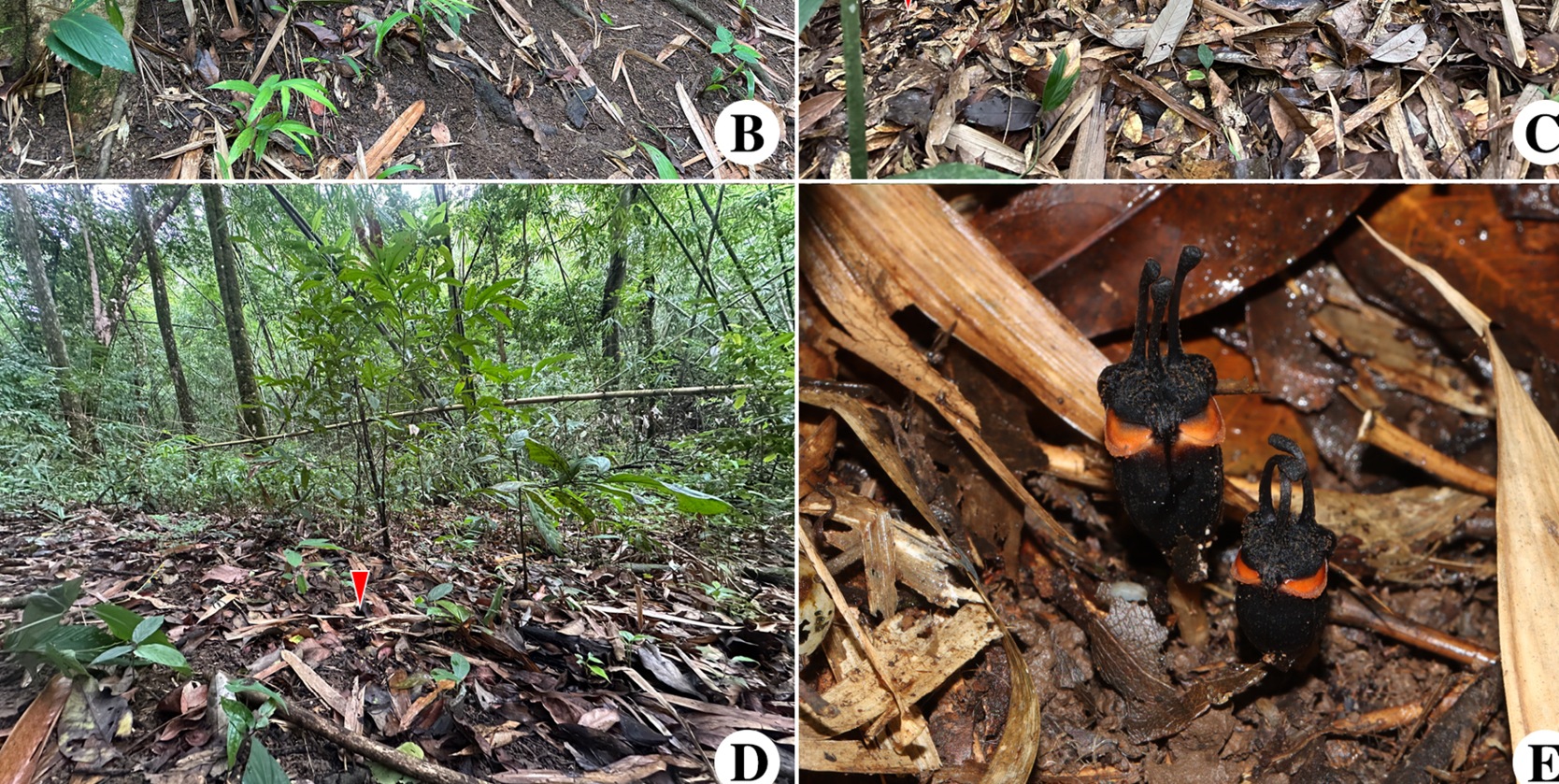
Push aside the leaf litter on a shaded slope in Thong Pha Phum National Park, in Thailand’s western Kanchanaburi Province, and you might find something that looks less like a flower than like a small piece of blackened hardware pressed into the soil: a dark urn barely a couple of centimeters tall, collared in reddish-orange flesh, topped by a mitre that ends in three slender horns. Botanists from Chulalongkorn University and Prince of Songkla University have described it as Thismia daemona, a new species published in PhytoKeys on August 17, 2026, and they know of fewer than 50 individuals anywhere in the wild.
The plant has no chlorophyll and does not photosynthesize. It is a full mycoheterotroph, obtaining its carbon and nutrients through fungi in the forest floor rather than making its own food from sunlight. Most of its life is hidden underground in coralliform roots, with the plant appearing above ground mainly during flowering and fruiting.
The horns, the collar, and the name
The epithet daemona is not marketing. The describing authors, Tosak Seelanan, Isareyakorn Chantapram, Neeranuch Taosiri, Chanachon Chuchuea, and corresponding author Sahut Chantanaorrapint, chose it for the flower’s devil-like appearance: a blackish body, fleshy outer tepals washed reddish-orange, and inner tepals that fuse into a dome, or mitre, from which three slender claviform appendages project like horns. Press coverage of the description, including a VICE writeup on September 4, 2026, leaned into the resemblance further, describing the pitch-black flower, horns and glowing reddish-orange collar in cartoonishly demonic terms. The paper is more restrained, but the geometry is genuinely odd: a tube, a hood and three antenna-like appendages, all at a scale that fits comfortably in a hand.
Its structure reflects a life with no dependence on photosynthesis. With only scale-like leaves and no chlorophyll, T. daemona does not invest in the broad green surfaces familiar from ordinary plants. Species of Thismia are notoriously difficult to find because their above-ground appearance is ephemeral, concentrated around flowering and fruiting. You do not spot them easily from standing height. You find them by looking closely at the forest floor and by being there during the relatively narrow period when they are visible.
The species belongs to Thismiaceae, section Geomitra, and the authors place it as sister to Thismia betung-kerihunensis, a Bornean species. That relationship helps place the discovery within a small and geographically restricted group of fairy lanterns.
A montane address farther north
Thismia daemona was found in seasonal lower montane evergreen forest at roughly 1,000 meters elevation, among leaf litter in deep shade with small bamboo in the understory. The type specimen was collected at about 970 meters.
The important record here is geographic rather than an elevation record. The discovery pushes the known distribution of section Geomitra farther north and documents another member of the section in montane forest. It is not, however, the highest-elevation member known: Thismia limkokthayi, from Genting Highlands in Peninsular Malaysia, has been documented at about 1,137 meters.
Two specimens of the new species were collected in 2025. The type is based on material gathered by Neeranuch Taosiri, and voucher material is deposited in the Forest Herbarium in Bangkok (BKF), Chulalongkorn University herbarium (BCU), and Prince of Songkla University herbarium (PSU).
Thailand has been a productive place for this genus. The paper notes fifteen Thismia species previously reported from the country; T. daemona brings the tally to sixteen. The authors raise the possibility, cautiously, that the species could occur elsewhere in western Thailand or in adjacent parts of Myanmar where comparable vegetation exists, but that remains a hypothesis about unsurveyed habitat, not a documented range extension. Nobody has reported a second population.
Fewer than fifty, inside a park with visitors
What is documented is thin. Thismia daemona is known from a single population. Fewer than 50 individuals have been recorded. The plants are confined to an area the authors estimate at no larger than 0.05 square kilometers, or about five hectares.
That patch sits inside a national park, which provides formal protection but does not make the population untouchable. The authors note that the locality is a common destination for tourists and identify regular tourist visits as a threat to habitat quality. The paper does not quantify trampling, soil compaction or other specific mechanisms, so the defensible point is narrower: the entire known population occupies a very small area at a frequently visited site.
On that basis, the describing authors apply a preliminary conservation assessment of Critically Endangered, CR B2ab(iii), D, following IUCN 2024 guidelines. That is a preliminary assessment made in the taxonomic paper, not the same thing as a finalized global Red List assessment. It is based on a single known population, a very small occupied area, inferred decline in habitat quality and fewer than 50 known individuals.
The authors do not offer a simple rescue plan, and there is no need to invent one. What the record shows, as of the August 2026 description, is a black, horned, chlorophyll-free flower drawing its nutrition through fungi under bamboo shade in western Thailand, known from one tiny patch of forest and fewer than fifty individuals.