

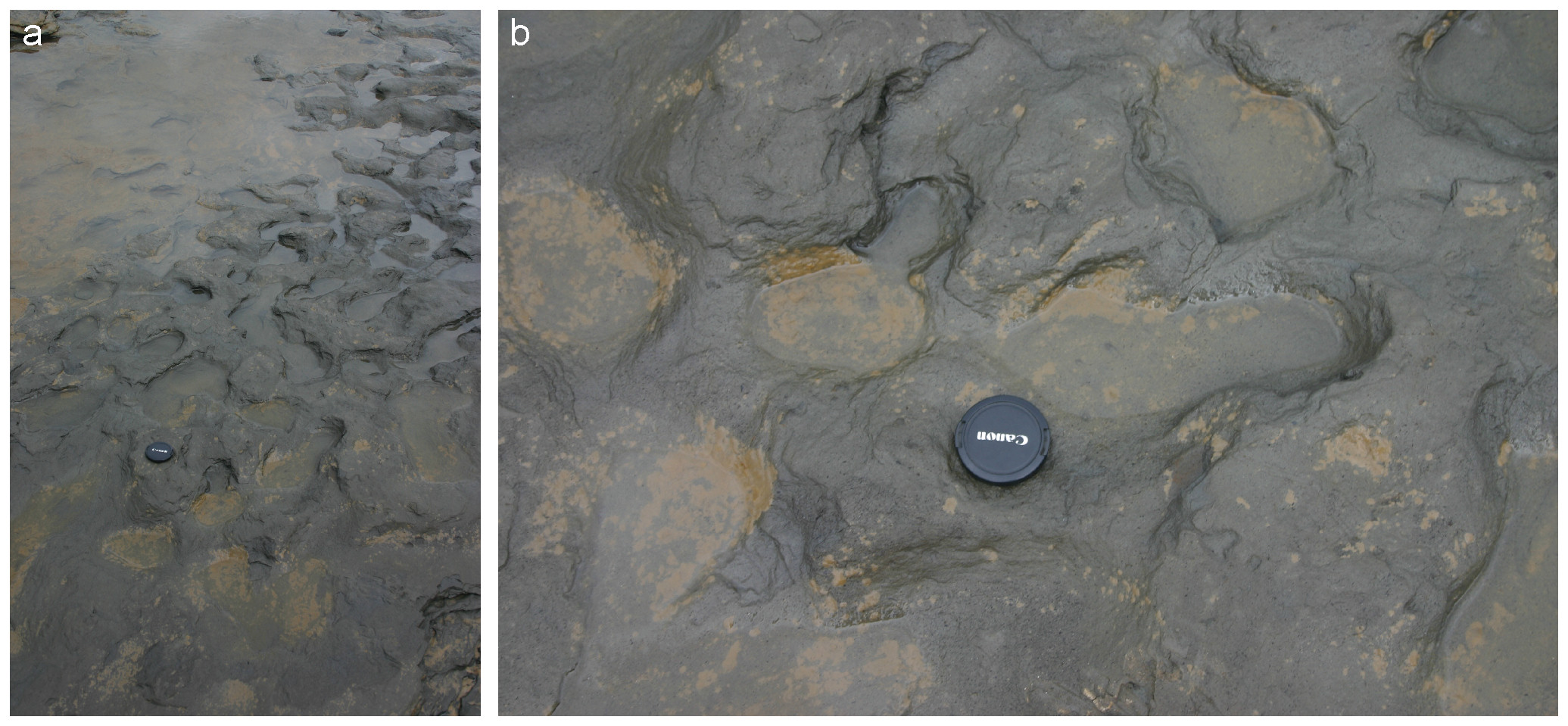
Twenty-one hominin footprints sit on one bedding plane at GaJi10, on the eastern shore of Kenya’s Lake Turkana. Kevin Hatala of Chatham University and the Max Planck Institute for Evolutionary Anthropology, with colleagues in the United States and Kenya, report them this week in the Proceedings of the National Academy of Sciences (volume 123, issue 31). They assign the prints to eight individuals who crossed the same muddy shore about 1.43 million years ago. The paper’s preferred call is Paranthropus boisei. The largest, they estimate, stood about 1.8 metres and weighed around 75 kilograms.
Bones accumulate. Footprints do not. The team treats the surface as one moment of what they call “fossil behavior”: company that skeletons almost never preserve.
Twenty-one prints, eight individuals, one shore
GaJi10 is in Area 103 of the Koobi Fora Formation, in the Okote Member. The track surface lies about 40 centimetres below a tuff correlated with the Akait Tuff, dated to about 1.43 million years. Kay Behrensmeyer of the Smithsonian and Léo Laporte first saw it in 1978, when a geological trench cut a hippo print in cross-section and the crew brushed out a pair of hominin tracks. The site was buried in sand. Excavations in 2016 and 2023 opened the same layer again.
The 2023 map records 21 hominin prints, 14 of them new since 1978–79. Two of the original 21 have since been lost to erosion; they survive in photographs and in a cast at the National Museums of Kenya. The authors provisionally assign the 21 prints to eight individuals. One trackway points east. The rest point west. They note it is possible the east-bound walker is also among the west-bound tracks, but they lack the evidence to say so.
The same surface holds 146 other animal tracks: 67 hippo, 64 bovid, 13 bird, and two equid. Hippo prints range from 15.5 to 42 centimetres wide, likely sampling both the large Hippopotamus gorgops and the smaller H. aethiopicus. The sediment was fresh, under a few centimetres of water, and then covered by fine sand. No desiccation cracks, no roots. A snapshot, not a cemetery.
The paper’s call is Paranthropus — size keeps a door open
Hatala’s group uses kinematic methods they published in 2024: relative arch volume against relative depth, and the abduction angle of the big toe. On those measures, the GaJi10 prints fall with East Turkana tracks previously attributed to P. boisei, and with the much older Laetoli prints usually given to Australopithecus afarensis. They sit outside the modern-human range: flatter arches, more abducted halluces. They do not match the more human-like East Turkana tracks given to Homo erectus.
Size is the snag. Assuming Australopithecus-like proportions, stature from the measurable GaJi10 individuals runs from 130.6 to 180.9 centimetres. Skeletal estimates for P. boisei published by Will and colleagues averaged 131.1 centimetres, with a published high of 161.3. Four of the trackmakers exceed that high. Body mass, on the same scaling, runs from 39.8 to 74.6 kilograms. Two individuals exceed the largest published skeletal mass for the species.
“The sizes of the footprints indicate human-like body sizes — up to 1.8 metres tall and around 75 kilograms,” Hatala said in the Max Planck / ScienceDaily briefing.
The paper does not treat species as settled. If the tracks are P. boisei, the species was larger and more variable than the bones had shown. If they are H. erectus, then that species’ foot anatomy and walking mechanics would vary far more than anything measured in living humans. “We believe the current balance of evidence favors attribution of the GaJi10 tracks to P. boisei,” the authors write; “we cannot exclude the possibility that the GaJi10 footprints were made by H. erectus.” A third possibility, they add, is an unknown species; they call that unlikely because every Okote Member hominin assigned to species so far is P. boisei or H. erectus.
That is the door New Scientist left open. This piece does not close it.
Mostly adult males is an inference, not a census
Press quotes have a way of hardening. Neil Roach of Harvard said the eight, “mostly adult male,” individuals “seemingly traveled together as a group, without females or children,” which “hints at a complex social structure.” The paper’s actual claim is narrower. If the prints are P. boisei, and if the skeletal record is an unbiased mix of sexes, then body sizes above the species mean are more likely adult males. Five of those large individuals were walking west, roughly perpendicular to the inferred north–south shoreline, from shallower toward deeper water. There is no overprinting among the preserved hominin tracks. That is mutual tolerance on one surface, perhaps the same group. It is not a headcount of a troop, and it is not proof that females and children were absent from the species.
Three measurable trackways give slow walking speeds, 0.32 to 0.50 metres per second. The authors do not think that pace is typical; other East Turkana sites with similar prints and similar mud show longer strides.
Purity Kiura of the National Museums of Kenya put the site on the Kenyan record: the prints “reinforce the region’s global importance in understanding human evolution” and “highlight our responsibility to protect this irreplaceable heritage.” Behrensmeyer, who has worked this lakeshore since 1969, notes the same kind of lake-margin deposits 40 kilometres apart at about the same age, and hundreds of hominin prints at more than half a dozen sites. Why hominins kept returning is a geological question as much as a behavioural one.
The object remains small. Twenty-one prints. Eight individuals. One muddy shore at GaJi10. The largest maybe 1.8 metres and 75 kilograms. Company bones almost never keep.